The Countercurrent Mechanism Increases Medullary Interstitial Osmolality with Minimal Energy Expenditure
The countercurrent mechanism is responsible for the amplification of the medullary hypertonicity initiated by the active reabsorption of solutes by the thick ascending limb of Henle’s loop and the medullary collecting duct.
This function is accomplished with minimal energy’ expenditure because of two characteristics: (I) the anatomical arrangement of the thin limbs of Henle’s loop and the vasa recta and (2) the differential water and salt permeabilities of the descending and ascending thin limbs.The thin limbs of Henle’s loop in Juxtamedullary nephrons extend deep into the inner medulla. The descending and ascending thin limbs are joined by a sharp, “hairpin” turn. Thus the descending and ascending thin limbs are parallel and juxtaposed, with the tubule Iluid flow in opposite directions. The vasa recta are arranged similarly. 'Γhis arrangement of parallel, adjacent conduits with opposite directions of flow enables energy-efficient conservation of solute in the region, similar to heat conservation mechanisms in the extremities of arctic animals (Figure 43-2) and in heat pumps used for home heating.
First, consider the contribution of the thin limbs of Henle’s loop to solute and water reabsorption (Figure 43-3). The descending thin limb originates from the straight portion of the proximal tubule and is aligned with the thick ascending limb of Henle’s loop. The tubule fluid entering the thin limb is essentially isosmolic to plasma. The surrounding interstitial fluid is hyperosmotic because of active Na' reabsorption by the water- impermeable thick ascending limb. Therefore a gradient for
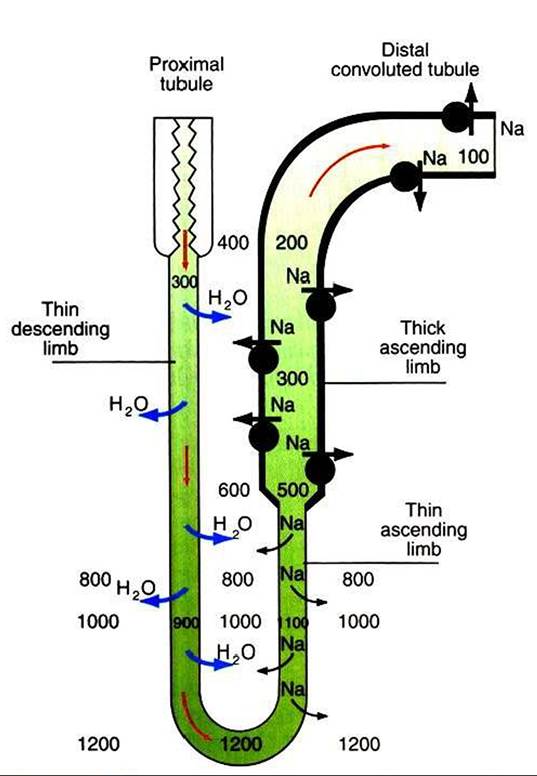
FIGURE 43-3 Roles of the thin limbs of Henle's loop and the distal nephron to the generation and maintenance of a medullary interstitial concentration gradient and a dilute tubule fluid.The osmolality of the tubule fluid is approximately 300 mθsm∕kg H2O when it leaves the proximal tubule and enters the environment of a progressively more concentrated medullary interstitium.
Because the thin descending limb is impermeable to sodium (Na) but is permeable to water (H2O), the gradient between the tubule fluid and the interstitial fluid is reduced by diffusion of water into the interstitium, thus raising the osmolality of the tubule fluid. After the hairpin turn deep in the inner medulla, the concentrated tubule fluid enters regions of lower interstitial osmolality as it flows through the ascending thin limb of Henle's loop. Because this segment is impermeable to water but is permeable to sodium, the gradient between the tubule fluid is minimized by movement of sodium into the interstitium from the tubule fluid.The differential permeabilities of the descending and ascending thin limbs and the countercurrent arrangement preserve the medullary interstitial concentration gradient.The thick ascending limb of Henle's loop is impermeable to water and actively transports sodium into the interstitium, thus diluting the tubule fluid and generating the medullary concentration gradient.The process of dilution of the tubule fluid is continued in the distal convoluted tubule so that the osmolality of the tubule fluid delivered to the collecting duct system is approximately 100 mθsm∕kg H2O, much less than that of plasma (295-300 mθsm∕kg H2O). water and solutes is established between the descending-thin- Iimb tubule fluid and the interstitial fluid. The descending thin limb contains aquaporin-1 water channels and is highly permeable to water. In addition, portions of the descending thin limb contain urea transporters that facilitate the movement of urea across the epithelium. However, the descending thin limb is not permeable to salt. Thus the tubule fluid equilibrates with the interstitial fluid by the movement of water into the interstitium and urea into the tubule lumen, and the tubule fluid osmolality rises.The osmolality of the medullary interstitial fluid is progressively higher in the deeper regions of the medulla.
As the water-permeable descending thin limb reaches regions of higher and higher interstitial osmolality, the tubule fluid continues to equilibrate by diffusion of water into the interstitium, and the tubule fluid osmolality progressively rises until it reaches its maximal concentration at the hairpin turn.At this point, the thin limb ascends through regions of progressively lower interstitial osmolality, and once again the tubule fluid equilibrates with the interstitial fluid. However, the ascending thin limb is impermeable to water and permeable to NaCl, so the equilibration occurs not by movement of water into the tubule fluid, but by diffusion of NaCI from the tubule fluid into the interstitial fluid. Thus the tubule fluid osmolality decreases and the interstitial osmolality increases. This process continues until the ascending thin limb merges with the thick ascending limb in the outer medulla. At the transition to the thick ascending limb, the tubule fluid osmolality is only moderately hypertonic.
At this point, what has been accomplished? By passive means, the thin limbs have reabsorbed both water and salt. The water was reabsorbed from the descending thin limb, and the salt was reabsorbed from the ascending thin limb. At the same time, the countercurrent flow in these two segments has helped to amplify the medullary hypertonicity.