Sound Waves Are Alternating Phases of Condensation and Rarefaction (Pressure Waves) of Molecules in the External Environment
Sound waves are longitudinal vibrations of molecules in the external environment characterized by alternating phases of condensation and rarefaction (increases and decreases in pressure).
These alternating changes in pressure produce the sensation of sound when they strike the tympanic membrane and are subsequently transduced into neural signals that ultimately reach cerebral cortex. Sound waves reaching the tympanic membrane can be expressed as changes in sound pressure as a function of time (Figure 17-1).In general, the subjective loudness of the sound is correlated with the amplitude of a sound wave; the subjective pitch is correlated with the frequency of the wave. The amplitude of a sound is usually quantified according to the logarithmic decibel scale, which expresses the energy of the sound relative to the energy of a standard reference sound. This standard sound, representing O decibels (dB), is the threshold for human hearing where the sound of the background movement of air molecules can almost be heard. Normal conversation is about 60 dB, and the loudest tolerable sound for humans is about 120 dB, about 1 million times the threshold amplitude. Sound frequency, the number of
A
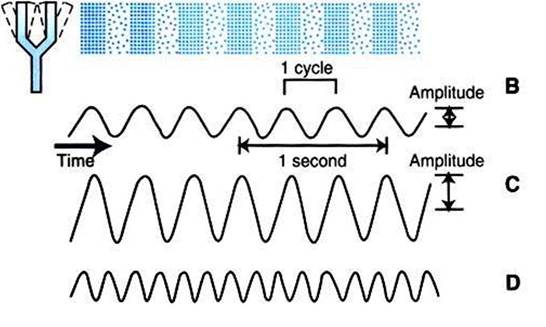
FIGURE 17-1 Characteristics of sound waves. A, Cyclical expansion and contraction of the tuning fork produce a cyclical compression and rarefaction of air molecules and a cyclical change in air pressure. B, Cyclical change in air pressure corresponding to a pure tone.The number of cycles per second is the frequency of the tone and is expressed in hertz (Hz). The frequency of the tone in B is 3 Hz. The amplitude of the wave reflects the magnitude of the pressure increase and is usually expressed in decibels (dB). C,Tone with a greater amplitude is perceived as louder than B. D,Tone with a greater frequency is perceived as having a higher pitch than B and C.
pressure oscillation cycles per unit time, is usually expressed in units called hertz (Hz), where 1 Hz = I cycle per second.