Temperature-Sensitive Receptors Are Located in the Central Nervous System, the Skin, and Some Internal Organs
To regulate body temperature, the animal needs a variety of temperature sensors at various locations within the body. These sensors relay information to the brain, which then initiates mechanisms either to increase or to decrease heat loss or production.
Numerous heat-sensitive neurons are located in the preoptic area of the hypothalamus. These neurons increase their firing rate in response to minor increases in local temperature. In addition, experimentally warming this area immediately initiates heat-losing mechanisms, such as peripheral vasodilation and sweating. These observations suggest that this region of the brain may be the main center for temperature regulation. Other hypothalamic and midbrain neurons decrease their firing in response to heat, and still others increase firing in response to cold. All these temperature-sensitive neurons are monitoring brain or core temperature.
When an animal is exposed to a change in temperature, considerable heat loss or heat gain can occur before a change in core temperature occurs. Therefore, it is advantageous to have temperature-sensitive neurons located in the skin so that environmental temperature changes are detected before they threaten core temperature. The most numerous temperaturesensitive neurons in the skin respond to cold. If these receptors are activated, the body can initiate mechanisms for heat conservation and heat production before the core temperature decreases. Skin cold receptors are particularly sensitive to the rate of decrease in temperature. For this reason, shivering can occur after exercise as the skin is rapidly cooled by sweat evaporation, despite that the core temperature may be normal or slightly elevated. Skin receptors sensitive to heat also exist and can initiate heat loss when the skin temperature rises.
Temperature-sensitive neurons are also present at various locations in the viscera. Drinking large volumes of cold fluids
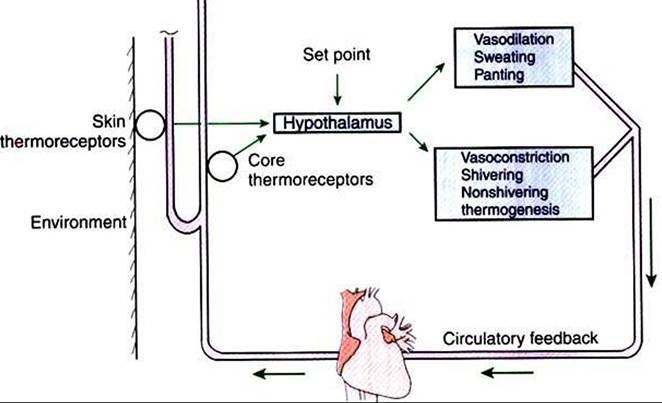
FIGURE 53-6 Feedback control mechanisms for the regulation of body temperature. Temperature receptors in the skin and the core relay information to the hypothalamus, which adjusts the responses either to conserve and produce or to lose heat. The results of these responses are relayed to the receptors through the circulatory feedback.
may stimulate cold receptors in the gastrointestinal system, initiating body heat-conserving mechanisms.