The Action Potential on the Sarcolemma Is Indirectly Coupled to the Contraction Mechanism Through the Release of Ca2+ from the Sarcoplasmic Reticulum
Whereas in the neuron a rise in cytoplasmic Ca2+ at the terminal is critical for initiating the process of transmitter release, a rise in Ca2' in the muscle cell sarcoplasm (cytoplasm of a muscle cell) is critical for initiating contraction.
At rest, Ca2, ions are pumped out of the sarcoplasm and stored in the sarcoplasmic reticulum using an energy-dependent pump. This leaves too low a concentration of Ca2* in the sarcoplasm to trigger contraction. However, as an action potential spreads along the muscle fiber surface and into the fibers core along the T tubules, the depolarization arrives at the junction between the tubules and the sarcoplasmic reticulum (Figure 6-4). The arrival of the action potential at this junction leads to the release of stored Ca2* ions from the sarcoplasmic reticulum. These Ca2‘ ions diffuse down their concentration gradient into the sarcoplasm, bathe the sarcomere, then trigger contraction. As the action potential passes, Ca2+ is pumped again into the sarcoplasmic reticulum, and relaxation results. This cycle of events is known as excitation-contraction coupling.The link between the action potential on the transverse tubule and Ca2* release from the sarcoplasmic reticulum is mediated by voltage-gated Ca2 ’ channels on the T tubule and Ca2‘-induced Ca2* release channels on the sarcoplasmic reticulum (see Figure 6-4). In skeletal muscle a mechanical coupling of these two types of channels is thought to exist; action potential opening of the voltage-gated Ca2+ channels of the
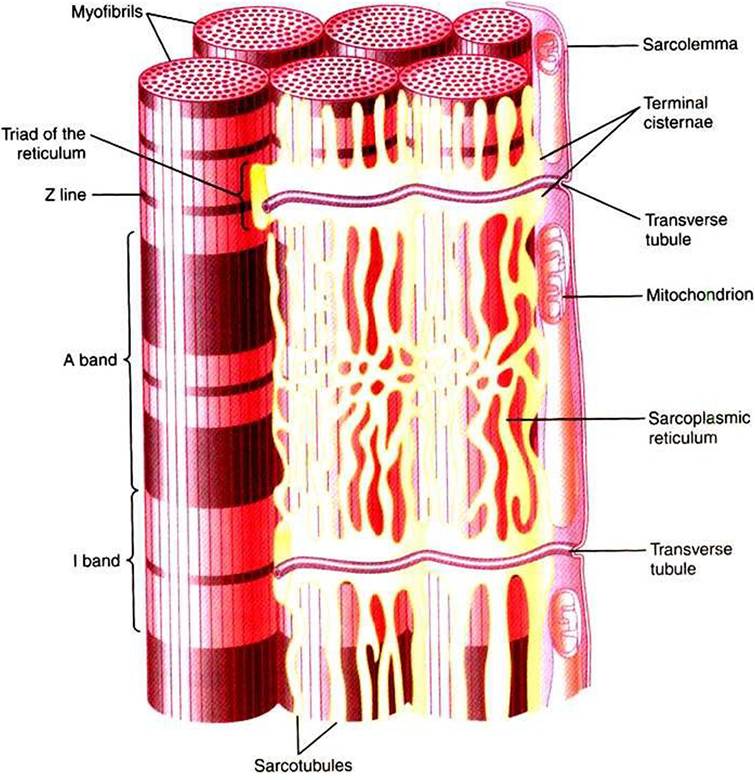
FIGURE 6-3 Diagram of skeletal muscle showing the juxtaposition of myofibrils, transverse (T) tubules, and sarcoplasmic reticula. (From Guyton AC, Hall JE: Textbook of medical physiology, ed 11, Philadelphia, 2006, Saunders.)
T tubule produces a direct configurational change in the Ca2*- induced Ca2+ release channels on the sarcoplasmic reticulum, allowing the stored Ca2i ions to escape from the sarcoplasmic reticulum into the sarcoplasm. The Ca2* sensitivity of the Ca2*-induced Ca2* release channels plays a more important role in excitation-contraction coupling in cardiac muscle than in skeletal muscle (see later discussion).