The Affinity of Hemoglobin for Oxygen Varies with Blood Temperature, pH, Carbon Dioxide Tension, and the Intracellular Concentration of Certain Organic Phosphates
An increase in tissue metabolism produces heat, which elevates blood temperature and shifts the oxyhemoglobin dissociation curve to the right (increases P50). Such a shift facilitates dissociation of oxygen from hemoglobin and releases oxygen to the tissues; hemoglobin is then said to have “less affinity” for oxygen.
Conversely, excessive cooling of the blood, as occurs in hypothermia, shifts the dissociation curve to the left. Because of this increased affinity ofhemoglobin for oxygen, tissue Po2 must be lower than usual to release oxygen from hemoglobin.Changes in carbon dioxide tension (Pco2) and pH also affect the affinity of hemoglobin for oxygen. The shift in the oxyhemoglobin dissociation curve resulting from a change in Pco2 is called the Bohrshift. This shift results in part from the combination of carbon dioxide with hemoglobin, but mostly from the production of hydrogen ions, which decrease the pH. A change in pH alters the oxygen binding by changing the structure of hemoglobin. As a result, a higher, more alkaline pH shifts the oxyhemoglobin dissociation curve to the left, and a lower, more acidic pH shifts the curve to the right (Figure 48-4). The Bohr effect is not constant among species; a given change in pH produces a greater shift in the dissociation curve for small mammals than for large mammals, supposedly ensuring the
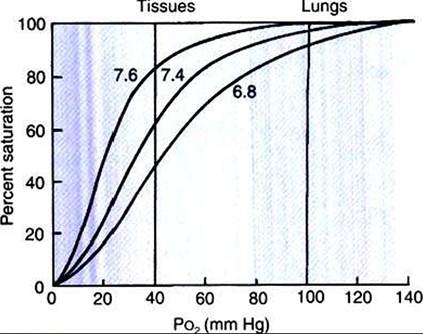
FIGURE 48-4 ■ Effect of pH on the oxyhemoglobin dissociation curve. A decrease in pH shifts the dissociation curve to the right and therefore assists in unloading oxygen at the tissues. The shift in the dissociation curve has much less effect on the percent saturation of hemoglobin when oxygen is being loaded into the blood in the lungs (i.e., Po2 = 100 mm Hg) than when oxygen is being unloaded in the tissues (i.e., Po2 = 40 mm Hg).
delivery of oxygen during high rates of metabolic activity, when carbon dioxide production is greatest.
A solution of mammalian hemoglobin generally has a lower affinity for oxygen than does whole blood until organic phosphates, such as 2,3-diphosphoglycerate (2,3-DPG) and adenosine triphosphate (ATP), are added to the solution. In erythrocytes, DPG has a molar content equivalent to that of hemoglobin, much higher than in other cells. This DPG regulates the combination of oxygen with hemoglobin. When concentrations of DPG are high, as occurs under the anaerobic conditions imposed by altitude or anemia, the oxyhemoglobin dissociation curve is shifted to the right (Pso increases), and the unloading of oxygen is facilitated. In contrast, a reduction in DPG levels, as can occur in stored blood, shifts the dissociation curve to the left. Not all forms of hemoglobin bind DPG equally. Ruminant hemoglobin in general is unresponsive to DPG; elephant hemoglobin binds DPG weakly; and some forms of fetal hemoglobin do not bind DPG.