The Oxyhemoglobin Dissociation Curve Can Be Displayed with Percent Saturation of Hemoglobin as a Function of Oxygen Tension
Percent saturation of hemoglobin is the ratio of oxygen content to oxygen capacity. Hemoglobin is more than 95% saturated with oxygen when it leaves the lungs of an animal at sea level.
Percent saturation of mixed venous blood averages 75%; venous oxygen tension (Pvo2) averages 40 mm Hg. Although all mammals have similarly shaped oxyhemoglobin dissociation curves, the position of the curve with regard to Po2 varies (Figure 48-3). This can be described by measurement of P50, the partial pressure at which hemoglobin is 50% saturated with oxygen. A higher P50 is generally found in small mammals and allows unloading of oxygen at a high Po2 to satisfy their higher metabolic demands.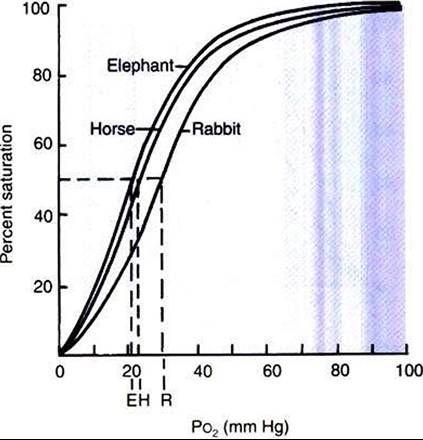
FIGURE 48-3 Oxyhemoglobin dissociation curve of three species of mammal. Percent saturation of hemoglobin is plotted as a function of oxygen tension (Po2)∙ Although the curves have similar shapes in all mammals, they are not superimposed.The differences between the curves can be expressed by the partial pressure (tension) at which hemoglobin is 50% saturated with oxygen (P50). P50 for each species is indicated as E (elephant), H (horse), and R (rabbit).
More on the topic The Oxyhemoglobin Dissociation Curve Can Be Displayed with Percent Saturation of Hemoglobin as a Function of Oxygen Tension:
-
Veterinarian -