The Caudal Part of the Foregut
A fusiform enlargement identifies the stomach at an early stage. The foregut between this enlargement and the pharynx becomes the esophagus, which is initially very short but elongates as the heart descends from the neck into the thorax.
The esophagus is involved in the origin of the lower respiratory tract (p. 156) but, apart from this, presents little of interest. At one stage, the proliferation of the endodermal lining obstructs the lumen, but the passage is later restored.The development of the stomach involves displacement, reorientation, and differential enlargement. The displacement carries it to a position ventral to the caudal thoracic segments. Reorientation appears to involve rotations about two axes. Rotation about the long axis of the stomach spindle carries the originally dorsal aspect to the left, where it is later distinguished as the greater curvature. The dorsal mesogastrium, which becomes the greater omentum, shares in the process. Rotation about a vertical axis swings the cranial (cardiac) extremity to the left and the caudal (pyloric) one to the right (Fig. 3.61). In most species the most conspicuous change in shape is an asymmetrical enlargement to the left of the cardia that produces the fundus; a much more radical reshaping is required in ruminants. In the human fetus the gastric glands are capable of secretion by midterm.
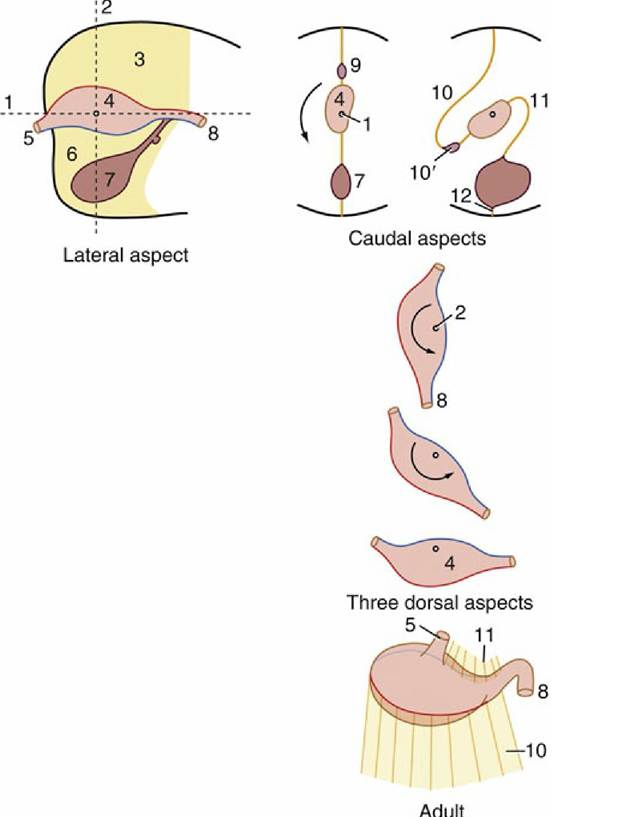
FIG. 3.61 The reorientation of the developing simple stomach. It rotates counterclockwise (as seen from behind) around a longitudinal axis (caudal aspects [1]) and continues counterclockwise (as seen from above) around a dorsoventral axis (three dorsal aspects [2]). 1, Longitudinal axis; 2, dorsoventral (vertical)
axis; 3, dorsal mesogastrium; 4, stomach primordium; 5, esophagus; 6, ventral mesogastrium; 7, developing liver; 8, duodenum; 9, developing spleen; 10, greater omentum; 10', omental bursa; 11, lesser omentum; 12, developing ligaments of the liver.
The short portion of foregut between the gastric spindle and the midgut forms the initial part of the duodenum, which terminates at the entrance of the bile and pancreatic ducts.