The Cell Cycle Is Stimulated by Growth Factors That Bind to and Activate Receptor Tyrosine Kinases
The growth factor/oncogene pathway begins with growth factors that function in a familiar way, as discussed in Chapter I: they bind to and activate an integral membrane protein receptor.
Indeed, growth factor receptors belong to the third family of receptors for environmental signals, the receptor tyrosine kinase family. This family of signal transducers has some similarities with the G-protein-coupled receptors (GPCRs), but also some important differences. Receptor tyrosine kinases (RTKs) do not require second messengers, but they do function through protein kinase activity (as many GPCRs do). The structure of RTKs is such that binding of ligand (a growth factor) by the extracellular portion of the receptor directly activates protein kinase activity by the cytoplasmic portion of the protein. The receptor itself is an enzyme (Figure 2-5). Thus the RTK itself carries the message across the plasma membrane, without the need for a second message. RTKs specifically add a phosphate group to a tyrosine residue of the substrate protein. This differs from the protein kinases discussed in Chapter 1 (A and C), which add the phosphate to serine or threonine residues. Phosphorylation of tyrosine residues within a protein is largely (but not exclusively) specialized to control cell growth pathways, and therefore tyrosine kinase activity generally is associated with stimulation of proliferation.The growth factors that hind to the RTKs are too diverse to be discussed at length in this chapter. Rathen one important similarity for introductory professional students is that these factors are all poorly named, so do not judge the factor by its name. Sometimes growth factors have “growth factor” in their name; some are referred to as “cytokines”; and some are called “colony-stimulating factors” (for growth of colonies in soft agar,as previously mentioned).
Furtherconfusion arises because their names always reflect their history but rarely their broader function. Thus, “epidermal growth factor” stimulates cell division in many more types of cells than only skin cells,but it was discovered using skin ceils. The other, more important similarity among growth factors is that whatever their name, as with the numerous ligands binding GPCRs and nuclear receptors, they share a conserved basic pathway and “strategy” for controlling the CDK engines of the cell cycle. Growth factor activation of RTKs stimulates a pathway involving a G-protein “on-off” molecular switch, the Ras protein introduced in Chapter 1, and uses a cascade of protein kinases, both tyrosine and serine-threonine, called the MAP kinase pathway. Ultimately, the MAP kinase pathway activates transcription factors, in turn controlling the expression of cyclins, and other direct regulators of CDKs (see Figure 2-5).
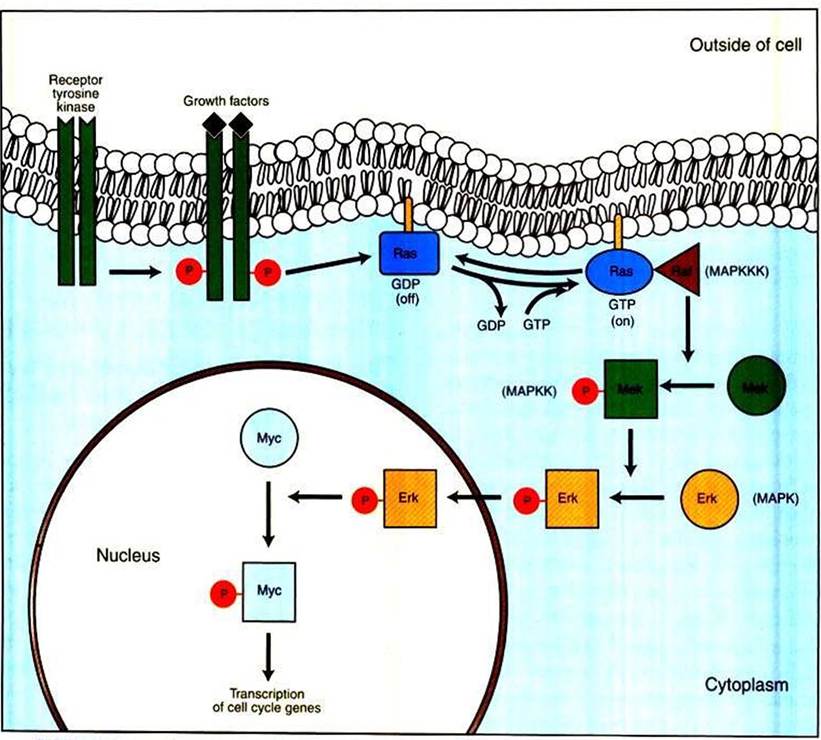
FIGURE 2-5 Growth factor/oncogene pathway.This diagram shows the normal stimulatory pathway by which growth factors lead to cell division. Growth factors bind to membrane receptors (receptor tyrosine kinases, RTKs) that are themselves protein kinases. As shown here, after activation by binding a growth factor, the first protein to be phosphorylated at tyrosine residues is the receptor protein itself. This in turn causes a "small G protein," Ras, to exchange GDP for GTP and thus be turned "on." The activated Ras then activates the first protein kinase in a conserved pathway of three kinases, called the MAP kinase pathway. For more detail on Ras and the MAP kinase pathway, see the text. Finally, this series of activating phosphorylations lead to the activation of transcription factors, such as Myc, in turn leading to the expression of genes directly involved in driving the cell cycle (e.g., expression of cyclin D). In this pathway, gain-of-function mutations of the RTKs, Ras, and Myc are particularly important in human cancers.