The Ras Oncogene Contributes to Many Cancers and Serves as a Model for Understanding "Small G Proteins"
After activation of the RTK, the next major step in the growth factor/oncogene pathway in normal cells is activation of the protein product of the rαs proto-oncogene. Investigations of how it worked revealed that the Ras protein was an important member of the “small G-protein family” of molecular regulators, all of which have intrinsic guanosinetriphosphatase (GTPase) activity and serve as molecular “on-off switches.” These proteins control many basic cellular functions, and the heterotrimeric G protein evolved from Ras-Iike ancestor proteins (see Chapter 1).
Indeed, in yeast it is Ras, not a heterotrimeric G protein, that controls adenyl cyclase and phospholipase C (see Figure 1-18). Figure 2-6 illustrates the duty cycle of this on-off switch and its basic similarity to the alpha subunit (Gα) of the heterotrimeric G proteins. Ras, other small G proteins, and Gα all are in the “on” state when they have guanosine triphosphate (GTP) bound to them (because of receptor activation). All are in the “off” state when the G protein hydrolyzes its GTP so that guanosine diphosphate (GDP) is now bound. You can see how this gene could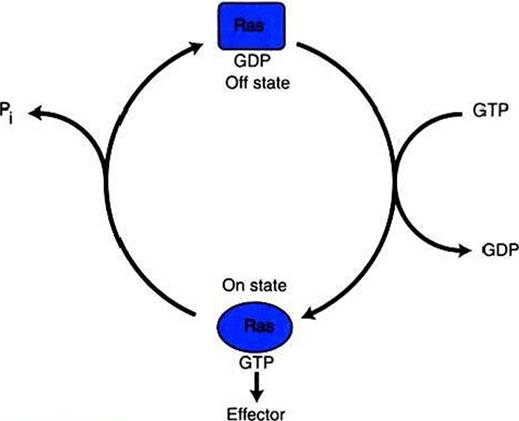
FIGURE 2-6 ■ Duty cycle of the Ras molecular "on-off switch." Ras serves as a model for the activity of "small G proteins," of which there are hundreds in the cell.The molecular mechanism of Ras is similar to the alpha subunit of the heterotrimeric G protein, discussed in Chapter 1 and which evolved from Ras-Iike proteins. As shown here, Ras is in the "off" state when bound to GDR Activation of RTKs leads to nucleotide exchange: GDP is lost and GTP is bound. In the GTP-bound form, Ras is in the "on" state and sends a stimulatory signal downstream, in this case to Raf in the MAP kinase pathway (see Figure 2-4).
Normally, Ras rapidly returns to the off state because an intrinisc GTPase activity of the Ras protein hydrolyzes the GTP to GDRThis nucleotide-dependent on-off cycle is characteristic of all normal small G proteins.be discovered as an oncogene, that is, a gene in which a gain- of-function mutation contributes to the development of cancer. If the GTPase activity is lost by mutation, this simple, enzymatic on-off switch remains trapped in the “on” position (the accelerator pedal is stuck). It continues to send an activating signal to the downstream cell cycle machinery without the presence of growth factors or the activation of RTKs. In fact, such mutations in Ras underlie its oncogenic function, and it is estimated that 30% of human cancers have activating mutations in their Ras gene.
Other small G proteins control a myriad of cellular functions, including others involved in cancer. Thus the Rho subfamily of small G proteins is directly involved in the spread of cancer because it helps regulate actin assembly and activity. As described later, the spread of cancer depends on the ability of cells to migrate through tissues. This “crawling” motility in turn depends on a musclelike mechanism based on actin and myosin (see Figure 1-4). Although the basic, on-off activity of Ras and Rho are the same as that shown in Figure 2-6, Rho is connected to actin, whereas active Ras activates the elements of the MAP kinase pathway