The Composition of a Gas Mixture Can Be Described by the Fractional Composition or Partial Pressure
Understanding gas exchange requires an understanding of the measurement of gas composition and the forces causing gas movement within the lungs, blood, and tissues. For convenience, physiologists use many abbreviations when describing gas exchange (Table 47-1).
Air contains 21% oxygen (the/rac- tion of oxygen in inspired air, FIo2, is 0.21). High in the Andes Mountains, the air still contains 21% oxygen, but mammals develop hypoxia at those altitudes. Clearly, therefore, it is not only the fraction of oxygen that is important for gas exchange; the hypoxia at high altitude is a result of the low barometric pressure. At this lower barometric pressure, the oxygen molecules are less densely packed, and therefore the partial pressure of oxygen (Po2) in the air is decreased. It is this partial pressure (also called tension) and, of more importance, the partial pressure difference, that is important in gas transfer.I he oxygen tension (Po2) of a dry gas mixture is determined by barometric pressure (PB) and Ihefraction of oxygen (Fo2) in the gas mixture, as follows:
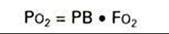
In the atmosphere, FIo2 is 0.21, so Po2 in dry air at sea level when PB = 760 mm Hg is approximately 160 mm Hg:

Po2 decreases at higher altitudes because barometric pressure decreases.
Common Abbreviations Used in Gas Exchange
| Abbreviation | Definition |
| AaDo2 | Alveolar-to-arterial oxygen tension difference |
| Flo2 | Fraction of oxygen in inspired air |
| Fo2 | Fraction of oxygen in the gas mixture |
| Paco2 | Arterial carbon dioxide tension |
| PAco2 | Alveolar carbon dioxide tension |
| Pao2 | Arterial oxygen tension |
| PAo2 | Alveolar oxygen tension |
| PB | Barometric pressure |
| Pcapco2 | Capillary carbon dioxide tension |
| Pcapo2 | Capillary oxygen tension |
| Pco2 | Carbon dioxide tension |
| PH2O | Partial pressure of water vapor |
| Plo2 | Inspired oxygen tension |
| Po2 | Oxygen tension |
| Pvco2 | Carbon dioxide tension of venous blood |
| Pvo2 | Oxygen tension of venous blood |
| Q | Perfusion |
| R | Respiratory exchange ratio |
| V | Ventilation |
| VA | Amount of alveolar ventilation |
| Vco2 | Rate of carbon dioxide production |
| Vo2 | Rate of oxygen movement between alveolus and blood |
| V/Q | Ratio of alveolar ventilation to pulmonary capillary blood flow |
Table 47-1
During inhalation, air is warmed to body temperature and humidified in the larger air passages. The concentration of other gases is reduced by the presence of water vapor molecules; therefore, Po2 decreases.
The Po2 of humidified gas is calculated as follows:
where PH2O is the partial pressure of water vapor at body temperature. The PH2O is determined by the temperature and percentage saturation of the air with water. In a mammal with a body temperature of 38.2oC, PH2O in saturated air equals 50 mm Hg; therefore the Po2 of warmed, completely humidified gas in the conducting airways is approximately 149 mm Hg:
