Alveolar Gas Composition Is Determined by AlveoIarVentiIation and the Exchange of Oxygen and Carbon Dioxide
Because there is only a negligible amount of carbon dioxide in the inspired air, PAco2 is determined by the rate of carbon dioxide production (Vco2) in relation to the amount of alveolar ventilation (Va):

where K = PB - PH2O.
It is obvious from this equation that if Vco2 increases, as occurs during exercise, Va must also increase if PACo2 is to remain constant. If Va does not increase sufficiently, PAco2 rises. Similarly, if Veo2 remains constant and VA halves, PAco2 doubles.
Po2 is lower in the alveolus than in inspired air because oxygen and carbon dioxide exchange occurs continually. During breathing, alveolar oxygen tension (PAo2) fluctuates
4. Lung resisting inflation
(e.g., airway obstruction, decreased lung compliance)
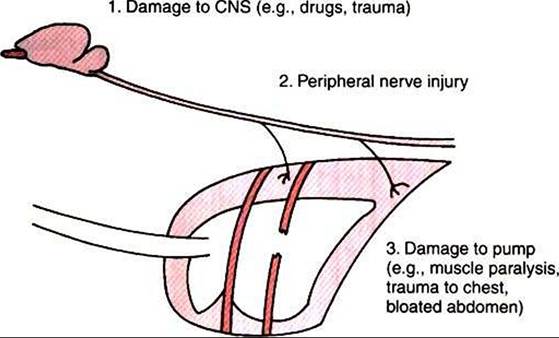
FIGURE 47-1 Diagrammatic representation of the brain, peripheral nerves, thorax, airways, and lung to show the causes of alveolar hypoventilation. CNSf Central nervous system.
around an average value, increasing during inhalation and decreasing during exhalation. The average oxygen tension in the alveoli of the lung can be calculated from the alveolar gas equation, a simplified version of which follows:

where R, the respiratory exchange ratio, is the ratio of the rate of carbon dioxide production to that of oxygen consumption. The respiratory exchange ratio is determined by the substrates being metabolized by the animal. This equation demonstrates that alveolar oxygen tension is determined by the inspired oxygen tension and the exchange of oxygen for carbon dioxide. Assuming an average R of 0.8 and an alveolar carbon dioxide tension (PAco2) of 40 mm Hg, PAo2 averages approximately 100 mm Hg at sea level, where PB is 760 mm Hg.
The alveolar gas equation also shows that whenever PAco2 increases, PAo2 decreases, and vice versa.Alveolar hypoventilation, a decrease in alveolar ventilation in relation to carbon dioxide production, elevates PAco2 and decreases PAo2. Figure 47-1 shows the causes of alveolar hypoventilation. It occurs when (1) the central nervous system is depressed by drugs or injury, (2) there is damage to the peripheral nerves, (3) there is damage to the thorax and respiratory muscles, (4) there is severe airway obstruction (e.g., in exercising horses with laryngeal hemiplegia) or (5) there is severe lung disease that decreases lung compliance.
The converse of alveolar hypoventilation, alveolar hyperventilation, causes a decrease in PAco2 because ventilation is increased in relation to carbon dioxide production. Therefore, according to the alveolar gas equation, as PAco2 decreases, PAo2 increases. Hyperventilation occurs when the need to ventilate is increased by stimuli such as hypoxia, increased production of hydrogen ions (Hf), or an increase in body temperature.
A modified form of the alveolar gas equation can be used to determine PAo2 for clinical purposes, as follows:

In this equation, arterial carbon dioxide tension (Paco2) is substituted for alveolar carbon dioxide tension (PAco2).