THE CUTANEOUS SENSE
As mentioned at the beginning of the chapter, much of the more immediate environment is experienced by the animal through its skin. The sensations are touch, pressure, pain, heat, and cold; touch is a light stimulus such as is produced by a fly on the haircoat, and pressure is a stronger and deeper stimulus such as a horse feels from a saddle or girth.
The receptors responsible for the detection of these stimuli vary considerably in structure. Unfortunately, because many intermediate forms exist, it is difficult to classify them and assign clear-cut functions to each kind. The simple classification given here is probably adequate for the purpose of this book.The sensory receptors of the skin can be divided into free nerve endings and those that bear terminal corpuscles. The free nerve endings are tufts formed by the branches of nerve fibers that terminate either in fine points or in buttonlike swellings; they are found principally in the epidermis and are thought to be pain receptors (Figure 9—33/1). The corpuscular endings fall into three kinds: bulbous, lamellar, and meniscoid. The bulbous corpuscles, which are encapsulated terminal tufts of nerve fibers found in the dermis, are thought to respond to heat or cold (Figure 9-33/2). The lamellar corpuscles are large (2-3 mm) and consist of many con-
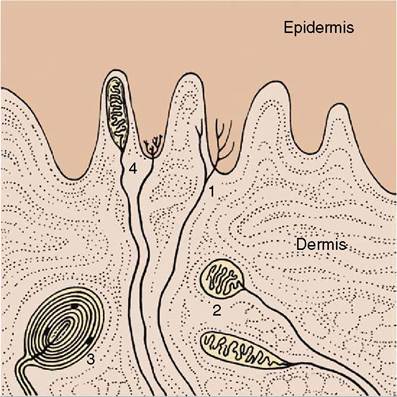
Figure 9-33 Sensory nerve endings of the skin, schematic. 1, Free nerve endings (pain); 2, bulbous corpuscles (heat or cold); 3, lamellar corpuscles (vibration); 4, meniscoid nerve endings (touch).
centric lamellae (flattened cells) in the center of which is the nerve fiber; they are found in the subcutis and are thought to be pressure receptors (Figure 9-33/3). Menis- coid corpuscles consist of small cup-shaped discs (menisci) at the ends of nerve fibers with which they contact “tactile” cells; they are found, usually encapsulated, both in the papillary layer of the dermis and free in the adjacent epidermis and are thought to be touch receptors (Figure 9-33/4).
A special sort of cutaneous sense is mediated by the tactile hairs. These are long, protrude from the head, and are substantially thicker than the hairs forming the haircoat. The cat’s whiskers are good examples, but all domestic mammals have them, principally about their muzzle and eyes. The walls of blood spaces (sinuses) surrounding the roots of these hairs contain numerous nerve endings. When the tips of the sinus hairs are touched, these nerve endings are stimulated and an impulse is sent to the central nervous system (see also p. 360).