The Distal Stomach Grinds and Sifts Food Entering the Small Intestine
The muscular activity of the distal stomach and pylorus (sphincterlike junction between stomach and duodenum) is completely different from that of the proximal stomach. In the distal stomach, known as the antrum, there is intense slow- wave activity, and muscular contractions are frequently present.
Strong waves of peristalsis begin at about the middle of the stomach and migrate, with the slow waves, toward the pylorus. As the waves of peristalsis near the pylorus, the pylorus constricts, blocking the gastric exit of all but the smallest particles (Figure 28-7). Particles leaving the stomach during the digestive phase of activity are less than 2 mm in diameter. Particles too large to pass the pylorus are crushed and ejected back into the antrum by the passing wave of peristalsis. Thus the peristaltic actions of the distal stomach walls serve not only to propel food but also, and perhaps more importantly, to grind and mix it.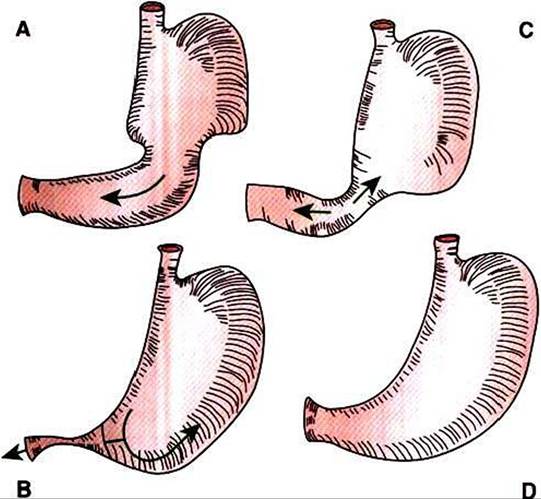
FIGURE 28-7 ■ Grinding and churning activity of the distal stomach. A, Wave of peristalsis begins at the junction of the proximal and distal areas of the stomach and moves toward the pylorus. Br As the peristaltic wave approaches the pylorus, the pylorus constricts, causing some of the ingesta to be crushed within the peristaltic ring and propelled back toward the proximal stomach. C, As the peristaltic wave reaches the pylorus, some finely ground and liquefied material passes through into the duodenum, but the majority of material has been propelled back into the stomach. D, Between contractions, no gross movement of gastric contents occurs. (From Johnson LR, editor: Gastrointestinal physiology, St Louis, 1985, Mosby.)