The Distal Tubule Segments Reabsorb Salts and Dilute the Tubule Fluid
The structure of the tubule epithelium changes abruptly and dramatically at the end of the proximal tubule. The proximal tubule, with its abundant mitochondria, luxuriant brush border, and pronounced basolateral plasma membrane infoldings, is suited for high-volume transport of a large variety of substances by both active and passive mechanisms.
The segments that follow the proximal tubule each have a unique structure, reflecting their specialized functions. Immediately downstream from the straight portion of the proximal tubule is the thin limb of Henle’s loop, which is a low epithelium with few mitochondria and few membranous infoldings (Figure 42-9). As might be expected, physiological studies suggest that active transport of solutes in this segment is virtually nonexistent. The function of the thin limb is determined by its passive permeability properties and its spatial orientation in the medulla. These characteristics are essential to its role in water reabsorption, as discussed in Chapter 43.In the ascending limb of Henle's loop, the low epithelium of the thin ascending limb abruptly changes to the relatively tall epithelium of the thick ascending limb. The thick ascending limb has many mitochondria and basolateral plasma membrane infoldings, reflecting its high capacity for active solute
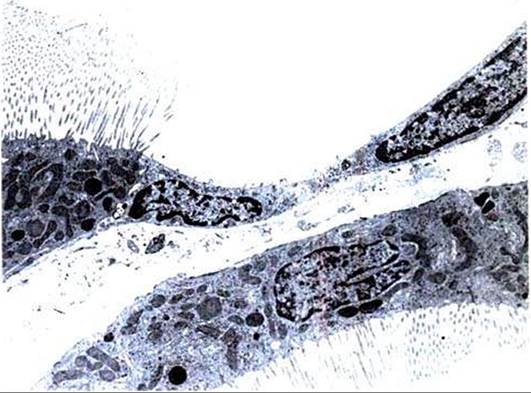
FIGURE 42-9 Transmission electron micrograph of rat kidney illustrating the transition from the proximal tubule to the thin descending limb of Henle's loop.The tall epithelium of the proximal tubule with the extensive brush border and abundant mitochondria abruptly changes to the low epithelium of the thin limb of Henle's loop. Epithelial cells of the thin limb have a smooth, simple plasma membrane surface and few mitochondria, which is consistent with the absence of active transport functions.
(Magnification ?5900.)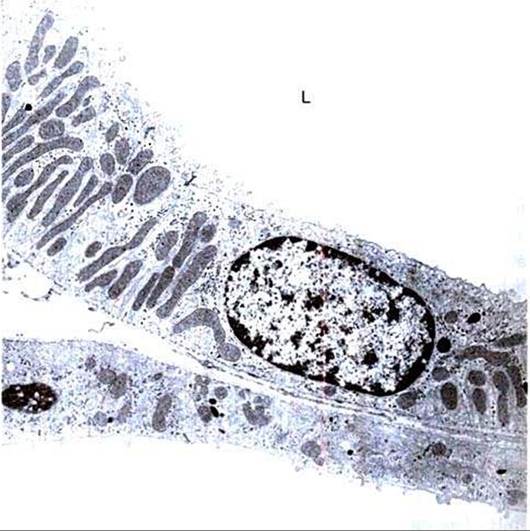
FIGURE 42-10 Transmission electron micrograph of thick ascending limb of Henle's loop in the rat. In accordance with its important role in active Na* reabsorption, the thick ascending limb is a tall epithelium, with extensive basolateral plasma membrane infoldings and numerous mitochondria. A collecting duct is adjacent to the basolateral aspect of the thick limb. L, Tubule lumen. (Magnification ?5600.)
transport (Figure 42-10). The distal convoluted tubule follows with an even taller epithelium and a dense array of mitochondria. Next is the connecting segment, a heterogeneous segment that connects the nephrons to the collecting duct system.
The distal tubule segments, which include the thick ascending limb of Henle’s loop and the distal convoluted tubule, reabsorb Na4, K+, CΓ, and the divalent cations Ca24 and Mg2∖ These segments reabsorb solutes against a high gradient. By the time the tubule fluid leaves the distal convoluted tubule, more than 90% of the filtered salts have been reabsorbed, and the osmolality of the tubule fluid is typically reduced from approximately 300 to 100 mθsm∕kg H2O.
As in the proximal tubule, salt reabsorption in the distal tubule segments is driven by the Na4jK4-ATPase pump in the basolateral plasma membrane. In the thick ascending limb of Henle’s loop, the basolateral Na',K4-AlPase pump actively transports Na4 from the cell into the interstitial fluid, creating an electrochemical gradient for Na' across the apical plasma membrane. This gradient drives ion transport through the Na+,K+,2CΓ co-transporter in the apical plasma membrane, and these ions enter the cell (Figure 42-11). The CΓ diffuses down its chemical gradient into the interstitial fluid through CΓ channels in the basolateral plasma membrane.
The K+ moves extracellularly down its concentration gradient through K+ channels across both the basolateral plasma membrane and the apical plasma membrane. The CΓ absorption and K+ secretion cause a lumen-positive voltage (electrical potential) relative to the interstitium, which creates a lumen-to-blood electrical gradient for cations that then diffuse into the interstitial fluid through the paracellular pathway. The apical Na+,K+,2CΓ co-transporter in the thick ascending limb is inhibited by the loop diuretics, such as bumetanide and furosemide, which are often used in clinical veterinary medicine.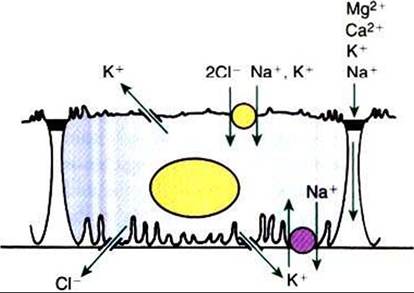
FIGURE 42-11 ■ Schematic illustration of transport functions of the thick ascending limb. Na* is actively reabsorbed through the basolateral Na*,K*-ATPase pump. Na+, K*, and Cl enter the cell from the luminal fluid through secondary active co-transport Cl diffuses down its concentration gradient across the basolateral plasma membrane through a Cl channel. K* leaves the cell through both an apical and a basolateral K* channel. A lumen-to- blood gradient for cations is present in this segment, which drives reabsorption of Na*, K*, Ca2*, and Mg2* through the cation-selective paracellular pathway.
The distal convoluted tubule contains a NaCl co-transporter, and the connecting segment contains a Na4 channel in the apical plasma membrane that permits transport of Na+ from the tubule fluid down the chemical gradient for Na+ generated by the basolateral Na',K'-ATPase pump. CΓ moves from the cell to the interstitial fluid through a basolateral CΓ channel, driven by the electrical gradient. The activity of the apical NaCl co-transporter is inhibited by thiazide diuretics.
Both the thick ascending limb and the distal convoluted tubule are impermeable to water. The avid reabsorption of salts without water results in a hypotonic tubule fluid, and thus these segments are sometimes called the diluting segments. Dilution of the tubule fluid takes place regardless of the volume status of the animal. Dilution of the tubule fluid in these segments is an important component of fluid volume regulation, allowing the kidney to excrete excess water without salt, thereby preventing water overload and plasma hypotonicity. The role of the thick ascending limb and the distal convoluted tubule in water balance is discussed further in Chapter 43.