The Efficiency of Gas Exchange at the Placenta Depends on the Species- Variable Arrangement of Fetal and Maternal Blood Vessels
The exchange of gases and other substances across the placenta is determined by several factors, including the amount of surface apposition between fetal and maternal tissues and the number of layers of cells separating fetal and maternal blood.
However, a major factor determining exchange is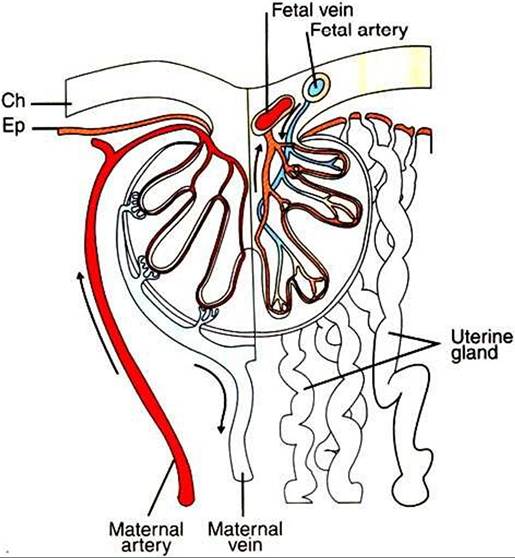
FIGURE 51-2 Diagram showing the arrangement of maternal and fetal blood vessels in the microcotyledons of the equine placenta. Arrows demonstrate the postulated countercurrent directions of maternal and fetal blood flow. Chl Chorioallantois; Ep, uterine epithelium. (Based on data inTsutsumiT: J Agriculture Hokkaide Imperial Univ 52:372, 1962; from Comline KS, Cross GS, Dawes GS, et al, editors: Foetal and neonatal physiology: proceedings of the Sir Joseph Barcroft Centenary Symposium, Cambridge, UK, 1973, Cambridge University Press.)
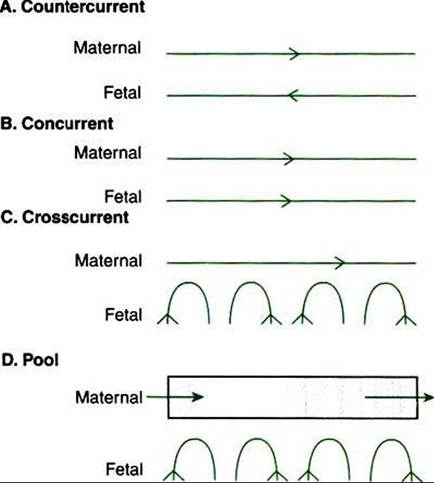
FIGURE 51-1 ■ Schematic representation of possible arrangements of fetal and maternal blood vessels. (From Dawes GS: Foetal and neonatal physiology, Chicago, 1968, Year Book Medical.)
the arrangement of fetal and maternal blood vessels within the small, interdigitating villi of the placenta (Figure 51-1). Countercurrent flow of maternal and fetal blood provides the most efficient exchange and allows equilibration of fetal and maternal arterial gas tensions. Concurrent flow of fetal and maternal blood allows fetal vessels to equilibrate with the maternal venous gas tensions. In crosscurrent and pool types of equilibrators, fetal capillaries loop down to maternal vessels or into a pool of maternal blood. No simple model easily describes these types of exchangers. It is likely that several different arrangements of vessels are found in the placentas of all species, but some seem to have more of the characteristics of countercurrent exchangers, and others have those of venous equilibrators.
Figure 51-2 shows the arrangement of vessels in the Ifiicrocotyledon of the horse, a species in which fetal and maternal blood flow is primarily countercurrent. The cotyledonary placenta of sheep functions as a venous equilibrator, whereas the hemochorial placenta of the rabbit seems to be a countercurrent exchanger.
Placental gas exchange has been best studied in the sheep (Figure 51-3). Maternal blood enters the uterus through the
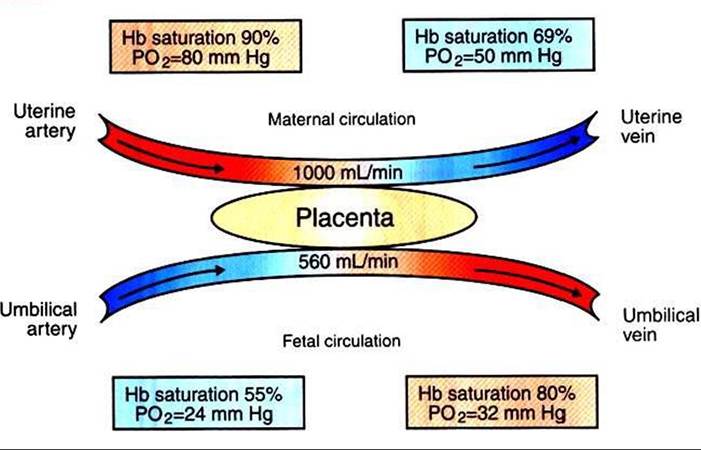
FIGURE 51-3 Placental blood flow, oxygen tension (Po2), and hemoglobin (Hb) saturation in the uterine and umbilical circulation of the sheep. (From Battaglia FC, Meschia G: An introduction to fetal physiology, Orlando, Fla, 1986, Academic Press.)
uterine artery with an oxygen tension (Po2) of 80 mm Hg and leaves through the uterine vein with a Po2 of 50 mm Hg. Some of the blood entering the uterus supplies the myometrium and endometrium, but most participates in gas exchange in the cotyledon. Fetal arterial blood reaches the placenta through the umbilical artery and enters the cotyledon with a Po2 of 24 mm Hg. Placental gas exchange occurs, and the blood leaving the placenta in the umbilical veins has a Po2 of only 32 mm Hg. This is because the sheep placenta is a venous equilibrator, so the maximal possible Po2 would be 50 mm Hg. However, this maximum is not reached because venous blood, which has provided nutrient blood flow to the chorion, dilutes the better-oxygenated blood draining from the cotyledon. The countercurrent exchanger of the horse is apparently more efficient because umbilical venous Po2 averages 48 mm Hg.
The amount of placenta available for exchange partly determines the ultimate size of the fetus. If uterine caruncles are surgically removed from sheep so that there are fewer sites for formation of fetal cotyledons, the full-term weight of lambs is reduced. The diffuse placenta of the horse apparently can support only one full-size fetus. One foal in a set of twins usually dies in utero or is very small. It is rare for horse twins to survive to term and be of equal size.