THE ESOPHAGUS
The esophagus (or gullet) conveys food from the pharynx to the stomach. This relatively narrow tube begins dorsal to the cricoid cartilage of the larynx and follows the trachea down the neck, at first inclining to the left but regaining a median position above the trachea before or shortly after entering the thorax (Figure 3-29).
Within the thorax it runs in the mediastinum (p. 158), and, continuing beyond the tracheal bifurcation, it passes over the heart before penetrating the esophageal hiatus of the diaphragm. It then makes its way over the dorsal border of the liver to join the stomach at the cardia. It thus consists of cervical, tho-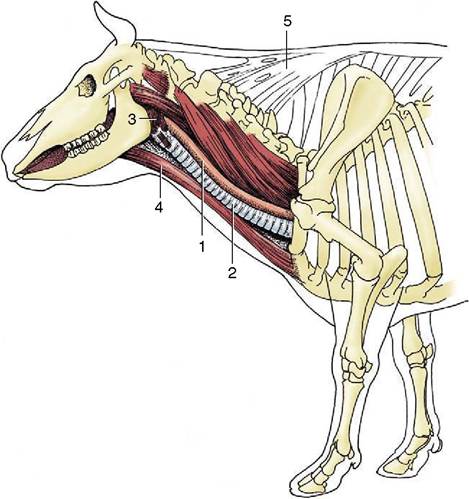
Figure 3-29 Lateral view of the bovine neck. In midneck the esophagus lies on the left dorsolateral aspect of the trachea. 1, Esophagus; 2, trachea; 3, pharyngeal musculature; 4, sternocephalicus muscle; 5, nuchal ligament.
racic, and abdominal portions, although the last is very short.
Only a few of the more important features of its topography are mentioned here. The cervical part runs within the visceral space of the neck, related to the subvertebral muscles dorsally and the left side of the trachea medioventrally (see Figure 3-29). For much of its length it is accompanied by the left common carotid artery and vagosympathetic and recurrent laryngeal nerves.
The thoracic part crosses to the right of the aortic arch, which may deflect it from its sagittal course; more caudally its dorsal and ventral borders are followed by the trunks into which the fibers of the right and left vagus nerves are regrouped.
The structure of the esophagus conforms to a pattern that is common to the remainder of the alimentary canal. The outer coat is a loose connective tissue (adventitia) in the neck, but this is largely replaced by serosa in the thorax and abdomen.
The muscle is striated at the origin of the esophagus, but in some species (e.g., cat, pig, and horse) the striated muscle is replaced by smooth muscle at some point within the thorax. It is usual to describe two muscle strata. Both are spiral, and they wind in opposite directions in the first part of the esophagus; closer to the stomach the outer coat becomes more longitudinal and the inner one more circular (Figure 3-30). The arrangement is quite complicated in detail and reveals considerable interlacing of muscle bundles that exchange between the two layers. Although morphological evidence for their existence is unconvincing, a number of sphincters are suggested by functional studies. They include a cranial sphincter, probably provided by fibers of the cricopharyngeus muscle, and possibly others within the thorax, where the passage of food tends to be delayed. A thickening suggestive of a sphincter occurs at the junction of the esophagus with the stomach, although the flow of food is more obviously impeded at a slightly more cranial level, immediately in front of the diaphragm. However, no anatomical evidence exists for a prediaphragmatic sphincter.The inner part of the wall is divided between submucosa and mucosa by a fenestrated muscularis mucosae, usually more prominent in the thoracic esophagus (Figure 3-31, B); it helps throw the lining of the empty organ into longitudinal folds. The surface epithelium is generally stratified squamous, and the degree of kerati- nization reflects the relative harshness of a species’ habitual diet. This is nicely illustrated when the esophageal epithelium of the dog (Figure 3-31, A) is compared with the thicker epithelium of the goat, which has a much rougher diet (Figure 3-31, B). Another striking difference between these species is provided by the many mucus-secreting tubuloacinar glands present in the submucosa of the canine esophagus. The boundary between
esophageal and gastric epithelia is sharp and may be displaced to either side of the cardia.
In humans, prolonged or repeated exposure to gastric juice (e.g., heartburn) may provoke transformation of the stratified epithelium of the lower esophagus into the columnar gastric variety.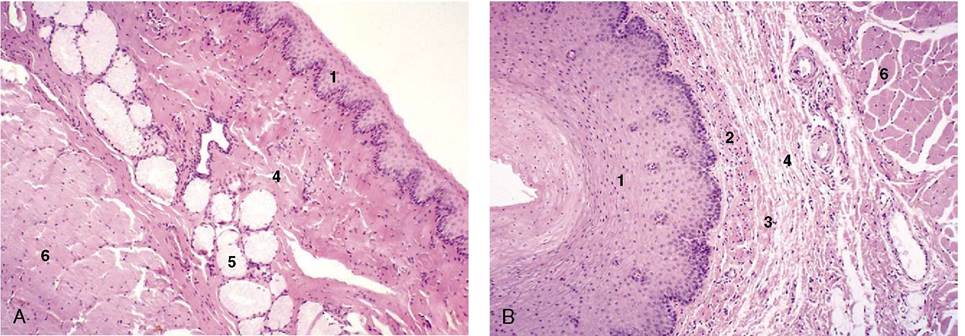
Figure 3-31 Esophagus, in the dog (A) and goat (B) (70?). 1, stratif. squam. epithelium; 2, lam. propria; 3, lam. muscularis mucosae; 4, submucosa; 5, mucus-secreting tubuloacinar glands; 6, muscularis interna.
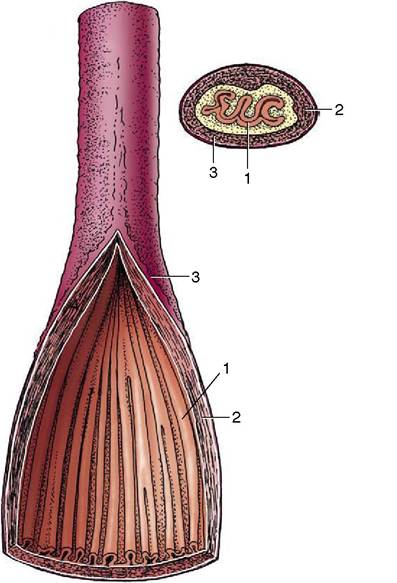
Figure 3-30 Semischematic drawing of the structure of the esophagus, sectioned longitudinally and transversely. 1, Mucosa; 2, muscular layer (longitudinal and circular); 3, adventitia.
The esophagus receives its innervation from the sympathetic and vagus nerves, including the recurrent laryngeal branches. The vagal supply is the more important. The striated muscle arises from the mesoderm of the pharyngeal arches and is under control of the general visceral motor neurons of the vagus, whereas the smooth muscle portions are under direct control of the intrinsic nervous system and indirect control of the autonomic nervous system. A myenteric plexus extends the length of the esophagus.
The blood supply from various local arteries presents no features of special interest.