THE ESTIMATION OF AGE FROM THE TEETH
Examination of the teeth provides the traditional and sole convenient means of estimating age. Because there is copious specialist literature, the subject is treated very briefly here (Table 18-1).
The eruption dates and changes in appearance of the occlusal surfaces, specifically those of the lower incisors, are the main criteria. Neither is wholly dependable but the first is more reliable, although limited in application to younger animals; the second may be used throughout the life span but becomes increasingly inaccurate.The initially oval occlusal surface of the incisors becomes rounded and finally forms a triangle elongated in the labiolingual direction. The enamel casing is intact when the tooth erupts, and the occlusal surface then presents a central depression (cup) that is soon stained by food debris. Wear first abrades the labial edge but quickly extends all around, isolating the infundibular from the external enamel; the tooth is then said to be level. Further wear reduces the depth of the cup, although its thick base (the enamel “spot”) resists attrition for a considerable time. The dental star appears on the labial aspect of the cup meanwhile and persists
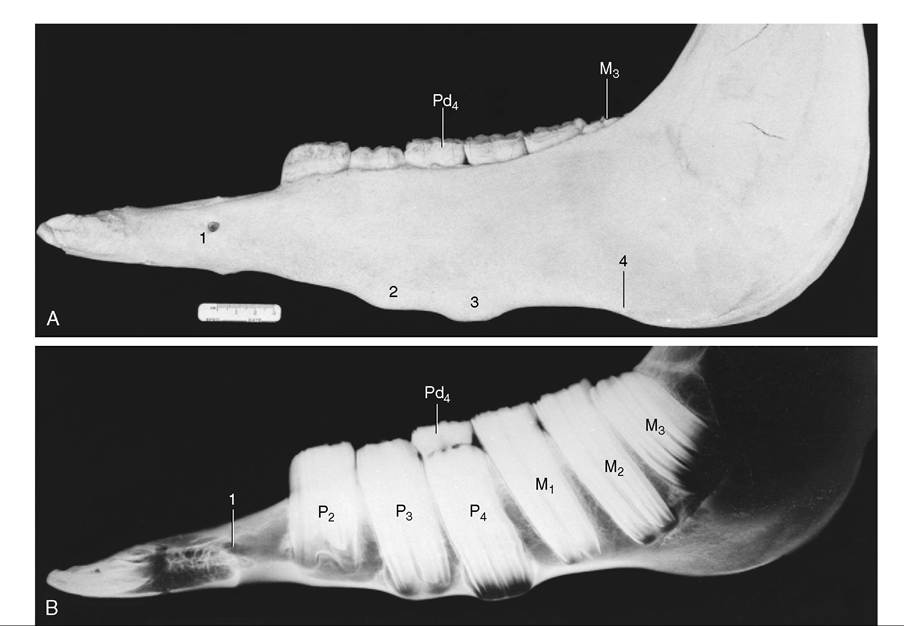
Figure 18-22 Photograph (A) and radiograph (B) of the left half-mandible of a horse 3 years old (estimated). Note the transitory tubercles on the ventral border and the wedged-in cap (Pd4) that retards the advance of P3 and P4. 1, Mental foramen; 2, 3, tubercles over the proximal ends of P3 and P4, respectively; 4, notch for facial artery and vein.
after the cup and the enamel spot have been entirely lost.
Less reliable criteria are a “hook” on I3 (see Table 18-1) and Galvayne’s groove on the labial surface of the same tooth. The hook is present when the horse is about 7 years old; unfortunately it may recur at 11 years. The appearance, progression, and disappearance of Galvayne’s groove are also depicted in Table 18-1. Although unreliable by themselves, both features may enhance accuracy when combined with the appearance of the occlusal surfaces and the profile of the incisors (Figure 18-24 and Figure 18-25).
It has to be emphasized that the variation in these (and in other undescribed) features is extremely large, and in a horse more than 8 years old the assessment may be at fault by several years.