The Gastric Glands Secrete Hydrochloric Acid
When the gastric glands are stimulated maximally, the HCl solution secreted into the lumen is isotonic and has a pH of less than 1. Both the hydrogen (H4) and the chloride (CΓ) ions are secreted by the parietal cells but apparently by different cellular mechanisms.
Ht is secreted through an H+,K+-ATPase (adenosine triphosphatase) enzyme located on the luminal surface of the cell. This enzyme, sometimes referred to as a “proton pump,” exchanges H+ for potassium ions (K+), pumping one K+ into the cell for each H* secreted into the lumen. In the exchange process, one molecule of adenosine triphosphate (ATP) is hydrolyzed to adenosine diphosphate (ADP), representing an expenditure of energy. The K+ cations that accumulate within the cells are released back into the lumen in combination with CΓ anions. This allows the recycling of K1 ions as they are pumped back into the cells in exchange for H4, resulting in the net secretion of H+ and CΓ, with little net movement of K+.Hydrogen ions for secretion come from the dissociation of intracellular carbonic acid (H2CO3), leaving a bicarbonate
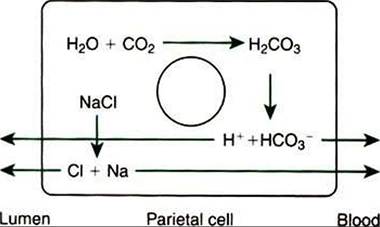
FIGURE 29-4 Electrolyte movements during gastric acid secretion.The production of hydrogen and bicarbonate ions from water and carbon dioxide is stimulated by the action of the enzyme carbonic anhydrase, the activity of which is high in the gastric mucosa.
ion (HCO3^) in the cell for each H, secreted into the lumen (Figure 29-4). Carbonic acid originates from water and carbon dioxide through the action of carbonic anhydrase, an enzyme found in high concentration in the gastric mucosa.
As hydrogen cations are secreted, bicarbonate anions accumulate in the cell. To counterbalance this accumulation, bicarbonate anions are exchanged for chloride anions at the cells nonluminal surface. In this manner, additional chloride is made available to the cell for secretion into the glandular lumen, and bicarbonate is secreted into the blood. During periods of intense secretion by the gastric glands, large amounts Ofbicarbonate are released into the blood. This transient and mild alkalization of the blood during digestion is known as the “alkaline tide.” Normally, the alkaline tide is reversed when bicarbonate in the blood is consumed indirectly during the neutralization of gastric secretions as they enter the intestine (see the section on pancreatic secretions later in this chapter). Thus, on a total-body basis, gastric acid production results in only small and transient changes in blood pH. In disease states, however, in which the secretions of the stomach are prevented from entering the intestine or are lost from the body because of vomiting, the pH of the blood can rise to dangerously high values.