The Gastric Mucosa Contains Many Different Cell Types
The glandular mucosa of the stomach has frequent invaginations, or pores, known as gastric pits. The size of the pits is such that the pores leading into them can be seen with a handheld magnifying glass.
At the base of each pit is a narrowing, or isthmus, that continues into the opening of one or more gastric glands (Figure 29-3).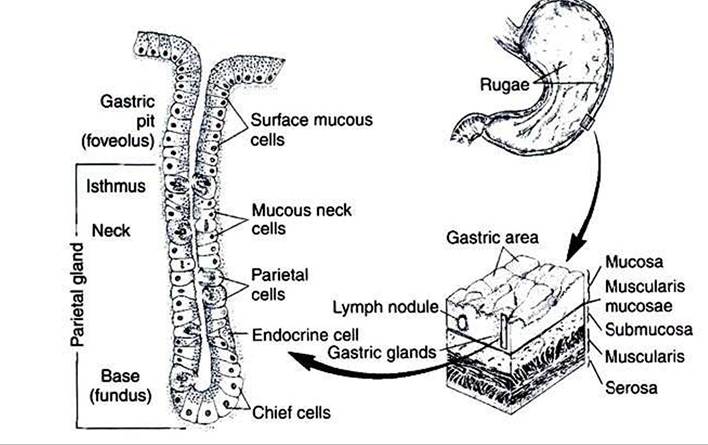
FIGURE 29-3 Anatomical illustration of glands of the stomach body. Other portions of the glandular stomach mucosa have similar structures but may differ somewhat in the cell types present in the glands. The gland openings are large enough to be seen with a hand-held magnifying glass.
The major surface areas of the stomach, as well as the lining of the pits, are covered with surface mucous cells. These cells produce thick, tenacious mucus that is a special characteristic of the stomach lining. The mucous cells and their associated secretion are important for protecting the stomach epithelium from the acid conditions and grinding activity present in the lumen. When the mucous cells are injured, stomach ulcers result.
Each region of the mucosa contains glands with characteristic cell types. Within the parietal area, the glands contain parietal cells. These cells are clustered in the neck, or proximal area, of the gland. Their function is to secrete hydrochloric acid (HCl). Distributed among the parietal cells in the neck of the gland is another type of cell, the mucous neck cells. These mucous cells secrete thin mucus, less viscous than that of the surface mucous cells. The mucous neck cells, in addition to their secretory function, appear to be the progenitor cells for the gastric mucosa. They are the only cells of the stomach lining capable of division. As they divide, they migrate either down into the glands or up into the pits and onto the surface epithelium. As they migrate, the mucous neck cells differentiate into any of the several types of mature cells of the gastric surface and glands. In the base of the gastric glands is yet a third type of cell, the chief cells. These cells secrete pepsinogen, the precursor to the digestive enzyme pepsin.
The glands of the cardiac and pyloric mucosal regions resemble those of the parietal area in structure but contain different cell types. The cardiac glands secrete only mucus. Their mucus is alkaline and probably serves to protect the adjacent esophageal mucosa from the acid secretions of the stomach. The pyloric glands have no parietal cells but contain the gastrin-producing G cells. According to most reports, pyloric glands do secrete pepsinogen.