THE GLUTEAL MUSCLES
The superficial and deep fasciae of the croup and thigh continue the corresponding coverings of the loins. The deep fascia detaches various septa that find anchorage on the pelvic girdle and the caudal edge of the sacrosci- atic ligament after passing between certain muscles.
The most substantial of these separate the gluteus superficialis and biceps femoris, the biceps and semitendinosus, and the semitendinosus and semimembranosus, thus molding the muscles so that their individual contours are often clearly visible through the skin; this is especially so in animals in “hard” training and when the muscles are contracted. The inner surface of this fascia itself, including the sides of the septa, gives origin to many fascicles of the muscles it covers.The tensor fasciae latae (Figure 24-2/5) radiates from its origin on the coxal tuber to end by a broad aponeurosis (fascia lata) that inserts on the patella, the lateral patellar ligament, and the cranial border of the tibia. The cranial border of the fleshy part is related to the subiliac lymph nodes. The tensor is a flexor of the hip that helps to advance the limb during the swing phase of the stride. It is supplied by the cranial gluteal nerve.
The gluteus superficialis lies between the tensor and biceps (Figure 24-2/4). It has separate origins from the coxal tuber and the gluteal fascia, but the two parts combine at a common insertion on the third trochanter. Occasionally, this projection is broken off, and it is then displaced dorsally by the attaching muscle. The gluteus superficialis is potentially a flexor of the hip and abductor of the thigh. Its two parts are separately supplied by the cranial and caudal gluteal nerves.
The gluteus medius is a muscle of exceptional size and power (24-2, B/2'). Its wide origin spreads from a depression scooped in the surface of the longissimus dorsi, over the coxal tuber and iliac wing, to the sacrum and adjacent part of the sacrosciatic ligament. The principal insertion is to the caudal part of the greater trochanter, but a deep division—gluteus accessorius— has a separate aponeurotic attachment to the intertrochanteric line of the femur.
This aponeurosis passes over the cranial part of the trochanter, where its passage is eased by the interposition of a synovial (trochanteric) bursa. This bursa may become inflamed, which is a condition detectable by the animal’s flinching when pressure is exerted over it. Horses so afflicted obtain relief by standing with the affected limb somewhat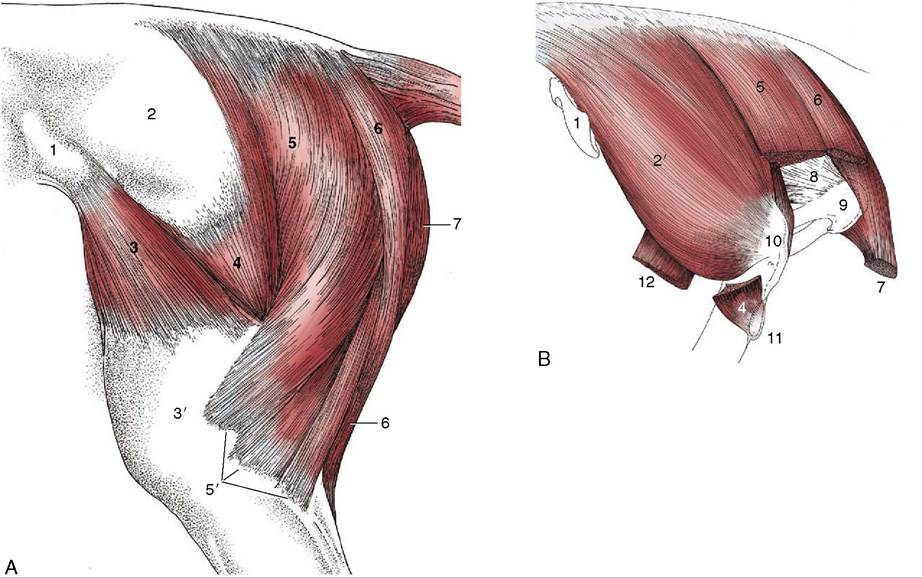
Figure 24-2 A, Muscles of the croup and thigh, lateral view. B, Croup muscles, resected to expose the ischial tuber, lateral view. 1, Coxal tuber; 2, deep gluteal fascia; 2', gluteus medius; 3, tensor fasciae latae; 3', fascia lata; 4, gluteus superficialis; 5, vertebral head of biceps; 5', the three distal divisions of the biceps; 6, semitendinosus; 7, semimembranosus; 8, sacrosciatic ligament; 9, ischial tuber; 10, caudal part of greater trochanter; 11, third trochanter; 12, stump of rectus femoris.
abducted; when they move, they tend to adopt an oblique doglike gait, swinging the limb in an arc.
This muscle is primarily an extensor of the hip, but it has a secondary use as an abductor of the thigh. Its association with the longissimus dorsi makes it an effective participant in rearing. It is supplied by the cranial gluteal nerve.
The gluteus profundus lies deep to the caudal part of the gluteus medius. It arises from and around the ischial spine and passes more or less transversely to insert on the cranial part of the greater trochanter. An abductor of the thigh, it is supplied by the cranial gluteal nerve.