The Heart
The avian heart is four chambered and broadly similar to that of mammals. It is, however, relatively much larger, and its rate of contraction is much faster—up to 1000 times per minute in certain small birds! It is conical, with the apex formed solely by the left ventricle.
The heart lies within the thorax both between and in front of the lobes of the liver (Fig. 37.16/8). It is attached to the sternum by the fibrous pericardium.The right atrium receives paired cranial venae cavae and a single caudal vena cava. The right atrioventricular valve is formed by a single muscular flap without chordae tendineae. The thinwalled right ventricle lays itself around the left ventricle so that its lumen on cross section is shaped like a crescent. The pulmonary veins combine to form a single trunk before entering the left atrium at an entrance provided with a valve capable of preventing reflux. The left atrioventricular valve has three cusps attached to chordae tendineae. The thick-walled left ventricle (Fig. 37.27/5) is conical. Internally, muscular bars give the cross section a rosette-like form. Cardiac puncture, performed for blood sampling, is dangerous in small birds.
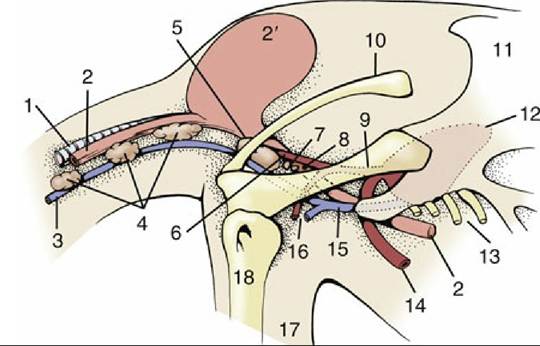
FIG. 37.37 Junction of neck and trunk as viewed from the right (semi-schematic). Cranial is to the left. 1, Trachea; 2, esophagus; 2', crop; 3, right jugular vein; 4, thymus; 5, thyroid gland; 6, right common carotid artery; 7, parathyroid glands; 8, ultimobranchial gland; 9, right brachiocephalic artery; 10, clavicle; 11, sternum; 12, position of heart; 13, sternal ribs; 14, descending aorta; 15, right cranial vena cava; 16, subclavian artery and vein; 17, wing; 18, humerus.