THE HOOFS
The hoofs of the principal digits curve toward each other at both ends, making contact behind and occasionally also at their apices (see Figure 30-11). The lateral hoof carries the greater share of weight and is larger than the medial one, although this is not always so in the hindfoot.
Each hoof consists of periople, wall, sole, and bulb. The ground surface is formed by the distal border of the wall, the sole, and the dorsal part of the bulb (Figure 30-11/1,3,4'); the parts visible in the standing animal are the wall to the sides and the bulb at the back of the hoof. The coronary border of the hoof is higher on the abaxial than on the axial side. The apical two thirds or so of the hoof are occupied by the distal phalanx and deep flexor tendon; the space behind is taken up by the digital cushion, the springy pad of fatty-fibrous tissue that also extends under the larger “half” of the bone (Figure 30-10∕tends to flake when allowed to build up (as in animals stood on fouled bedding), and the resulting fissures provide access to infection; resulting abscesses may destroy the dermis and deeper structures.The hoof capsule is molded on a dermis attached to underlying structures by a modified subcutis, best devel-
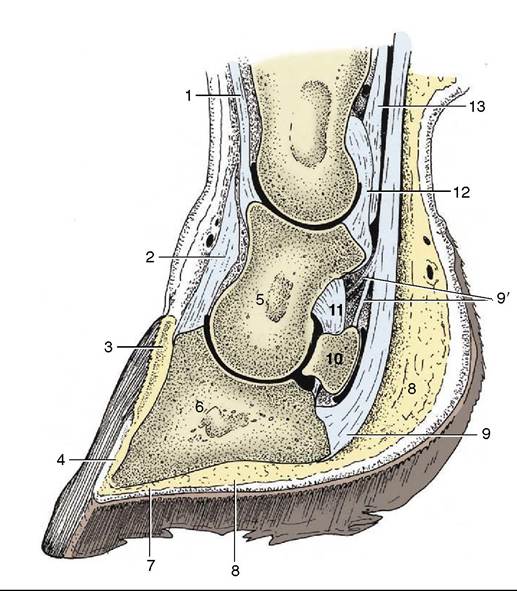
Figure 30-10 Sagittal section of the medial digit of the bovine forefoot. 1, Proper (medial) digital extensor; 2, common digital extensor; 3, coronary dermis; 4, laminar dermis; 5, middle phalanx; 6, distal phalanx; 7, sole dermis covered by sole; 8, digital cushion; 9, deep digital flexor; 9', fibers of deep digital flexor to the middle phalanx and navicular bone; 10, navicular bone; 11, collateral navicular ligament; 12, palmar ligaments of pastern joint; 13, superficial digital flexor.
oped where it forms the digital cushion.
The dermis presents segments that correspond to the parts of the hoof (Figure 30-12). The horn of the wall is produced over the coronary dermis (Figure 30-12/2) and slides distally over and between the dermal laminae, where horn just sufficient to maintain adhesion is produced.The horn of other parts of the hoof grows away from the dermis at a rate of about 5 mm per month; growth occurs a little faster in calves. In cattle allowed free range, wear at the ground surface equals growth, and at the toe the angle with the ground is maintained at about 50°. On soft surfaces, growth exceeds wear, and the hoofs must be trimmed periodically if the toe is not to grow forward at a lesser angle. When this occurs, the coffin joint is gradually overextended, the deep flexor tensed, and greater weight placed on the (caudal) part of the hoof over the insertion of the deep flexor and navicular bone. This causes pain and therefore lameness.
In late fetal life the distal parts of the hoof are covered with soft horn, which is said to prevent injury
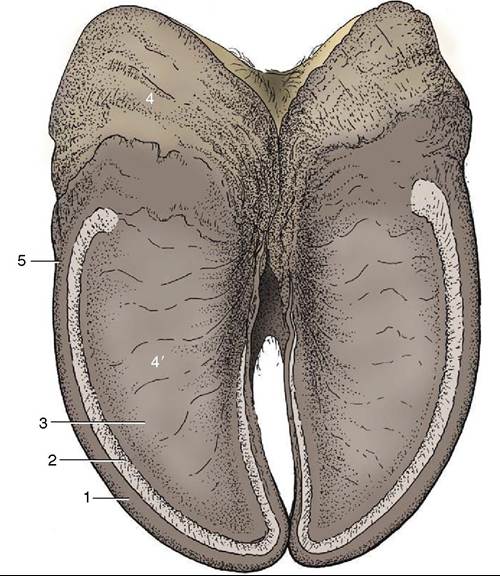
Figure 30-11 Ground surface of the hoofs of the bovine forefoot. 1, Wall; 2, white line; 3, sole; 4, bulb; 4’, dorsal part of bulb; 5, abaxial groove on the wall, dividing wall from bulb.
to the fetal membranes and the birth canal. This soft cushion soon dries when exposed to air.
The dewclaws, miniatures of the principal hoofs, consist mainly of wall and bulb; they have no practical importance.