The intestine* commences at the pylorus and continues to the anus.
It is divided between the proximal small intestine (intestinum tenue) and the distal large intestine (intestinum crassum), which are parts that do not always differ as much in caliber as their names suggest.
However, the boundary is made obvious by the outgrowth of a blind diverticulum, the cecum, at the origin of the large intestine (Fig. 3.40). The small intestine consists of three parts: an initial duodenum, which is short and rather closely fixed in position, and the jejunum and ileum, which are carried by the great mesentery. The large intestine also comprises three parts; recognition of the blind-ending cecum presents no problem, but the separation of colon from rectum is arbitrarily put at the pelvic inlet. The rectum joins the short anal canal that leads to the exterior, but this canal is not part of the intestine in the strict sense.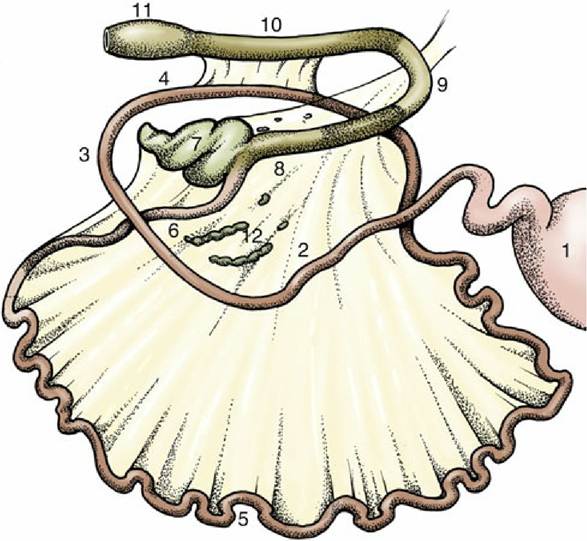
FIG. 3.40 Intestinal tract of the dog (schematic). 1, Stomach; 2, descending duodenum; 3, caudal flexure; 4, ascending duodenum; 5, jejunum; 6, ileum; 7, cecum; 8, ascending colon; 9, transverse colon; 10, descending colon; 11, rectal ampulla; 12, jejunal lymph nodes.
The length of the intestine may be given in absolute terms or, more usefully, in measures of body length, and neither figure may reflect the reality. The dog, in keeping with its diet, has a relatively short gut, which is perhaps some three or four times its body length in life. Intestinal length in herbivores varies with the nature of the gastrointestinal adaptation but may be as much as 25 times the body length in sheep.