» The Lymphatic Structures of the Abdomen
The numerous abdominal lymph nodes fall into three groups: those of the abdominal roof, those associated with the mesogastric viscera (supplied by the celiac artery), and those associated with the viscera supplied by the two mesenteric arteries (Fig.
34.17).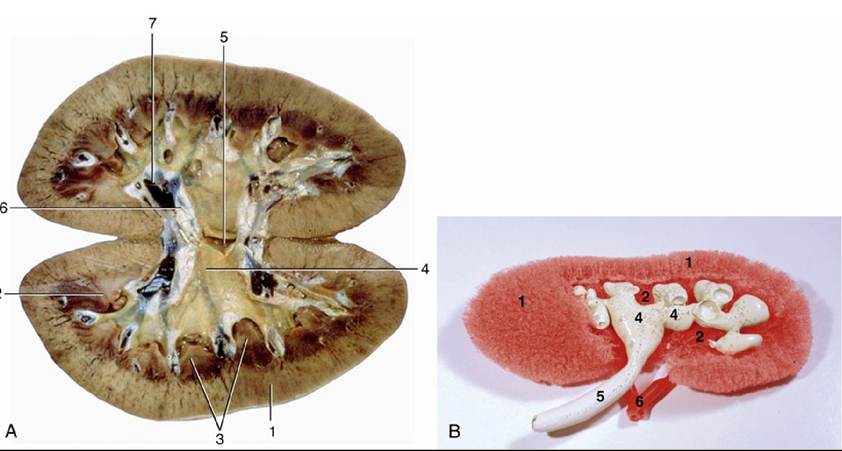
FIG. 34.16 Kidney sectioned through poles and hilus (A) and corrosion cast (B). 1, Cortex; 2, medulla; 3, papilla; 4, pelvis; 5, ureter; 6, renal artery; 7, renal vein.
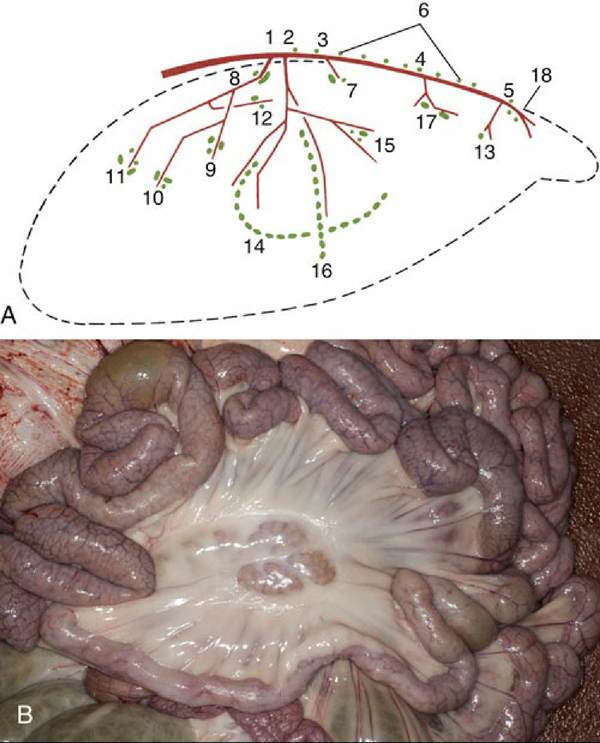
FIG. 34.17 (A) Schema of the major abdominal arteries and lymph nodes. 1, Celiac artery; 2, cranial mesenteric artery; 3, renal artery; 4, caudal mesenteric artery; 5, deep circumflex iliac artery; 6, lumbar aortic nodes; 7, renal nodes; 8, celiac nodes; 9, splenic nodes; 10, gastric nodes; 11, hepatic nodes; 12, pancreaticoduodenal nodes; 13, lateral iliac nodes; 14, jejunal nodes; 15, ileocolic nodes; 16, colic nodes;
17, caudal mesenteric nodes; 18, medial iliac nodes. (B) Part of the jejunum, showing the inclusion of jejunal lymph nodes in the mesentery.
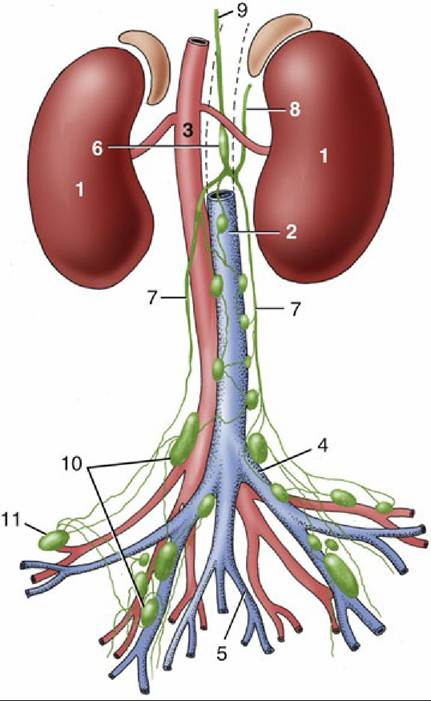
FIG. 34.18 The lymph nodes of the sublumbar area, ventral view. 1, Kidneys; 2, aorta; 3, caudal vena cava; 4, external iliac artery; 5, internal iliac artery; 6, cisterna chyli; 7, lumbar trunks and lumbar aortic nodes; 8, intestinal trunk; 9, thoracic duct; 10, medial iliac nodes; 11, lateral iliac node.
The first group includes aortic, renal, and iliac nodes whose disposition is illustrated in Fig. 34.18. The iliac assemblage receives lymph from structures of the hindlimb and pelvis and from part of the belly wall, including most mammary glands. Most nodes of this group drain lymph from structures of the back and forward it to the lumbar trunks or directly into the cisterna chyli.
The second group of nodes that are associated with the mesogastric viscera are mainly located close to where the arteries enter the individual organs; others, directly related to the celiac artery, provide an additional station on the drainage route, which ultimately joins the cisterna chyli. The celiac nodes also receive some lymph from caudal thoracic structures, including the caudal lobes of the lungs. The group that drains lymph from the small and large intestines includes a long chain in the mesentery of the jejunum, placed midway between its root and the gut, and a second set within the mesentery of the ascending colon; others are more randomly placed in relation to the remainder of the large intestine. All drain to the cisterna via an intestinal trunk. The nodes associated with the jejunum are of particular importance in meat inspection (Fig. 34.17B).
Comprehension Check
Create a flow chart of the blood supply to the abdominal viscera of the pig.