» The Mouth
Because cattle do not ingest large mouthfuls, the small size of the oral opening is no disadvantage to the animal. However, it is a considerable hindrance to clinical inspection of the mouth parts and pharynx.
The vestibule between the cheeks and the margin of the jaws is surprisingly roomy; the inner surface of the lips and cheeks bears large, backward-pointing papillae that are most prominent toward the corners of the mouth (Fig. 25.13/3).The mouth cavity proper is long and narrow and is largely occupied by the tongue. The hard palate is most constricted directly in front of the cheek teeth. It is sculpted to display a dozen or more transverse ridges that progressively decrease in prominence and at last fade out toward the back of the mouth; their crests carry numerous papillae (Fig. 25.14). The region occupied in other species by the upper incisor teeth here carries the paired dental pads; these are crescentic elevations that are pliant when compressed, though cornified on the surface (Fig. 25.14/2). Cattle do not graze by edge-to-edge biting but, after drawing a tuft into the mouth with the assistance of the tongue, their main organ for prehension, sever it by pressing the incisor blades against these pads. The highly mobile lips of the small ruminants are main organs for prehension and allow them close cropping of the pasture. The pads are protected from injury by their tough but pliant covering and by the procumbent arrangement and rather loose implantation of the incisors (Figs. 25.15 and 25.16). The incisive papilla behind the pads is flanked by the small openings of the incisive ducts.
In cattle the caudal part of the pointed tongue is raised to form a large torus that has a transverse lingual fossa on its rostral side. The delicate epithelium in the fossa may be pricked by sharp particles in the food and become a portal for infection (Fig. 25.17/5).
The papillae that give the surface of the tongue a characteristic roughness are concentrated over the dorsum and toward the apex. Harsh, caudally directed, filiform papillae are freely spread over the apex in the area rostral to the fossa, while the conical and lenticular papillae populate the torus (Fig. 25.17/4' and 4"); all of these have a purely mechanical function. As usual, the fungiform papillae scattered on and along the edges of the apex and the vallate papillae (8-12 in cattle, 18-24 in sheep, and 12-18 in the goat on each side of the tongue) (Fig. 25.17/3) present caudal to the torus perform the sensory function. Foliate papillae are usually absent in the ruminants. Although the mechanical nature and direction of the papillae make it easier for cattle to prehense and swallow food, it also makes it difficult for them to expel undesirable food items such as nails from their mouth. An accumulation of lymphoid tissue toward the root constitutes the diffuse lingual tonsil.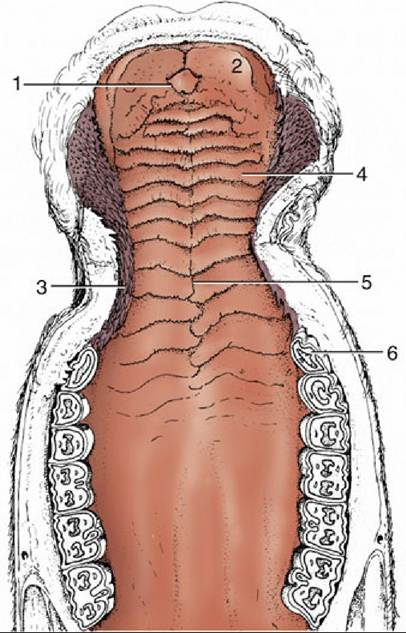
FIG. 25.14 The roof of the bovine oral cavity. 1, Incisive papilla; 2, dental pad; 3, buccal papillae; 4, palatine ridges; 5, palatine raphe; 6, first upper cheek tooth (P2).
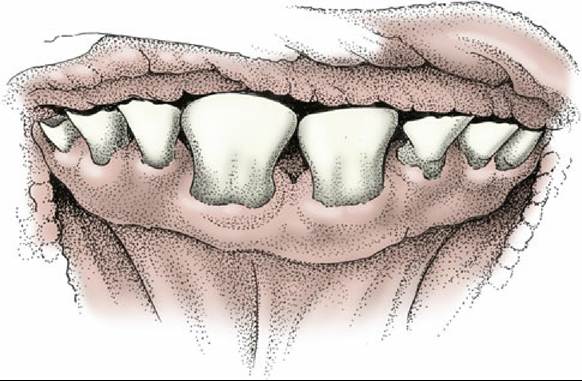
FIG. 25.15 Front view of the incisors of a 2-year-old cow. The central incisors are permanent, the others deciduous.
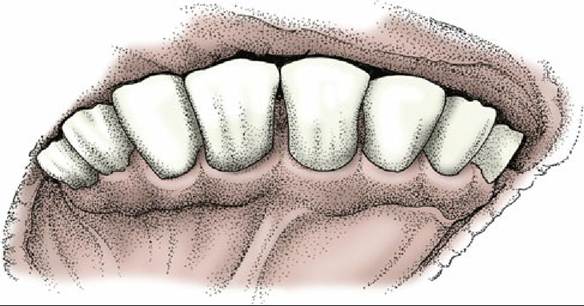
FIG. 25.16 Front view of the incisors of a 4½- to 5-year-old cow. The fourth incisors have reached the height of their neighbors and are coming into wear.
The oral floor below the apex of the tongue presents a fleshy sublingual caruncle to each side; the ducts of the mandibular and monostomatic sublingual glands open beside this (Fig. 25.13).