» The Dentition and Masticatory Apparatus
The most unusual features of the dentition are the absence of incisor and canine teeth in the upper jaw and the assimilation of the canines to the incisors in the lower one. Because both upper and lower first premolar teeth fail to develop, the dental formulae read
0-0-3
3-1-3
for the temporary set, and
0—0—3—3
3-1-3-3
for the permanent set.
It is customary to refer to the canine tooth as the fourth or corner incisor.The eight incisor teeth toward the front of the lower jaw are arranged in a continuous crescent that is opposed to the dental pads when the mouth is closed. Each tooth presents a wide spatulate crown abruptly joined to a narrow, peglike root. The crown is asymmetrical, and in young animals it overlaps the lingual aspect of its medial neighbor (Fig. 25.15). The convex labial and concave lingual surfaces initially meet at a ridge, but this becomes increasingly broadened and the dentine increasingly exposed with continuing use (Fig. 25.16 and see Fig. 25.19 D and E). The crowns are sometimes wholly eroded in old animals, and then only narrow but widely spaced roots remain in the margin of the jaw. Often the incisors are shed before this state is reached.
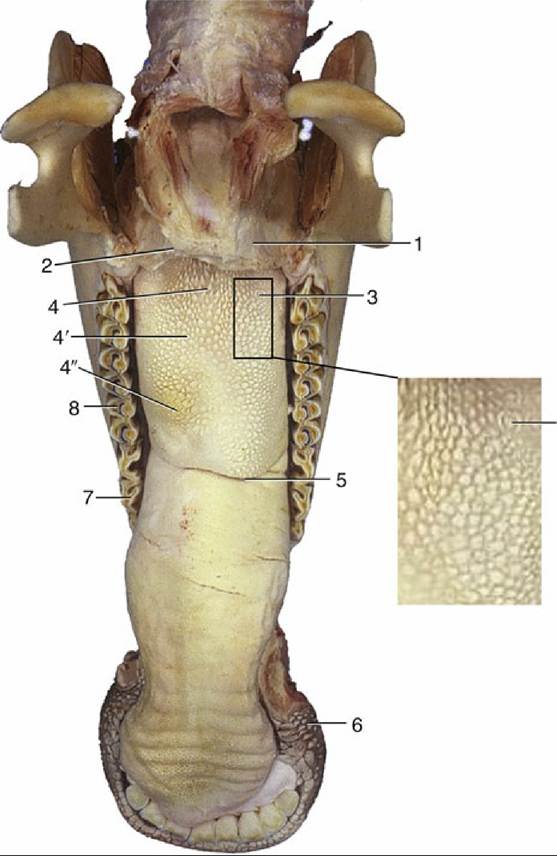
FIG. 25.17 Bovine tongue and lower jaw. 1, Soft palate, cut; 2, palatoglossal arch; 3, vallate papillae; 4, 4', and 4", filiform, lenticular, and conical papillae, respectively; 5, lingual fossa; 6, buccal papillae; 7, first lower cheek tooth (P2); 8, first lower molar (M1).
The wide gap or diastema that separates the front teeth from the cheek teeth makes it easy to grasp the tongue to force the animal to permit examination of its mouth. The six cheek teeth in each jaw increase in size from front to back and are so arranged that most occlude with two opponents.
The upper tooth rows are more widely separated than those of the lower jaw; consequently, only narrow strips of opposing teeth are in contact when the mouth is closed in central occlusion (Fig. 25.10). The tables slope transversely; the buccal edge is raised on the maxillary teeth, and the lingual edge is raised on those in the mandible. The masticatory surfaces of unworn teeth bear a series of crescentic enamel cusps arranged in two rows parallel to the axis of the jaw: the premolars have one pair of these cusps, and the molars have two. Once wear has exposed the dentine, the alternation of softer and more resistant tissues creates an uneven surface that is a very efficient shredding mechanism when the lower teeth are swung inward across their upper counterparts (Fig. 25.18). Attrition of the crowns is compensated by their continuing growth for a time; when growth eventually ceases, the roots are formed, and the height of the exposed part is then maintained only by gradual extrusion of the embedded portion. Eventually the crowns completely erode in animals that survive to very advanced age.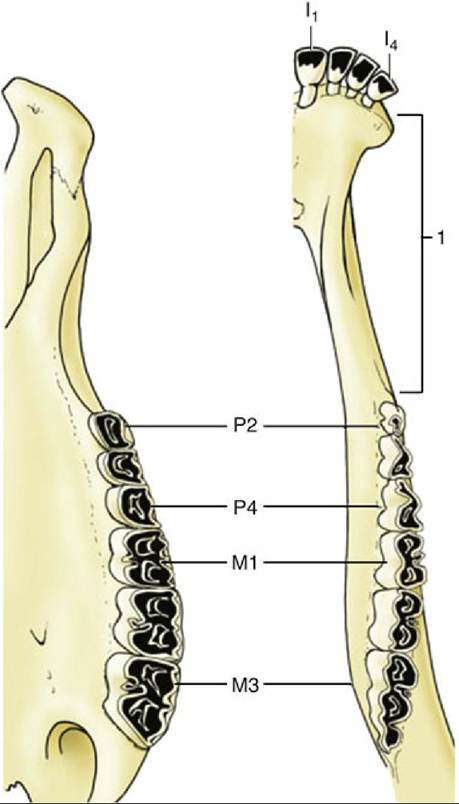
FIG. 25.18 Left half of upper and right half of lower jaw of cow. Note the different shapes of the upper and lower cheek teeth and the large diastema (1). I1 and I4, First and fourth incisors; M1 and M3, fourth and sixth upper and lower cheek teeth, respectively; P2 and P4, first and third upper and lower cheek teeth, respectively.
Most temporary teeth closely resemble their replacements, but the temporary premolars, which initially bear the full burden of mastication, are larger and more complicated than those that succeed them. The eruption dates of the teeth are given in Table 25.2.
Estimation of age is based on these dates and on the state of wear of the incisors. Neither factor is very reliable. The dates of eruption are influenced by breed and reflect differences in the general rate of maturation.
The rate of wear provides a somewhat more useful criterion, though it obviously depends on the nature of the fodder. Wear converts the cutting edge into a surface that gradually broadens. The lingual edge of this surface is originally jagged (because of the ridging of the distal part of the lingual surface of the crown) but becomes smooth when the tooth is worn down; the change in character occurs at 6 years on the first incisor and at 7, 8, and 9 years on the second, third, and fourth incisors, respectively. The teeth are then said to be "level." Exposure of the root coincides with this alteration in the crown (Fig. 25.19E). The changes at later ages are too unreliable to be of value.» TABLE 25.2
Eruption Dates of the Teeth of Cattle
| Temporary Tooth (wks) | Permanent Tooth (mos) | |
| Incisor 1 | Birth-2 | 18-24 |
| Incisor 2 | Birth-2 | 24-30 |
| Incisor 3 | Birth-2 | 36-42 |
id="Picutre 888" class="lazyload" data-src="/files/uch_group31/uch_pgroup304/uch_uch7239/image/image888.jpg">
The dentition of the small ruminants broadly resembles that of cattle. The teeth of sheep are often exposed to very rough wear, and tooth loss ("broken mouth") is a frequent reason for culling older animals. The dates of tooth eruption and replacement in sheep and goats are given in Table 25.3.
Because of the unequal width of the upper and lower dental arcades, mastication is unilateral, and although both sides are used in alternation, most animals tend to favor one. The usual action comprises three phases. In the first, the jaw is dropped and carried laterally; in the second, it is raised while displaced farther to the side; and in the third, which is performed much more swiftly and vigorously, it is carried upward and medially so that the tooth crescents of the lower row engage between those of the upper row as the jaw is returned to its resting position.
The pterygoids of the active side and the masseter of the passive side are the most important muscles in the work stroke.