THE NASAL CAVITY
The nostrils (Figure 37-1Z1) or nares at the base of the beak are overhung by a horny flap (operculum) or surrounded by a thick cere as in psittacines. They lead into the nasal cavity, which is divided, as in the mammal, by a median septum and is in wide communication with the oropharynx through the choana (Figure 37-14Z3).
The nasal cavities are laterally compressed and extend to the large orbits. Rostral, middle, and caudal conchae that arise from the lateral wall encroach on the space (Figure 37-25Z2,2',2"). They play a major role in olfaction, filtering, and thermoregulation. The rostral
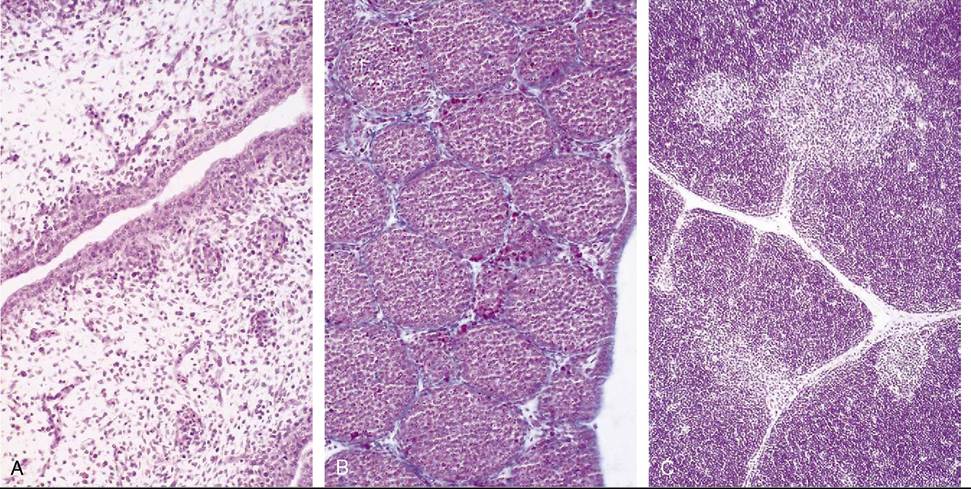
Figure 37-23 A, Bursa of 15-day-old embryo (HE); some infiltrating lymphocytes are present (70?). B, Bursa of 18-day-old embryo (Azan) showing developing epithelial buds (70?). C, Bursa of 6-week-old chick (HE) showing developed bursa follicles (70?).
and middle conchae enclose recesses that communicate with the nasal cavity; the caudal one encloses a diverticulum of the infraorbital sinus. This sinus lies lateral to the nasal cavity into which it opens by a narrow duct so placed that natural drainage is impeded. The sinus wall is thin and directly subcutaneous rostral and ventral to the eye, where it may be identified by its yielding on palpation; it may be opened and any exudate, which accumulates in several diseases, may be flushed out. The relatively wide nasolacrimal duct opens into the nasal cavity ventral to the middle concha. The infraorbital sinus is particularly well developed in psittacines, in which it becomes superficial ventromedial to the orbit. It has numerous diverticula and also communicates with the cervicocephalic air sac at its caudal extent. The elongated nasal gland extends forward from the dorsal part of the orbit in the lateral wall of the nasal cavity. Its duct opens into the cavity at the level of the rostral concha. The gland is widely known as the salt gland, although it secretes a hypertonic sodium chloride solution only in marine (and a few other) species; it is this that enables seabirds to drink seawater.