THE OROPHARYNX
Birds lack a soft palate and any obvious constriction separating the mouth from the pharynx. Oropharynx thus denotes the combined cavity that extends from the beak to the esophagus.
The roof of this dorsoventrally flattened cavity is formed by the palate, and its floor is formed by the mandible, tongue, and laryngeal mound (Figure 37-14). Lips and teeth are absent; their functions are met by the edges of the beak and the ventriculus (see further on). The palate presents a long median cleft (choana) that connects with the nasal cavity. A shorter, more caudal (infundibular) cleft (Figure 37-14/4 and Figure 37-2, B) is the common opening of the auditory tubes. The two clefts open together in the budgerigar. Numerous “mechanical” papillae populate the oropharyngeal wall, either scattered singly or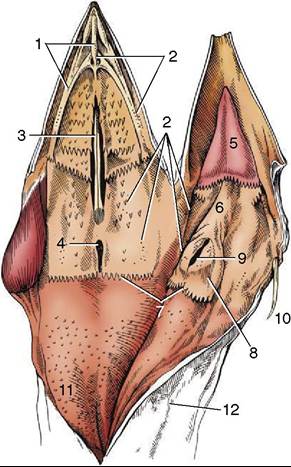
Figure 37-14 Oropharynx opened by the reflection of the lower jaw. 1, Median and lateral palatine ridges; 2, openings of salivary glands; 3, choana; 4, infundibular cleft; 5, body of tongue; 6, root of tongue; 7, "mechanical" papillae; 8, laryngeal mound; 9, glottis; 10, branchial cornu of hyobranchial apparatus; 11, esophagus; 12, position of trachea.
arranged in transverse rows; they are directed caudally and aid in moving the bolus toward the esophagus. Generous amounts of saliva, discharged through the barely visible openings (Figure 37-14/2) of several sets of salivary glands, moisten the food. The triangular nonprotrusible tongue (Figure 37-14) is supported by a delicate hyoid apparatus. It moves the bolus within the oropharynx and, when the bird swallows, propels it into the esophagus; the choanal cleft is closed. Ducks and geese have tongues fringed with papillae that fit loosely into grooves in the edges of the beak, which provides a means of sifting food particles from water (Figure 37-3, E). In some bird species the tongue is more actively used for collecting, manipulating, and swallowing food. Psittacines are unique in having paired entoglossal bones and a large muscular tongue capable of amazing dexterity.
Birds appear to have a poorly developed sense of taste. The laryngeal mound (Figure 37-14/8) caudal to the base of the tongue presents a median slit (glottis), which is not guarded by an epiglottis. A row of papillae marks the level of origin of the esophagus.