The Paranasal Sinuses
The sinus system of the dog is poorly developed. The sinuses may even be absent in brachycephalic dogs, but the absence may not cause any clinical symptoms. The frontal sinus is the largest, occupies much of the frontal bone including its zygomatic process, and is separated from its fellow by a median septum.
It may extend to the level of the temporomandibular joints in larger animals (especially if long-headed) (Fig. 11.11). The three cavities (lateral, medial, and rostral) of each of the frontal sinus communicate separately with the nasal cavity via nasofrontal openings (ethmoidal meatuses). The lateral compartment is the largest, has ethnoturbinates in its rostral part, and may be subdivided by incomplete septa. The medial and rostral compartments are also filled with ethmoturbinates, which hamper identification of these compartments on radiographs. The ethmoturbinates are covered with olfactory mucosa, in contrast to the sinus walls, which are lined with nonolfactory mucoperiosteum.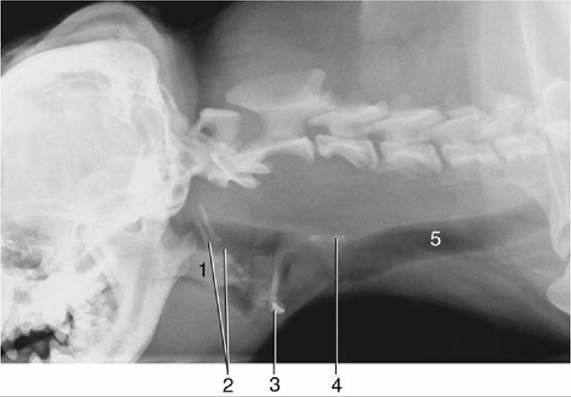
FIG. 11.9 Radiograph of the cramped pharyngeal region of the brachiocephalic dog. (The space available is rather cramped.) 1, Soft palate; 2, hyoid apparatus; 3, basihyoid; 4, cricoid cartilage; 5, trachea.
The sinus system of the cat comprises frontal, sphenoidal, and maxillary compartments, of which the frontal is the most important (Figs. 11.7B and 11.12/1). Its position generally corresponds to that in the dog, but the compartment is undivided and extends rather far ventrally within the medial wall of the orbit. The communication with the nasal cavity is in its rostral part and may provide ineffective drainage in the bacterial sinusitis that is corrected with surgical drainage. In mature cats, the sinus can be surgically approached just lateral to the midline, on the line connecting the rostral margins of the supraorbital processes.
In 3- to 4-month-old kittens the approach is made midway between the line connecting the rostral margins of the supraorbital processes and that connecting the medial angles of the eyes.In both dogs and cats, the maxillary sinus (Fig. 11.10/13) communicates so freely with the nasal cavity that the term nasal recess is preferred. It is not a true sinus because it is not formed between two plates of maxillary bone, being bounded by the maxilla laterally and the ethmoid medially. The recess occupies the face immediately rostral to the orbit, above the roots of the last three cheek teeth, and communicates with the middle meatus by a wide nasomaxillary opening flanked by the nasal conchae. The recess houses on its lateral wall the broad, flat, lateral nasal gland, which appears as a thickening of the mucosa. Root abscesses of the sectorial tooth P4 may break into the recess and later onto the surface of the skull. Surgical drainage is most conveniently achieved by the extraction of the sectorial tooth to open a passage to the mouth; the presence of the infraorbital canal makes the direct lateral approach unwise.
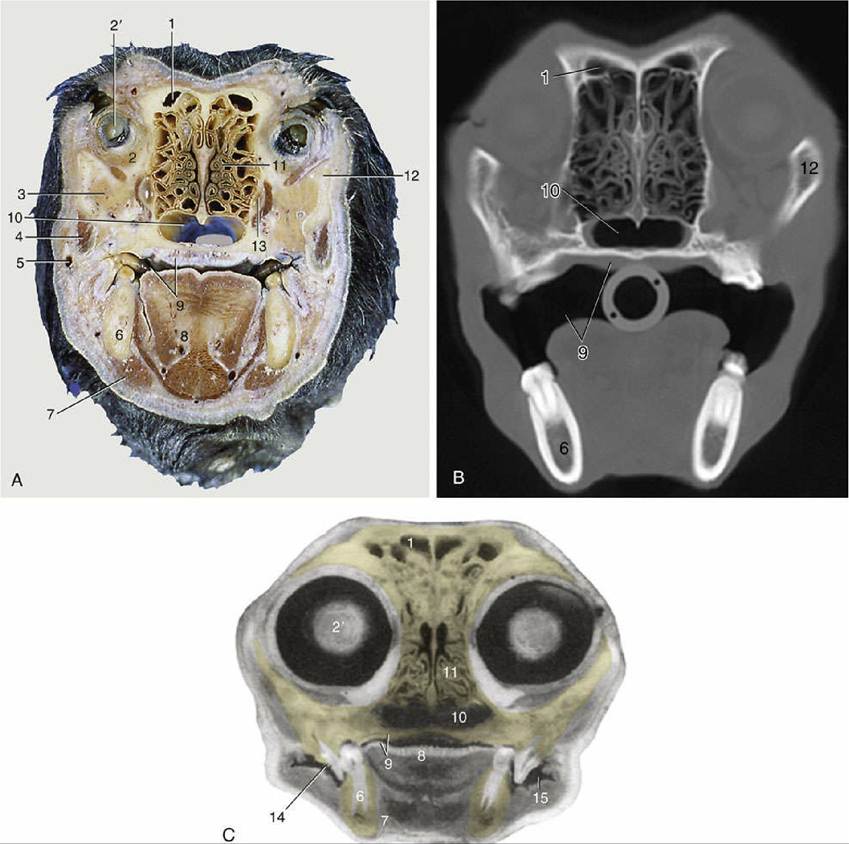
FIG. 11.10 Transverse sections of (A) canine and (C) feline heads through the rostral part of the orbit, rostral surface. (B) Computed tomography scan (bone window) of canine head at the level of (A). 1, Frontal sinus; 2, orbital structures; 2', eye; 3, zygomatic gland; 4, masseter; 5, facial vein; 6, mandible; 7, digastricus; 8, tongue; 9, oral cavity and hard palate; 10, choana; 11, ethmoidal conchae; 12, zygomatic arch; 13, maxillary recess; 14, sectorial teeth, P4 engaging M1; 15, oral vestibule.
In cats, a small sphenoidal sinus is present; the similar cavity found in dogs is filled with ethmoturbinates.
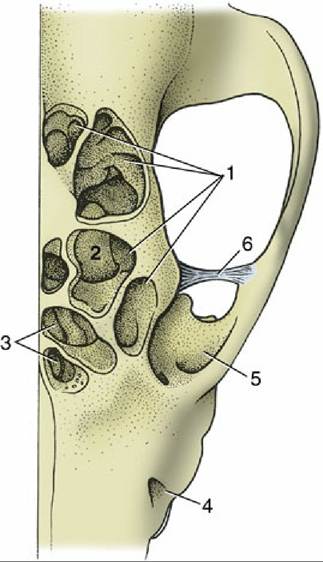
FIG. 11.11 The canine frontal sinuses, dorsal view. 1, Lateral frontal sinus; 2, ethmoidal concha invading the sinus; 3, medial and rostral frontal sinuses; 4, infraorbital foramen; 5, orbit; 6, orbital ligament.
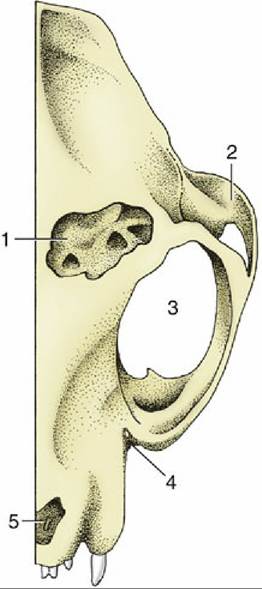
FIG. 11.12 The feline frontal sinus, dorsal view. 1, Frontal sinus, opened; 2, zygomatic arch; 3, orbit; 4, position of infraorbital foramen; 5, nasal aperture.