The Penis and Prepuce
The penis is suspended below the trunk and is partly contained between the thighs, where it is anchored to the floor of the pelvis by a suspensory ligament in the large species. In the quiescent state, the free extremity is concealed within an invagination of the abdominal skin, the prepuce, which opens at a variable site behind the umbilicus.
The organ is mainly constructed of three columns of erectile tissue (Fig. 5.53). These are independent caudally where they constitute the root of the penis, but their major parts are combined in the body of the penis.The paired crura of the penis (Fig. 5.53/1), widely separated origins from the ischial arch, converge, bend to run forward under the pelvic floor, and join. Each consists of a core of cavernous tissue enclosed within a thick connective tissue casing (tunica albuginea), and the complex is known as a corpus cavernosum (Fig. 5.53/4). A septum exists between the two corpora cavernosa in the proximal part of the body, but in most species this structure weakens and ultimately disappears toward the apex of the penis. In carnivores the septum is complete. The combined structure is grooved ventrally to accommodate the third component, the urethra within its enveloping vascular sleeve, the corpus spongiosum (Fig. 5.53/3). The blood spaces within the crura and corpus cavernosum communicate freely.
The corpus cavernosum does not extend to the apex of the penis, which is formed by an expansion of the corpus spongiosum. The corpus spongiosum commences at the pelvic outlet with the sudden enlargement of the meager spongy tissue of the pelvic urethra. The expansion constitutes the bulb of the penis (Fig. 5.53/2), a bilobed structure that tapers to continue as a more uniform sleeve. The corpus spongiosum is more delicate than the corpus cavernosum, having larger blood spaces separated by thinner septa.
Its cranial expansion over the distal end of the corpus cavernosum, usually known as the glans (Fig. 5.53/9), forms the apex of the whole organ. Because the corpus spongiosum surrounds the urethra, the urethral orifice is brought to the very extremity of the penis; indeed, in small ruminants a free urethral process prolongs the urethra well beyond this point.Species Differences in Penis Structure
There are other pronounced species differences in penis structure, such as the transformation of the corpus cavernosum into the os penis in the dog and cat. The glans too differs in its form; it is minimally developed in the pig, insubstantial in the ruminants, and large and mushroom shaped in the horse. It is most specialized in the dog, in which it presents bulbar proximal and long cylindrical distal parts. The penis of the cat is unique (among domestic species) in that it retains its embryonic posture of pointing caudoventrally from the ischial arch, which affects the manner of copulation.
The construction of the corpus cavernosum also exhibits major differences. In some species it contains small blood spaces enclosed within and divided by substantial amounts of tough fibroelastic tissue. This fibroelastic type of penis, found in the boar and ruminants, requires relatively little additional blood to become erect (Fig. 5.54A). The penis of the ruminants also has a sigmoid flexure in the part of its body carried between the thighs. The musculocavernous type of penis, found in the stallion and, in atypical form, in the dog, has larger blood spaces separated by delicate septa (Fig. 5.54B). This muscular penis requires a greater quantity of the blood to achieve erection, which is accompanied by significant increase in both length and girth.
The prepuce or sheath is a tubular fold consisting of an external layer (lamina externa), continuous with the general integument, and an internal layer (lamina interna) that faces the free end of the penis; the internal layer continues as the covering of the free part of the penis after reflection in the depth of the preputial cavity.
Both the internal layer and the penile covering are hairless but often well provided with smegma-secreting glands and lymphoid tissue. In the newborn male the penis and sheath are fused, and separation is gradually achieved during the period before puberty (p. 705). The attachments of the adult prepuce are sufficiently loose to allow the internal lamina to be reflected onto the erect penis when it is protruded through the preputial orifice.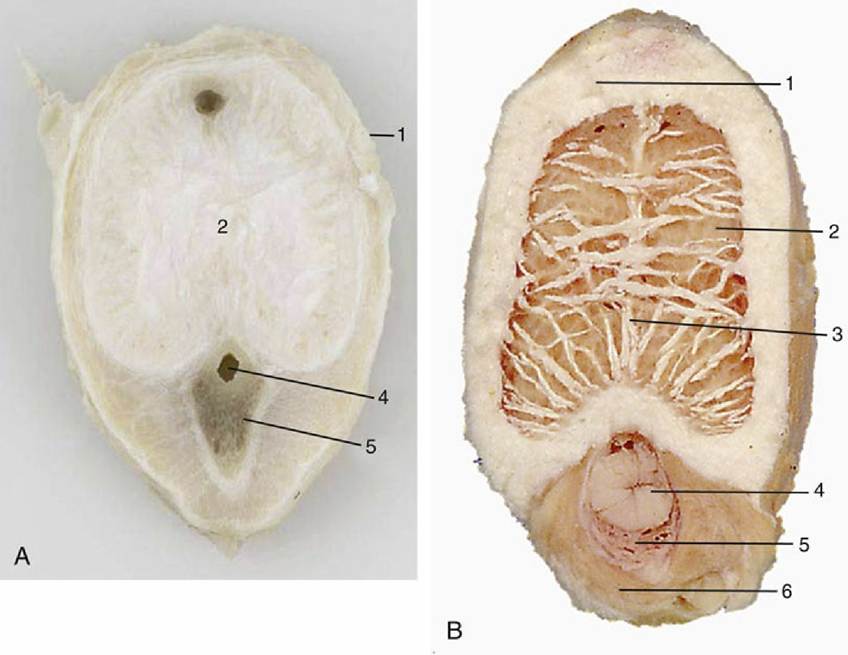
FIG. 5.54 Transverse sections of the fibroelastic penis of a bull (A) and the musculocavernous penis of a stallion (B). 1, Tunica albuginea; 2, corpus cavernosum; 3, septum; 4, urethra; 5, corpus spongiosum; 6, bulbospongiosus.
Certain muscles are associated with the penis. The bulbospongiosus is the thick extrapelvic continuation of the urethralis. It begins abruptly and extends distally to end on the surface of the corpus spongiosum, at a variable distance beyond the point at which this structure is incorporated within the penis. The powerful paired ischiocavernosi arise from the ischial arch, almost enclose the crura, and follow them to their fusion. The retractor penis is also paired. The two muscles arise from the caudal vertebrae and descend through the perineum, bending laterally to pass around the anal canal, to reach the penis. Unlike the other muscles associated with the penis, the retractors are mainly composed of smooth muscle fibers. Narrow slips of striated muscle (cranial and caudal preputial) may pass onto the prepuce and attach near its opening. The caudal muscles are less frequently encountered and retract the prepuce, thus uncovering the extremity of the penis. The cranial muscles protract the prepuce. Both caudal and cranial muscles must be regarded as detachments of the cutaneous trunci and are best developed in the bull but lacking in the stallion.
The penis obtains its exclusive (in the horse, principal) blood supply from the artery of the penis, a terminal branch of the internal pudendal. The artery of the penis has a very short course, and at the ischial arch it quickly divides to form an artery of the bulb, which enters the bulb of the penis and supplies the corpus spongiosum; a deep artery, which pierces the tunica albuginea to supply the corpus cavernosum; and the dorsal artery, which passes apically on the dorsal border of the organ to supply the free end. The dorsal artery may be reinforced by anastomosis with the obturator artery (horse) and generally by anastomosis with the external pudendal artery for the supply of the prepuce. The veins are broadly satellite. Interspecific details are considered in the later chapters if they are significant.
The nerves to the penis accompany the vessels. The motor fibers are predominantly parasympathetic and from the pelvic nerves.