The Rate of Fermentation and Volatile Fatty-Acid Production in the Equine Colon Is Similar to That in the Rumen
In the equine colon, efficient means of buffering and VFA absorption must be present. Salivary buffering, as occurs in ruminants, cannot aid in buffering the colon. In the horse, large quantities of fluid, rich in bicarbonate and phosphate buffers, are secreted by the ileum and transferred to the
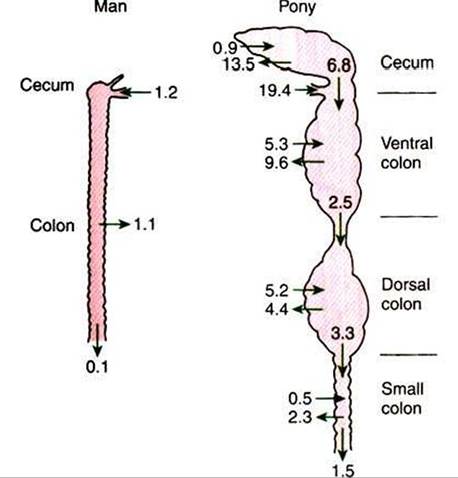
FIGURE 31-15 Net movement of water through the large intestine of a 70-kg man and a 160-kg pony.
Values are in liters per day. Note the relatively large amount of fluid delivered to the pony's colon from the ileum (19.4 L∕day) compared with the human colon. Also note the inward and outward movement of fluid in the various compartments of the pony's large intestine. (From Argenzio RA, Lowe JE, Pickard DW, Stevens CE: Digesta passage and water exchange in the equine large intestine, Am J Physiol 226:1035, 1974.)cecum, thus mimicking the actions of the salivary glands in ruminants. Also, because of the glandular nature of the colonic mucosa, bicarbonate and other electrolytes are added more directly to the lumen fluid in the cecum and colon than in the rumen.
Large Iluxes of water traverse the cecal and colonic mucosa during the course of digestion. When horses are meal-fed, feed starts to enter the cecum about 2 hours after eating, and VFA production rapidly commences. As ingesta are transported from the cecum, VFA production continues in the large colon. During the period of active VFA production, large quantities of water enter the hindgut from the blood through the mucosa. Although this water flux may be a response to increased osmolality created by the generation of osmotically active VFA molecules, it is more likely a response to direct fluid secretion from the crypts of the colonic epithelium (see Chapter 29). Secretion of fluid containing sodium, bicarbonate, and chloride from the colonic mucosa appears to occur in response to high concentrations of VFA in the lumen.
This secretory response, in combination with the ileal secretions, is responsible for buffering of the lumen contents. Figure 31-15 illustrates the magnitude of water fluxes that occur during hindgut digestion in the pony. Note that considerable inward and outward movement of water occurs across the mucosa in each of the major fermentation compartments, ventral and dorsal colons, and cecum. Inward (into the lumen) water movement results from mucosal secretion, whereas outward water movement occurs in association with absorption of VFA.The molecular mechanisms of VFA absorption in the equine colon appear to be identical to those in the rumen (see Figure 31-12). Note in Figure 31-12 that sodium absorption accompanies VFA absorption and that bicarbonate is generated in the lumen. The absorption of VFA and sodium leads to osmotic absorption of waler, probably through the trans- Cellular pathway. (See Chapter 30 for a review of the dynamics of water and electrolyte absorption in the gut.)
The function of the small colon is to recover water, electrolytes, and VFAs that were not absorbed in the large colon. VFA production appears minimal in the small colon, but considerable absorption of water, sodium, and phosphate occurs there.
The large water and electrolyte fluxes in the colon make horses vulnerable to colonic diseases, resulting in fluid and electrolyte losses that are more characteristic of small- intestinal disease in many other animals.