The Regulation of Gastrointestinal Function Is Integrated by the Interaction of Many Regulatory Molecules on Multiple Cell Types in the Gut
You should now appreciate that the physical, chemical, and antigenic environments of the gut are monitored by multiple systems, and that responses to various stimuli are mediated by a bewildering and seemingly redundant array of neurohumoral regulatory molecules.
From a clinical standpoint, it is most important to realize that all the regulatory molecules of the gut form a highly integrated scheme for the overall control of gut function (Figure 27-10). This integration is achieved in a milieu of stimulatory and inhibitory molecules that can arise from nervous or glandular (endocrine/paracrine) elements of the gut. All these regulatory molecules act by occupying ligand sites on target cells. These target cells may be glands, muscles, and vascular muscle cells of the Gl tract, but they may also be other regulatory cells, such as neurons and endocrine/paracrine cells (Figure 27-11). Thus, nerve cells can influence endocrine/paracrine cells, and vice versa. This provides a system of positive and negative feedback controls that can orchestrate a fine degree of regulation over gut function. The overall effect is that the balance of inhibitory versus excitatory neurohumoral regulatory molecules determines the activity of muscles, glands, and blood vessels in a given area of the gut.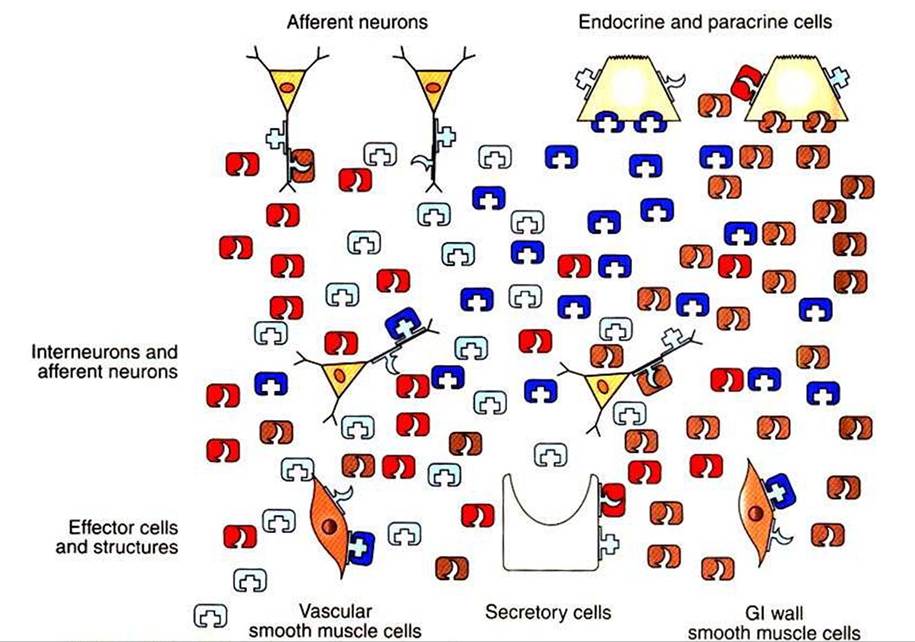
FIGURE 27-11 Role of neurohumoral regulatory substances in stimulus-response coupling in the gut. No attempt is made to distinguish individual regulatory substances, other than to indicate that some are stimulatory and others inhibitory. Of particular importance is the existence of ligand receptors on the surfaces of the nerve and endocrine/paracrine cells that are similar to those on the response cells. This indicates considerable feedback among the regulatory cell types of the gut. For example, a regulatory substance secreted by a neuron could influence the sensitivity of a paracrine cell, either blunting or augmenting its response to stimulation.This type of cellular feedback leads to a fine level of integration and control.The response reactions of the gut are the result of the overall balance of stimulatory and inhibitory neurohumoral regulatory substances.
From a clinical standpoint, it is important to understand that specific neurohumoral regulatory molecules provide opportunities for pharmacological intervention. Several highly effective drugs that either mimic or block the actions of GI neurohumoral regulatory molecules are now available for the treatment of Gl diseases in animals.