The Release of Thyroid Hormones Involves Transport of Thyroglobulin with Attached Thyroid Hormones into the Cell, Cleavage of the Thyroid Hormones from Thyroxine-Binding Globulin, and Release into the Interstitial Tissues
In order for thyroid hormones to be released from the thyroid gland, thyroglobulin with its attached monoiodotyrosine, diiodotyrosine, T3, and T4 molecules must be translocated into the follicle cell, and the hormones must be cleaved from thyroglobulin (Figure 34-3).
Key enzymes in this transfer are found in the lysosomes.On entering the cell, the TBG molecules fuse with lysosomes, and lysosomal enzymes cleave both the iodinated tyrosine molecules and the iodinated thyronines from the thyroglobulin molecule. The thyronines are released through the basal cell membrane (they freely pass through the cell membrane); Inonoiodotyrosine and diiodotyrosine are deiodinated by an enzyme called iodotyrosine deluιlogenase∖ and both the iodide and the remaining tyrosine molecules are recycled to form new hormone in association with thyroglobulin.The majority of T3 formation occurs outside the thyroid gland by deiodination of T4. Tissues that have the highest concentration Ofdeiodinating enzymes are those of the liver and kidneys, although muscle tissue produces more T3 on the basis of relative size. The enzyme that is involved in the removal of iodide from the outer phenolic ring of T4 in the formation of T3 is called 5'-nιoιιodeiodiιιase (Figure 34-4). Another type of
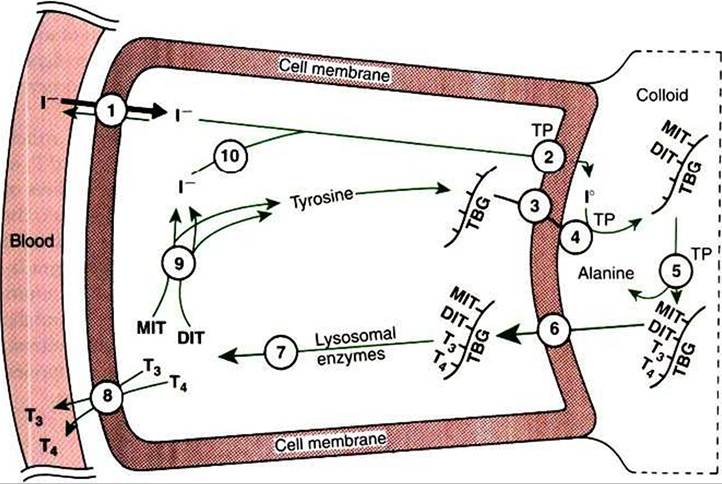
FIGURE 34-3 Depiction of follicular cell showing steps in the synthesis and release of triiodothyronine (T3) and thyronine f TJ. The numbers identify the major steps: 1t trapping of iodide;
2, oxidation of iodide; 3t e?ocytosis of thyroglobulin; 4, iodination of thyroglobulin; 5, coupling of iodotyrosines; 6, endocytosis of thyroglobulin; 7t hydrolysis of thyroglobulin; 8, release ofT3 andT4; 9t deiodination of monoiodotyrosine (MIT) and diiodotyrosine (DIT); and 10, recycling of iodide.
TBGt Thyroxine-binding globulin; TPt thyroperoxidase. (From Hedge GA, Colby HD, Goodman RL: Clinical endocrine physiology, Philadelphia, 1987, Saunders.)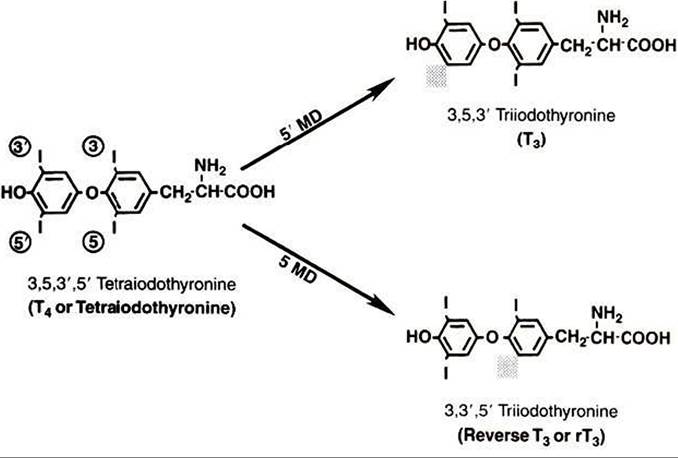
FIGURE 34-4 Structure and nomenclature of thyroxine and its conversion to the two triiodothyronines by 5'-monodeiodinase and 5- monodeiodinase (MD). Shaded squares indicate the sites of deiodination. (From Hedge GA, Colby HD, Goodman RL: Clinical endocrine physiology, Philadelphia, 1987, Saunders.)
T3 in which an iodide molecule is removed from the inner phenolic ring of T4, a compound called reverse T3, is also formed. Reverse T3 has little of the biological effects of thyroid hormones and is formed only by the action of extrathyroidal deiodinating enzymes and not by activity of the thyroid gland.