The Responses to Heat Stress Are Peripheral Vasodilation and Increased Evaporative Cooling
For all mammals and birds, an environmental temperature exists at which body temperature can be maintained in a normal range, primarily by vasomotor mechanisms (Figure 53-7). This zone of tlιernιoneutrality varies with the metabolic rate and the amount of insulation.
The pig, which lacks fur, clearly has a higher thermoneutral temperature than does the sheep, which has thick wool. Dairy cattle that have high milk production produce so much metabolic heat that their thermoneutral zone is surprisingly low: 4o to 15oC (390-59oF). In the thermoneutral zone, body temperature can be regulated by vasomotor mechanisms that increase or decrease skin blood flow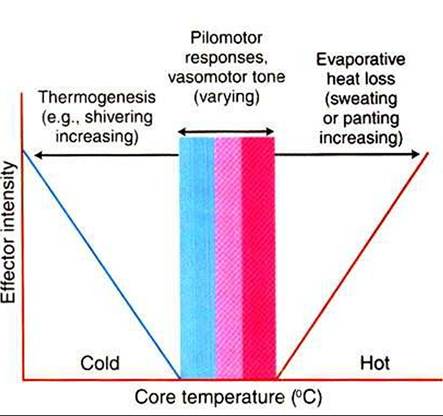
FIGURE 53-7 Relationship between the intensity of thermoregulatory responses and core temperature.The set point for temperature regulation is indicated by the pink bar zone. On either side of this set point is a zone where temperature can be maintained by vasomotor responses (blue and red zones). As the core temperature deviates more dramatically from the set point, there is a need either to increase thermogenesis during cold stress or to increase evaporative heat loss during heat stress. (Modified from Bligh J:Temperature regulation in environmental physiology of animals. In Bligh J, Cloudsley-Thompson JL, MacDonald AG, editors: Environmental physiology of animals, Oxford, UK, 1976, Blackwell Scientific.)
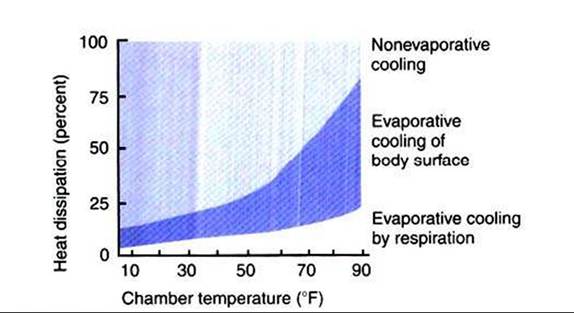
FIGURE 53-8 Methods of heat loss used by a cow as the environmental temperature increases. At low temperatures, most heat loss is by nonevaporative cooling (pale blue shading), but as the environmental temperature increases, the cow becomes increasingly dependent on evaporation (darker blue shading).
and therefore change the amount of heat loss by convection and radiation.
When a homeotherm is exposed to heat stress, the initial response is vasodilation, which increases skin and limb blood flow. The resulting increase in skin temperature and the extension of core temperature down the limbs increase the temperature gradient between the skin and the environment, resulting in more heat loss by radiation and convection (see Figure 53-3).
If vasodilation alone is ineffective in maintaining a normal temperature, evaporative cooling is increased by sweating, panting, or both. Evaporative cooling is the only method of heat loss available once the environmental temperature exceeds the skin temperature and is most effective when relative humidity is low. Figure 53-8 shows that at -IO0C (14o F), cows lose about 10% of their heal by evaporation, but as the ambient temperature rises to about 32o C (90o F), they lose 80% by evaporation. As relative humidity rises, animals have increasing difficulty losing heat; therefore, exercise in hot, humid conditions is likely to cause heat exhaustion. This was a major concern for horses competing in the 1996 Olympics in Athens, Georgia, where the high July temperatures were combined with high humidity.
Animals also use behavioral methods to resist heat stress. These methods, which include seeking shade, standing in water, and wallowing in mud, are not available to intensively managed livestock. The producer must assume increased responsibility for the animals’ comfort and survival. Because high-producing dairy cattle have such a low thermoneutral temperature, their primary requirement is shade in hot climates, which is a greater concern than a source of heat or insulation in cold climates.