» The Salivary Glands
Cattle produce an enormous volume of saliva—perhaps as much as 100 L a day—which contributes to the fermentation medium within the forechambers of the stomach, where it helps to buffer the fatty acids that are produced.
Interference with the normal flow to the stomach results in serious depletion of the electrolytes that are normally reabsorbed and recycled.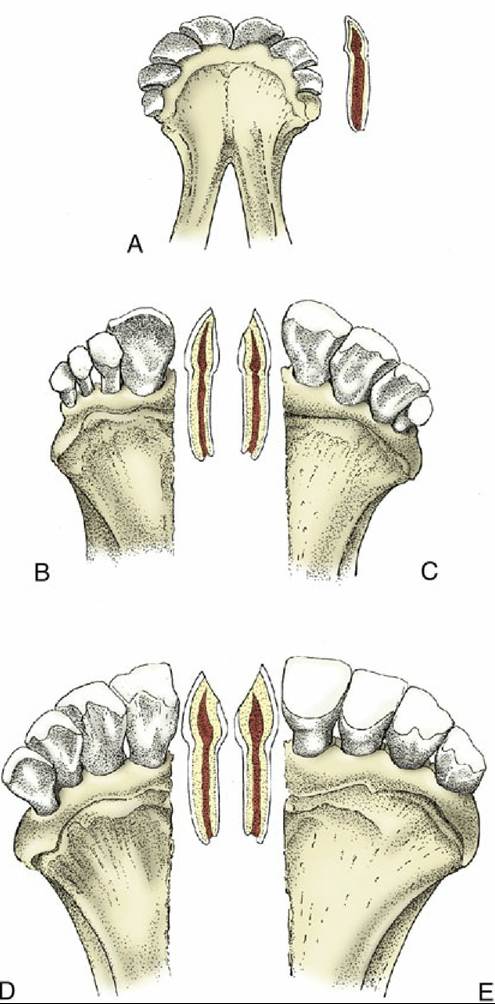
FIG. 25.19 Changes in the bovine incisors with increasing age. (A) Deciduous incisors in the newborn calf. In the longitudinal section of the first incisor (I1) the enamel still surrounds the crown. (B) Two years: I 1 has been replaced. The other incisors are deciduous. The distal border of 11 is slightly worn, and the dentine is exposed. (C) Three and one-half years: 11, I 2, and 13 (the first, second, and third incisors, respectively) are permanent; the fourth incisor (14) is deciduous. The occlusal surface of 12, wider than that of 13, is shown in the longitudinal section. (D) Five years. (E) Eight years. Note the size of the occlusal surface in the longitudinal section. The lingual edge of the occlusal surfaces of 11 and 12 is smooth; these
two teeth are said to be “level.”
Although the parotid gland is almost continuously active, it is smaller than might be expected. It lies ventral to the ear along the caudal border of the masseter, where it partly covers the parotid lymph node. It touches the temporomandibular joint dorsally. A spurt in its growth is coordinated with the initiation of ruminant digestion by the calf. The duct, included in the description of the face (Fig. 25.2/10), opens on the parotid papilla opposite the fifth upper cheek tooth.
» TABLE 25.3
Eruption Dates of the Teeth of Sheep and Goats
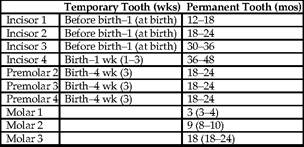
From Habermehl KH: Altersbestimmung bei Haus- und Labortieren, ed 2, Berlin, 1975, Blackwell Wissenschafts-Verlag.
The mandibular gland is considerably larger and attains a length of 18 to 20 cm and a width of 8 to 10 cm. The gland has lateral relationships with the external jugular vein branches and those of the facial nerve. It produces a mixed secretion but only when the animal is actually feeding or remasticating; the flow is most copious when the fodder is dry. The gland extends in an arc on the inner aspect of the lower jaw. Its palpable ventral end projects below the mandible and often almost meets its fellow in the midline; its dorsal end is within the atlantal fossa. The duct runs below the oral mucosa to open by the sublingual caruncle (Fig. 25.13/2).
The sublingual gland has the usual two divisions and is seromucous in nature. The polystomatic part lies in the mouth floor, lateral to the tongue, and drains through many small openings beside the frenulum. It is overlapped by the more compact rostral monostomatic part, whose single duct formed through the union of many smaller ducts opens close by or together with that of the mandibular gland on the sublingual caruncle.
Many minor salivary glands are scattered below the labial, buccal, palatine, and lingual mucosae; those in the cheeks are particularly well developed. In the aggregate, these lesser glands must contribute a considerable volume of secretion.