The Semicircular Ducts Detect Rotary Acceleration and Deceleration of the Head
Three membranous semicircular ducts are located within corresponding semicircular canals of each bony labyrinth (Figure 11-4). They are positioned at approximately right angles to each other, and both ends of each fluid-filled duct terminate in the utricle.
Each semicircular duct has an enlargement al one end, called the ampulla, near its junction with the utricle. The ampulla contains a hair cell receptor organ called the crista ampullaris (see Figure 11-2). This is a ridge of hair cells that, at their base, synapse on sensory neurons projecting to the central nervous system (CNS) and whose cilia are embedded in an overlying gelatinous mass. This mass, called the cupula, attaches to the roof of the ampulla (Figure 11-5). All hair cells of a given crista ampullaris are oriented in the same direction with respect to their cilia. Together, the hair cell ridge and overlying cupula span the diameter of the ampulla.The semicircular ducts, together with the ampulla and its contents, are involved in transducing rotary acceleration and deceleration of the head. When the head begins to accelerate in a rotary fashion, the semicircular duct and its receptor organ rotate with the head, but the endolymph’s acceleration lags behind because of inertia. This relative difference in the rate of acceleration of the semicircular duct and its enclosed endolymph causes the crista ampullaris to “crash into” the slower-moving endolymph. This results in a displacement of
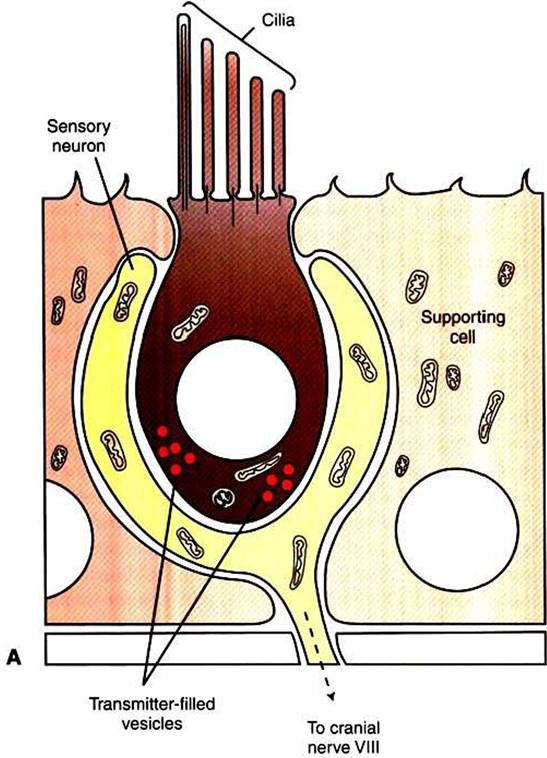
FIGURE 11-2 Each structure of the peripheral vestibular apparatus contains a region of hair cells that form the basis of a sensory receptor organ. A, Each hair cell has several cilia at its apex, arranged in size order, and synapses on a sensory neuron of cranial nerve Vlll at its base. B, In each ampulla of the semicircular ducts, there is a crest of hair cells whose cilia project into a gelatinous mass called the cupula, forming a receptor organ called the crista ampullaris.The hair cell receptor organ in the utricle and saccule is the macula, a layer of hair cells whose cilia project up into a gelatinous layer, on top of which lies a layer of calcium carbonate crystals called otoliths.

the gelatinous cupula in the direction opposite that of head rotation and a corresponding bending of the hair cells. This in turn changes the firing rate of the sensory neurons projecting to the CNS. The opposite happens with deceleration because the semicircular duct and crista ampullaris slow immediately along with the head while inertia continues to carry the endolymph forward. Stimulation of the crista ampullaris occurs only on rotary acceleration or deceleration of the head, not during constant velocity, since the movement of the endolymph will eventually catch up with the movement of the semicircular ducts, and the hair cells will no longer be bent.
Semicircular ducts located on opposite sides of the head, but in approximately the same plane (co-planar), work as a pair to provide the brain with information about the direction and nature of head movement. For instance, a clockwise rotary acceleration of the head would cause bending of the

FIGURE 11-3 At rest, sensory neurons on which vestibular hair cells synapse transmit action potentials spontaneously at a rate of about 100 per second. When hair cell cilia are deflected in one direction, the action potential frequency increases; when cilia are deflected in the opposite direction, the frequency decreases.
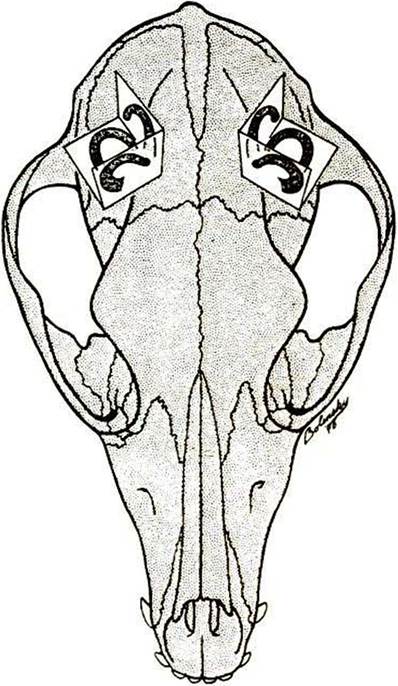
FIGURE 11-4 Three semicircular ducts, each positioned at approximately right angles to the other two, are located on each side of the head and work to detect rotary acceleration and deceleration of the head.
directionally sensitive hair cell cilia in each member of a coplanar pair of semicircular ducts on opposite sides of the head. However, the sensory axons leaving the crista ampullaris from the duct on one side of the head would carry an increased action potential frequency, whereas those from the duct of the other side would carry a decreased action potential frequency. The brain interprets such reciprocal changes in Sensoryaction potential frequency as resulting from clockwise or counterclockwise acceleration or deceleration in a given plane of movement. In reality, rotary UccelerationZdeceleration in any given plane usually affects all three sets of paired semicircular ducts, but each pair to different degrees. In this way, the bilateral system of six semicircular ducts detects the direction of both rotary acceleration and deceleration of the head and activates or inhibits particular CNS structures to produce the appropriate reflex response.