The Utricle and Saccule Detect Linear Acceleration and Deceleration and Static Tilt of the Head in Space
In the utricle and saccule, the hair cell receptor organ is called the macula (see Figure 11-2). Il is an oval patch of hair cells with a primarily horizontal orientation on the floor of the utricle and a primarily vertical orientation on the wall of the saccule.
The cilia of the macular hair cells extend up into a gelatinous layer atop the hair cells. Embedded at the top of this gelatinous mass is a layer of calcium carbonate crystals called otoliths. This otolith layer is heavier and denser than the endolymph and other surrounding materials.Given the organization of the receptor apparatus that lies within the utricle and saccule, these vestibular structures can transduce linear acceleration and deceleration of the head, as well as static head tilt (Figure 11-6). Considering the horizontally oriented macula of the utricle, if the head is accelerated forward in a straight line, movement of the dense otolith layer lags behind that of the macular hair cells. This produces a shearing force that bends the tips of the hair cell cilia, by way of the gelatinous layer, until constant velocity is achieved and the otolith layer catches up with the hair cell layer. In contrast to the crista ampullaris, not all the hair cell clusters of a given macula are oriented in the same direction with respect to their cilia (Figure 11-7). In addition, as previously noted, hair cells of the utricle are oriented in the horizontal plane, whereas those of the saccule are in the vertical plane. Therefore, linear acceleration in a specific direction will bend hair cells of a particular location and orientation in a way that will transiently increase the action potential firing rate of their associated sensory neurons; those of another location and orientation will be bent in a way that transiently decreases the firing rate; and those of yet another location and orientation will be bent in a
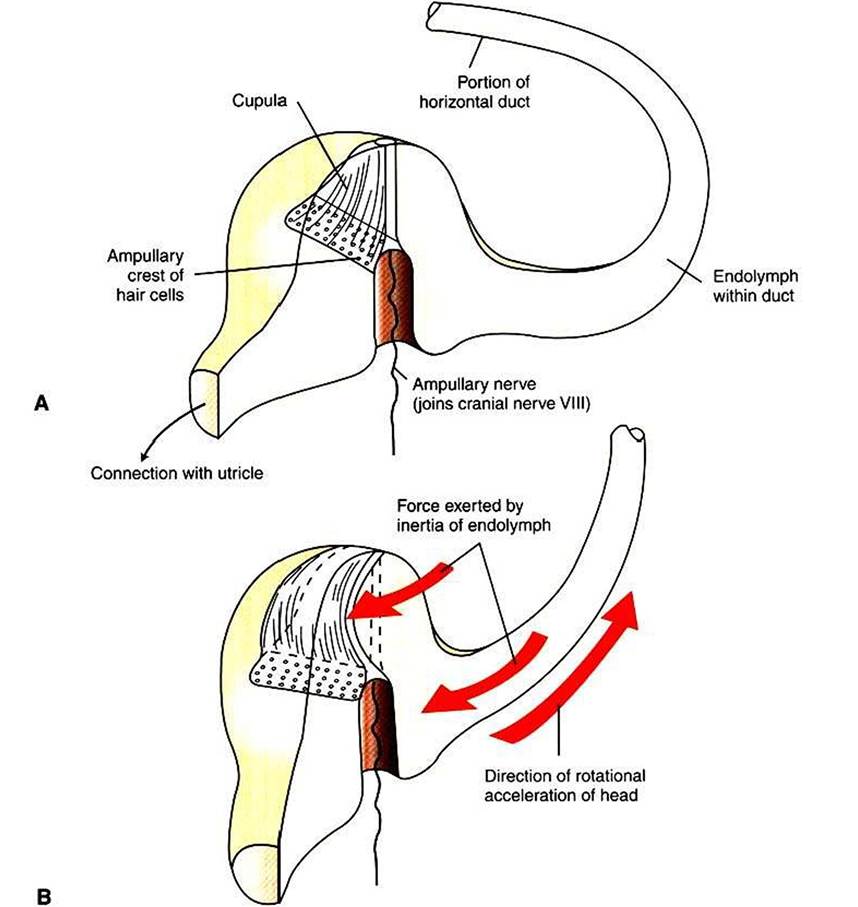
FIGURE 11-5 Ampullae of the semicircular ducts contain a crista ampullaris, which transduces rotational acceleration/deceleration of the head.
The ducts are filled with endolymph. A, Crista ampullaris of the horizontal canal when the head is at rest.Bf On rotational acceleration of the head in the indicated direction, the relative inertia of the endolymphatic fluid displaces the cupula, and thus the hair cell cilia, in the opposite direction. (Modified from Kandel ER, Schwartz JH, editors: Principles of neural science, ed 2, NewYorkz 1985, Elsevier Science Publishing.)
way that has little or no effect on firing rate. This topographic pattern of hair cell bending and associated transient changes in action potential firing will be different for linear acceleration in a different direction. The CNS can decipher these various patterns of neural activity to determine the onset and direction of linear acceleration and to initiate an appropriate compensatory response.
Again considering the horizontally oriented macula of the utricle, when the head tilts from the upright position, the heavy and dense otolith layer effectively “falls over” as it is pulled by gravity (see Figure 11-6, B). This bends the hair cell cilia, by way of the gelatinous layer, and keeps them bent as long as the head is tilted. This sustained bending (compared with the transient bending during linear acceleration) is translated into sustained changes in action potential firing frequency (compared to transient changes during linear acceleration) in particular populations of associated sensory neurons. In this way the utricle and saccule can inform the brain about a stationary tilt of the head. The direction of the tilt is detected by a similar mechanism as that for detecting the direction of linear acceleration. Astronauts in low gravitational settings receive relatively little information from their utricles and saccules about their stationary head position and must rely more heavily on visual and other sensory cues to detect head position.
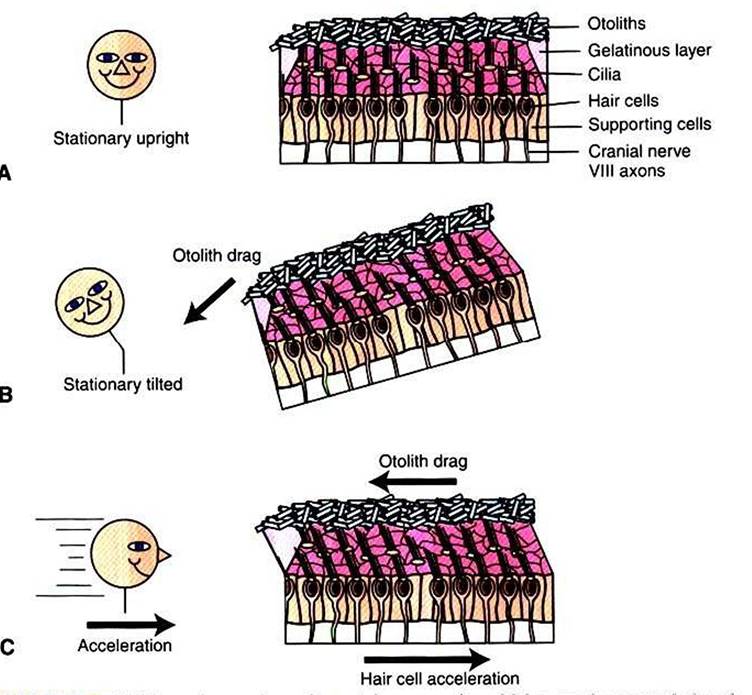
FIGURE 11-6 Utricle and saccule each contain a macula, which transduces static head tilt and linear acceleration/deceleration of the head.
Macula of the utricle is horizontally oriented. ArWhen the head is stationary and upright, there is little or no bending of the hair cell cilia. BrWhen the head tilts and remains tilted, the heavy otolith layer "falls over," producing a drag.This bends the hair cell cilia, by way of the interposed gelatinous layer, in the direction of the tilt. CrWhen the head accelerates in a straight line, the hair cells accelerate in the same direction, but the heavy otolith layer lags behind, producing a drag in the opposite direction.This bends the hair cell cilia, by way of the interposed gelatinous layer, in the direction opposite the acceleration. (Portions modified from Purves D, Augustine G, Fitzpatrick D, et al: Neurosciencet ed 3, Sunderland, Mass, 2004, SinauerAssociates.)