THE STOMACH
The most remarkable feature of the stomach is its small size in relation to the animal and to the volume of fodder consumed. It is probably flattered by the figure of 5 to 15 L commonly quoted as the physiological capacity.
It is relatively larger in the unweaned foal.The equine stomach lies mainly within the left half of the abdomen (Figure 21-10/2). Like other simple stomachs, it consists of two limbs that meet at a ventral angle. The left limb comprises the fundus (unusually large and often termed saccus cecus [blind sac] in this species) and the body; the right limb or pyloric part is much narrower and extends across the midline to join the duodenum (Figure 21-9, A). Although the situation naturally varies with the degree of distention, the stomach remains within the protection of the rib cage even when grossly distended; it is therefore inaccessible by the ordinary methods of clinical examination, either through the flank or per rectum. Gross overdistention may be revealed by a raising of the overlying ribs on the left side, which destroys the normal symmetry of the trunk. When moderately distended the fundus extends under the upper part of the fifteenth rib (or thereabouts), and the lowest part of the body reaches the ventral parts of the ninth and tenth ribs. The cardia provides a relatively fixed point, opposite the upper part of the eleventh rib, and enlargement after feeding is therefore mainly downward and forward (Figure 21-6/2).
The cranial surface is directed against the diaphragm above and against the left lobe of the liver more ventrally; it faces cranially, dorsally, and laterally. The caudal surface faces in the opposite direction and makes contact with various viscera, including coils of small intestine and descending colon dorsally and the dorsal diaphragmatic flexure of the ascending colon ventrally. The left part of the greater curvature is followed by the hilus and adjoining gastric surface of the spleen (see Figure 21-21).
A stepped edge (margo plicatus; Figure 21-21/2") divides the interior between a large nonglandular region, occupying the fundus and part of the body, and a glandular region. The nonglandular part resembles the mucosa of the esophagus and is dirty white and harsh to the touch (see Figure 21-9). The softer glandular region consists of cardiac, proper gastric, and pyloric glandular zones; although the borders between these zones are ill-defined, the zone occupied by the proper gastric glands is somewhat darker and redder than the yellowish cardiac and pyloric zones in the fresh specimen. Both the cardiac and pyloric regions are incidentally parasitized by botfly (Gasterophilus) larvae; when these relinquish their hold to pupate in the soil they may leave the mucosa densely pocked by small focal ulcerations. These, when semihealed, can be misinterpreted as normal features (Figure 21-9, B).
The cardiac sphincter is exceptionally well developed, and this, coupled with the oblique entrance of the
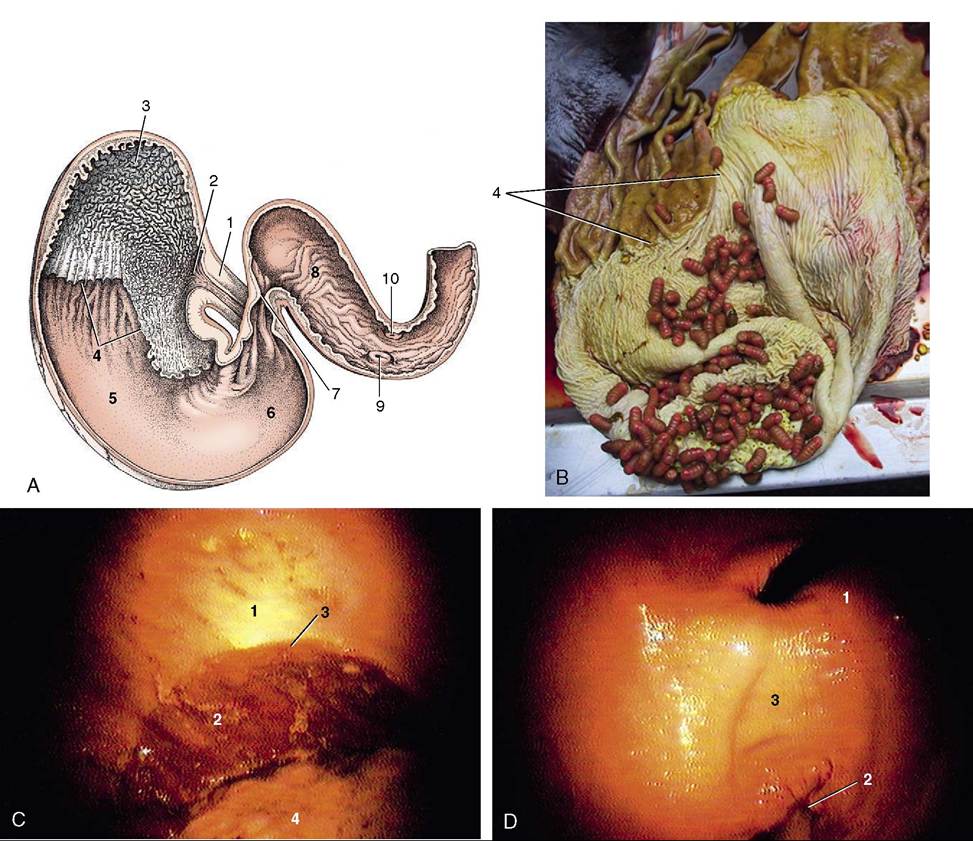
Figure 21-9 A, Interior of the stomach and cranial part of the duodenum. 1, Esophagus; 2, cardiac opening; 3, fundus (blind sac); 4, margo plicatus; 5, body; 6, pyloric part; 7, pylorus; 8, cranial part of duodenum; 9, major duodenal papilla within hepatopancreatic ampulla; 10, minor duodenal papilla. B, Notice the white mucosa of the fundus. The Gastrophilus larvae are an incidental finding in this part of the stomach. 4, Margo plicatus is clearly visible. C, Endoscopic view of stomach. 1, Nonglandular mucosa; 2, glandular mucosa; 3, margo plicatus; 4, ingesta. D, Endoscopic view of stomach. 1, Fiber optic cable of endoscope entering through cardia; 2, pylorus; 3, lesser curvature.
esophagus, is held responsible for the horse’s reputed inability to eructate or vomit; however, eructation and vomiting, though rare, is possible. The canal or distal portion of the pyloric part is more muscular than the remainder of the organ and is bounded by proximal and distal thickenings that converge at the lesser curvature. Even when the second of these, the pyloric sphincter, is fully relaxed, the actual exit is remarkably narrow (Figure 21-21/5).