THE STRUCTURE OF SKIN
Some recapitulation and amplification of the earlier account (p. 8) of basic skin structure is now required. It will be recalled that skin is composed of two parts: a superficial epithelium (epidermis) and a tough fibrous layer (dermis) that rests on a stratum of loose connective tissue (subcutis) (see Figure 1-7).
The epidermis is continuously renewed. The surface cells are sloughed in flakes (e.g., dandruff) or as smaller particles (those of human skin accounting for much household dust), and this loss is made good by cell division in the deepest layer followed by migration of daughter cells toward the surface. As the epidermal cells drift superficially, they undergo a series of internal changes that gradually brings about their deaths, and when presented to the environment, they are incapable of reacting to the various influences to which they are then exposed. The sequence of changes, shown in Figure 10-1, imposes an obvious stratification. The deepest layer (stratum basale) is closely molded on the irregularities of the underlying dermis and has a considerably greater area than the surface of the body (Figure 10-1/7). As the cells move into the stratum spinosum, they shrink and draw apart, though remaining connected by intercellular bridges (desmosomes). The process of keratinization (cornification) now begins, and in the next layer (stratum granulosum) the cells contain scattered keratohyalin granules (Figure 10-1∕√). In some regions this layer is followed by a narrow stratum lucidum in which the flattened cells, which have already lost their nuclei and distinct outlines, obtain a homogeneous appearance from the even dispersal of the granules. Finally, the outermost layer (stratum corneum; Figure 10-1∕d) consists of squames densely packed with the fibrous protein keratin, the true horny substance, into which keratohyalin has been transformed.
It is keratin that gives epidermal specializations (e.g., hair, hoof, and horn) their hardness and their strength.The epidermal layers are thickest and most clearly differentiated where the skin is exposed to hard usage, as on the footpads of a dog (Figure 10-2). Where abrasion is less severe, as in haired regions, the epidermis is much thinner, and neither the stratum granulosum nor the stratum lucidum may be clearly represented. The thickness of the epidermis depends on the mitotic rate within the stratum basale, which is adjusted by a substance (epidermal chalone) that inhibits cell division. Although cell production and loss normally match to maintain an even epidermal thickness, this balance may be disturbed in certain circumstances.
There are no blood or lymphatic vessels in the epidermis, which is nourished by diffusion from the subjacent dermis.
The dermis is largely composed of collagen bundles, thickly felted together, as can be demonstrated by teasing leather (tanned dermis). Elastic fibers, which are also present, make the skin pliable and are able to
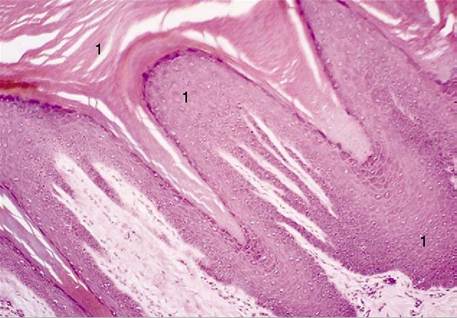
Figure 10-2 Stratified squamous epithelium of a footpad of a dog (HE) (70?). 1, Very thick stratum corneum.
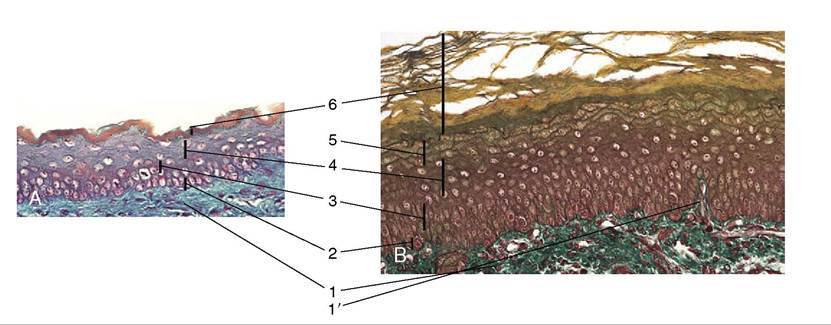
Figure 10-1 Structure of the adult skin (Crossmon). A, Skin from the canine flank. B, Skin from a worn feline footpad. Note the increased keratinization and the presence of a stratum lucidum and dermal papillae. 1, Dermis; 1', dermal papilla; 2, stratum basale; 3, stratum spinosum; 4, stratum granulosum; 5, stratum lucidum; 6, stratum corneum.
restore its shape after being wrinkled or deformed. It is these fibers that draw apart the edges of a wound, making it gape (Figure 10-3). Chronic tension damages the structure of the dermis, rupturing the connective tissue bundles; subsequent repair is usually by lighter scar tissue.
A physiological example of this process is provided by the white lines (striae) of abdominal skin that appear after the completion of a pregnancy, especially in women.The dermis is generously vascularized and innervated. It is also invaded by hair follicles and sweat, sebaceous, and other glands growing from the epidermis (see Figure 1-7)
The interface across which nutrients and waste substances diffuse between the epidermis and the dermis is enlarged by the complicated molding of these components. The finger- and ridgelike projections (papillae; Figure 10-1Z7') of the dermis fit closely into reciprocal depressions of the epidermis, and under normal condi-
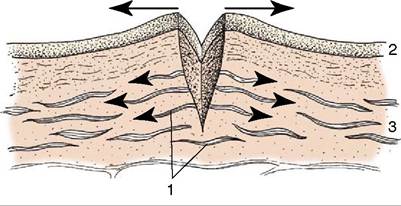
Figure 10-3 Skin incision; elastic fibers in the dermis cause the wound to gape. 1, Elastic fibers; 2, epidermis; 3, dermis.
tions adhesion between the two structures is not easily disturbed. Trauma, such as that caused by the rubbing of an ill-fitting boot or shoe, sometimes separates them forcibly, and interstitial fluid then collects in a blister. Rupture of the blister exposes the raw surface of the dermis; normally this is quickly covered by epithelium growing inward from the margin of the sore.
The larger dermal ridges and papillae, generally developed where the covering epithelium is thickest, are reflected by corresponding epidermal contours. These are permanent and individually distinct and provide a means of identification, widely used in ourselves (fingerprinting) and less commonly used in other species (noseprinting of dogs and cattle; Figure 10-4).
The subcutis consists of loose connective tissue interspersed with fat. It varies in amount according to situation and is thin or even absent where movement is undesirable (e.g., over the lips, eyelids, and teats). It is particularly ample in dogs and cats, whose easily shifted skin can be grasped in large folds over much of the body (Figure 10-5).
In the pig and ourselves, the subcutis contains more substantial accumulations of fat, even in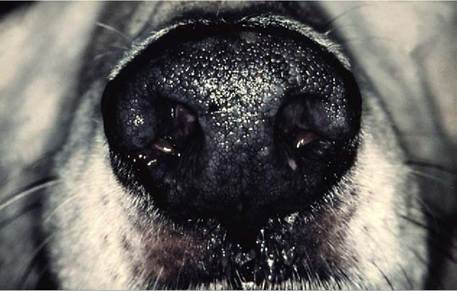
Figure 10—4 The noseprint in the dog can be used for identification of an individual.
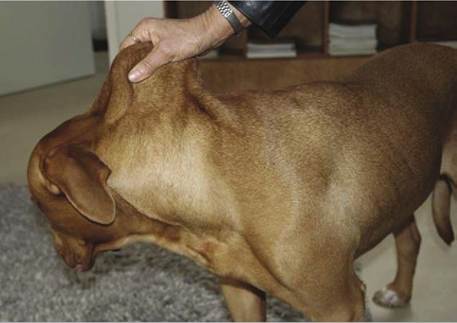
Figure 10-5 Loose skin on the neck of a dog. Ample subcutis permits shifting of the skin.
relatively ill-nourished individuals; this constitutes the panniculus adiposus familiar in sliced bacon.
The clinical significance of the effects of dehydration or edema of the subcutis has been mentioned (p. 9).
The cutaneous blood vessels come from those that supply the fasciae and superficial muscles. The arteries form a series of networks within the dermis. The most superficial network lies at the bases of the papillae and provides end-arteries that enter the papillae to release numerous capillaries from which fluid passes to nourish the basal epidermal cells. Other capillary plexuses surround the hair follicles and associated glands (see Figure 1-7). Variation in flow through the superficial vessels plays an important role in temperature regulation. When the body temperature is raised, vasodilation promotes heat loss—directly by surface radiation and indirectly by favoring the activity of the glands that produce sweat, which then evaporates. Conversely, the surface vessels constrict in cold environments or when the internal temperature drops. The regulation of flow is in part achieved by opening or closing numerous anastomoses connecting the cutaneous arteries with veins. The skin vessels normally contain a considerable volume of blood, but much can be recalled to the musculature and internal organs after hemorrhage or shock.
Skin has a rich sensory innervation. The nerves accompany the vessels through the fasciae and form networks within the dermis. From these, fibers disperse to a variety of sensory receptors; some even penetrate a little way into the epidermis (see Figure 9-33). Other (autonomic) fibers regulate the caliber of the smaller vessels, control the activity of skin glands, and excite the arrector pili muscles that attach to the hair follicles.
The epidermis develops from the embryonic ectoderm. This is initially a single layer of cells lying on a bed of mesenchyme that in time gives rise to the dermis (Figure 10-6, A). Long before birth the ectodermal cells begin to proliferate, pushing new cells toward the surface to produce a multilayered epithelium, while local condensations grow into the mesenchyme as the epithelial buds from which hair and glands differentiate. By the time of birth the skin of domestic mammals has a basically adult character, unlike that of many rodents and other small mammals that are born naked.