The thymus is of greatest importance in the young animal. It begins to regress about the time of puberty and may eventually almost disappear.
Even when a more sizable vestige persists, it will be found to consist largely of fat and fibrous elements.
The thymus has a paired origin from the third pharyngeal pouch (see Fig.
6.5/6). Although some uncertainty exists about the precise contributions made by the endoderm and subjacent mesoderm to thymus development, an ectodermal contribution is even conjectured in some species. The buds grow down the neck beside the trachea and invade the mediastinum, in which they extend to the pericardium. The cervical part regresses prematurely in many species (including the dog), and the thymus then appears as a single, median organ. At its peak the thymus is a lobulated structure that fills the ventral part of the cranial mediastinum, fitting about the other contents of this space.The thymus tissue is divided into a cortex and medulla. The cortex produces the immunocompetent T lymphocytes, which enter the bloodstream for distribution to and multiplication in the peripheral lymphoid organs (nodes and scattered lymph nodules). The medulla is formed of epithelioid cells of more speculative significance (Fig. 7.63). Because of its relevance to the postnatal development and maintenance of immunologic competence, the thymus is of vital importance.
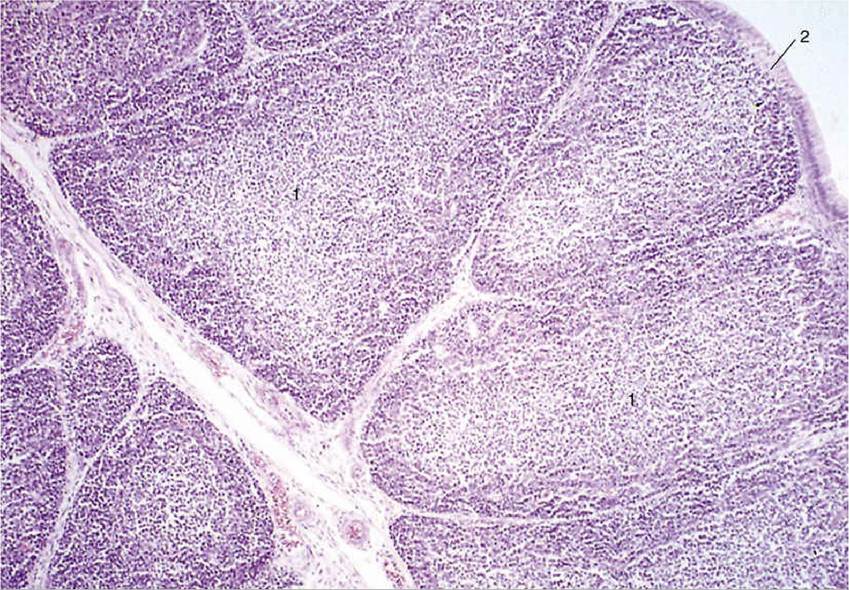
FIG. 7.63 Thymus of calf (hematoxylin and eosin; magnification ?70). 1, Thymic lobules; 2, capsule.
Comprehension Check
Create a list of the organs that have backup arterial blood supply.
Using embryologic foundation, compare the structure of the fetal and postnatal heart, and detail the transition of the heart from fetal to postnatal life.
Practice auscultation on species of your choice. Imagine you hear a "murmur." Work through different types of murmurs and their structural origins.
* This qualification, necessary for strict accuracy, may be assumed in later references to the relations of the heart.
* The official name, lien, is the stem for many descriptive terms—for example, a. lienalis, the splenic artery.