The Uterus
The uterus,* the womb in popular speech, is the enlarged part of the tract in which embryos arrive to establish a means of physiologic exchange with the mother's bloodstream. It is the part of the tract that displays the most striking specific differences, although the most extreme forms do not occur among domestic species.
These differences find a ready explanation in the manner of formation of the reproductive tract (p. 161) from two paramesonephric ducts that grow caudally to meet and fuse with each other and with the median urogenital sinus, the ventral division of the cloaca (Figs. 5.15 and 5.16). In some species, including many rodents, fusion of the ducts is limited to the most caudal portions, which contribute to the vagina. Because of the distinct cranial parts, the uterus consists of paired tubes that open separately into the vagina (double uterus—uterus duplex). In contrast, in women and most other primates, fusion is much more extensive and only the uterine tubes remain paired; a median uterus with a simple undivided lumen is present. In the intermediate variety (bicornuate uterus) found in all major domestic species, the uterus contains a caudal median part from which paired horns diverge cranially to continue as the uterine tubes.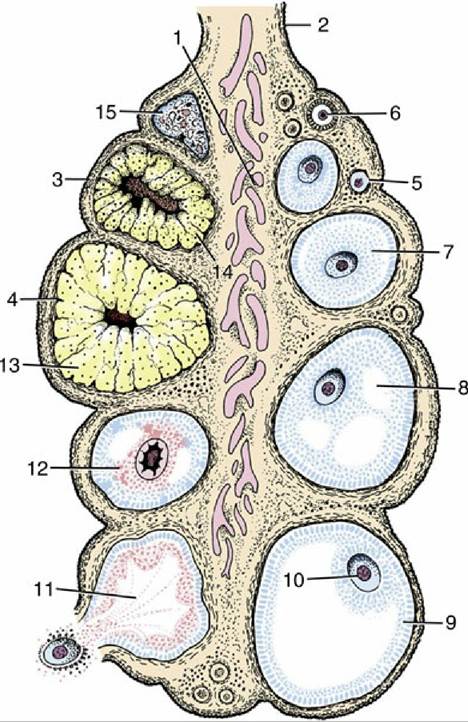
FIG. 5.56 Schematic representation of the different functional stages in ovarian activity. 1, Medulla; 2, mesovarium; 3, surface epithelium; 4, tunica albuginea (poorly developed); 5, primordial follicle; 6, primary follicle; 7, secondary follicle; 8, early tertiary follicle; 9, mature follicle; 10, oocyte; 11, ruptured follicle; 12, atretic follicle; 13, corpus luteum; 14, atretic corpus luteum; 15, corpus albicans.
In all domestic mammals the median part of the uterus has two segments. The caudal, very thickwalled segment, the cervix (Fig.
5.59/8), provides a sphincter controlling access to and from the vagina. A part of the cervix (Fig. 5.59/9) (portio vaginalis) usually projects into the vaginal lumen with which it communicates at the external ostium. The lumen of the cervix (cervical canal) is constricted and often almost occluded by mucosal folds. It opens into the body of the uterus (Fig. 5.59/6) at the internal ostium. The body is generally a rather small segment in domestic species, although the proportions vary see (Fig. 5.16); it is largest in the mare. The division of the interior is not always obvious externally because an internal septum may partially divide an apparently single space. The extent of the cervix, not apparent visually, is easily discovered on rectal palpation, on the basis of its firmness in comparison with the adjacent parts.The horns (cornua) vary greatly in length and are longest in polytocous species. Their disposition also varies from characteristically round in ruminants, to straight and divergent in mares and bitches, to cast into intestine-like loops in sows. The cervix generally lies within the pelvic cavity, interposed between the rectum and the bladder (Fig. 5.32/7), but the body and horns of the uterus typically lie within the abdomen above the mass of intestines.
The uterus possesses serosal, muscular, and mucosal coats that are known as the perimetrium, myometrium, and endometrium, respectively. The serosal covering reaches the uterus by extension from the supporting broad ligament (mesometrium; Fig. 5.33/7). The muscle is arranged as weak external longitudinal and thicker internal circular layers that are separated by a very vascular stratum of connective tissue. The tissues, especially the external muscle layer, extend (as parametrium) into the supporting broad ligaments. Dense connective tissue intermingles with the muscle of the cervix, making it a very indistensible part of the tract at most times (Fig. 5.60).
The endometrium is thick. Its surface relief varies among species and is most remarkable in ruminants, in which numerous permanent elevations (caruncles) mark the sites where the embryonic membranes firmly attach during pregnancy (Fig. 5.59/7). Numerous tubular glands open on the surface, which is generally lined by a simple columnar epithelium. The mucosa within the cervix is prominently modeled by both longitudinal and circular folds whose interdigitation helps close the passage (Fig. 5.59/8). Mucus secreted by cervical glands plugs the canal at most times and so helps seal the uterus from the vagina. The passage is open only at estrus and immediately before, during, and, for a short time, after parturition.