The workers and maintenance crew: The reflex arc
Key point
■ The simplest reflex arc has a receptor in the PNS, a sensory axon projecting to the CNS where it connects with LMNs that project to a muscle. Via reflex arc wiring a stimulus results in a stereotypical motor output.
Reflex arcs occur in somatic and visceral systems.A large amount of motor activity used for basic functions such as postural support, locomotion or visceral function involves reflex activity. The reflex activity can then be modulated by input from higher centres.
A reflex arc involves both the PNS and the CNS. It has a sensory/afferent nerve in the PNS that brings information into the CNS where the input is linked to a motor/efferent nerve that connects back to a muscle (Fig. 4.3). Via that linkage, the stimulus of the sensory nerve elicits a stereotypical motor output and muscle activation. The neural wiring of a reflex arc is laid down during embryological development. Thus, unlike a learned motor response, its function does not depend on experience. An example of a learned motor activity is the menace response in which the animal blinks in response to a menacing gesture made to the eye. By comparison, the palpebral reflex, in which the animal blinks in response to tactile stimulation of the palpebrum, is present from birth.
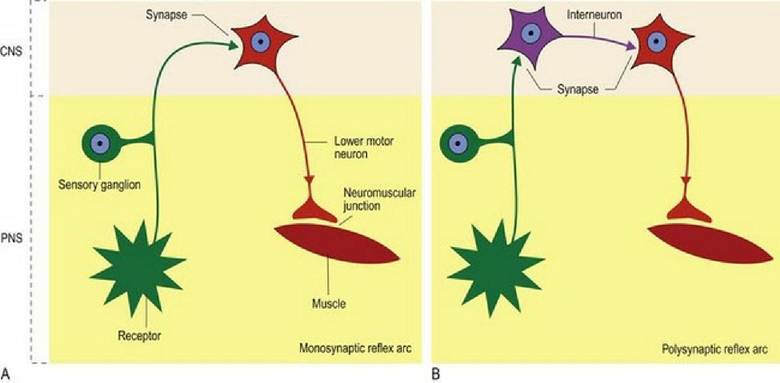
Fig. 4.3 Basic reflex arcs: (A) monosynaptic arc; (B) polysynaptic arc.
A typical reflex is the patellar, or ‘knee jerk’ reflex, in which tapping the patellar ligament with a plexor (patellar hammer), causes reflex contraction of the quadriceps muscle and stifle extension (Fig. 4.4). Simultaneously, the antagonistic semitendinosus and semimembranosus muscles are reflexively inhibited from contracting. Sensory input is via the femoral nerve. In dogs, this nerve synapses directly onto the LMNs in the ventral horns of L4-L6 spinal cord segments, which supply the quadriceps muscle, also via the femoral nerve. Note: a monosynaptic reflex like this is unusual but may include stretch/myotatic reflexes (see Chapter 5); interneurons are usually interspersed between afferent and efferent neurons, resulting in a polysynaptic reflex. Simultaneously, the sensory input also travels caudally, via interneurons, to spinal cord segments L6-S1 to synapse on interneurons that inhibit LMN-induced contraction of the hamstring muscles. Thus, contraction of the quadriceps muscle is unopposed.
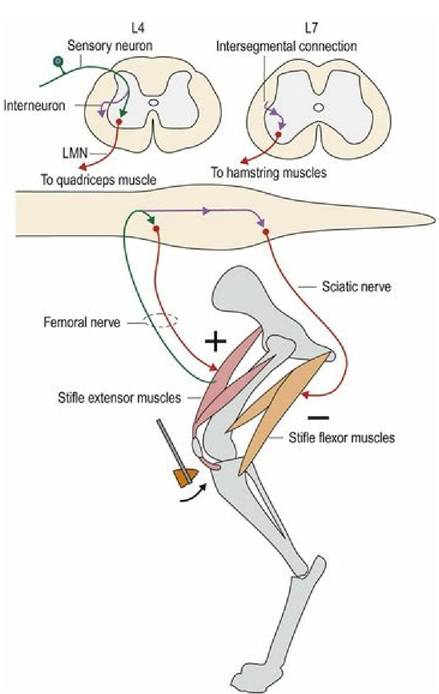
Fig. 4.4 Basic wiring involved in the patellar reflex. Reflexes utilise input from exteroceptors, interoceptors or proprioceptors. They use spinal nerves and cranial nerves and may affect striated or smooth muscles. For example, gut activity is stimulated by the sight and/or smell of food.