» Thorax
The ribs and the thoracic vertebrae are typical. In llamas and alpacas there are seven sternal ribs and five asternal ribs. The anatomy of the thorax with regard to auscultation and thoracic imaging is very similar to that of other species.
In llamas and alpacas, the long axis of the heart in a standing animal is approximately perpendicular to the vertebrae and parallel to the ribs, and on radiographs the heart extends from about the third rib to the fifth intercostal space. The axis of the heart will be tilted more cranially in a lateral radiograph. A heart that is wider than 3 intercostal spaces or taller than three-fourths of the depth of the thorax is considered enlarged.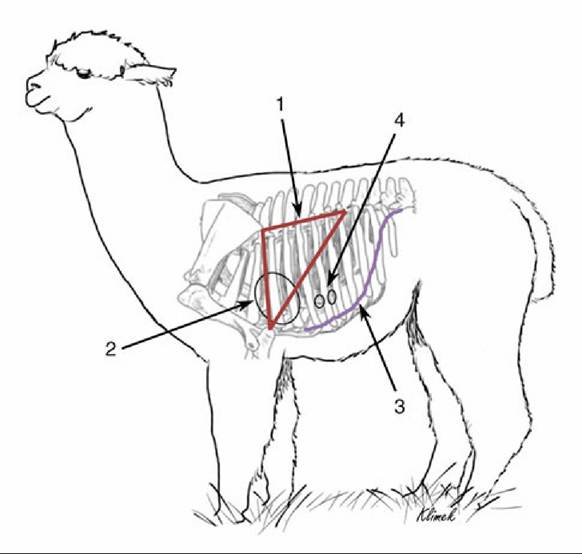
FIG. 38.20 Alpaca thorax showing auscultation landmarks (schematic). 1, Area for auscultation of the lungs (red triangle); 2, position of the heart (large black circle); 3, diaphragmatic line of pleural reflection (purple line); 4, locations to obtain pleural fluid in the seventh or sixth intercostal space (small black circles).
The carina of the trachea is usually at the fourth rib or fourth intercostal space. The angle of the thoracic trachea with the vertebral bodies is 10 to 19 degrees in normal adult llamas and 9 to 22 degrees in normal alpaca crias. This angle may be diminished with heart enlargement.
The boundaries for auscultation of the lungs are typical: the caudal border of the triceps brachii, the lateral border of the epaxial muscles, and a line from the olecranon to the dorsal part of the eighth or ninth intercostal space. The diaphragmatic line of pleural reflections extends dorsally from caudal to the last rib, through the middle of the 11th rib, to the costochondral junction of the 10th rib, and finally follows the costal arch to about the 7th rib. These landmarks are shown schematically in Fig. 38.20.
The lungs of the camelid do not have obvious lobation. There is a tracheal bronchus similar to that found in ruminants that supplies the cranial portion of the right lung. The trachea is often focally enlarged at that point. The right lung extends farther cranially and caudally than does the left.