URINARY SYSTEM
Water intake
Rabbits are thirsty animals. The average intake is 120 ml/kg so a 2 kg rabbit will drink as much per day as a 10 kg dog (Cheeke 1994; Harkness & Wagner 1995).
The amount of water will be influenced by the ambient temperature and the composition and quantity of feed. Rabbits fed a lot of fresh greens obviously will drink less (Brewer & Cruise 1994). Dry food diets and high fiber diets increase water intake to moisten the ingesta in transit.Rabbits will drink excessively if fasted and can drink as much as 650% of normal fluid intake on the third day of anorexia. This can result in sodium depletion (Brewer & Cruise 1994; Lebas et al. 1997a).
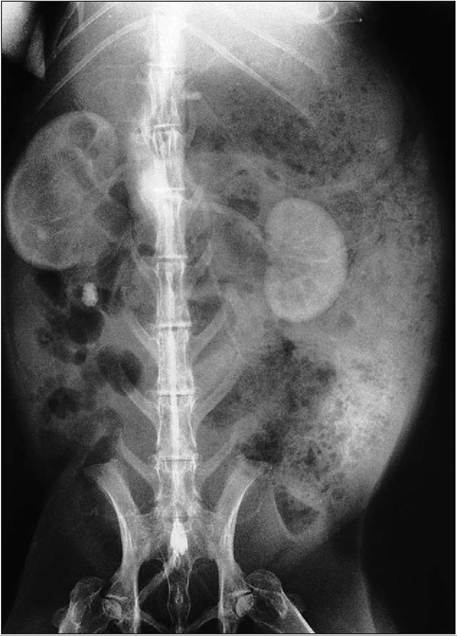
Figure 8.23 • Intravenous urogram in a 2-year-old rabbit with a longstanding ureteral calculus. A benign embryonal nephroma had caused hydronephrosis and hydroureter of the right kidney.
Rabbits are also more vulnerable to acid loads because they lack the normal mammalian renal ammonium buffering system. In most mammals metabolic acidosis (i.e., a drop in serum pH or low bicarbonate) increases the rate of ammonia, which then combines with hydrogen ions and is excreted as the buffer ammonium. This process only occurs in the rabbit in response to low bicarbonate levels making them susceptible to acid-base imbalances (Brewer & Cruise 1994; Cheeke 1987e).
Urine
Rabbits are less able to concentrate their urine and so pass copious amounts. Urine volume varies widely with environment and animal, ranging from 20-350 ml/kg per day, with an average of about 130 ml/kg (Brewer & Cruise 1994). The specific gravity is from 1.003 to 1.036 (average 1.015) and it is alkaline with a pH 7.6-8.8 (lower in a fasting rabbit). Occasional traces of protein and glucose may be present.
Crystals (triple phosphate, calcium carbonate) are found in large quantities, but casts, epithelial cells, and bacteria are usually absent.CLINICAL NOTE
Rabbit fed high calcium diets excrete nearby all the calcium via the urine. This combined with the alkaline pH can cause precipitation of solutes and urolithiasis (Fig. 8.24)
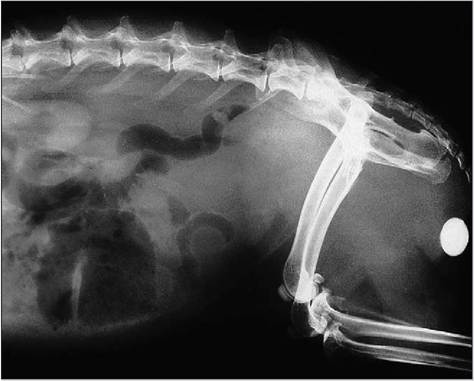
Figure 8.24 • Lateral radiograph of buck rabbit with large urolith obstructing distal urethra. Intestinal ileus is present secondary to anorexia and pain.
Urine is the major route for excretion of magnesium and calcium (Kennedy 1965). It is normally cream colored due to the high levels of calcium carbonate but it can vary from yellow to red in color. Plant pigments commonly produce a bright red urine, which can be confused with hemorrhage (Cheeke 1994).
Calcium metabolism
Calcium absorption and excretion is very different in rabbits (Cheeke 1987e; Kennedy 1965). In most mammals calcium absorption is related to the animal's needs and is regulated by the interaction of parathyroid hormone (PTH) with vitamin D3. Low calcium levels stimulate PTH to produce more Vitamin D3 in the kidney, which then acts on the gut to increase calcium absorption. It also increases tubular reabsorption of calcium from the kidneys and phosphorus excretion. The reverse happens when calcium levels are high.
Rabbits, including wild rabbits, have a much higher (30-50%) plasma calcium level than most mammals; in fact they frequently have blood plasma levels as high as that seen in laying hens (Chapin & Smith 1967a; Cheeke 1994; Kennedy 1965). Dietary calcium rapidly increases serum calcium and decreases phosphorus (Chapin & Smith 1967a). This is controlled by rapid changes in PTH, which stimulates passive absorption of calcium from the gut, independent of Vitamin D (Fairham & Harcourt-Brown 1999; Kennedy 1965).
Excretion of calcium rises during hypercalcemia and decreases with lowered serum levels.
Unlike other mammals that excrete calcium via the bile, rabbits excrete calcium via the kidneys. In contrast to rats, which have been shown to excrete 2% of dietary calcium in their urine, rabbits can excrete up to 60% of that ingested (Cheeke & Amber 1973). Phosphorus, however, is excreted through the feces. The rabbit kidney has a fractional excretion of calcium of 44.9% compared to 2% in most mammals. In fact a 2-3 kg rabbit would excrete as much calcium as an adult human. This is facilitated by a high level of plasma calcium combined with a low rate of tubular reabsorption (Buss & Bordeau 1984; Kennedy 1965).The Ca:P ratio is not as critical in rabbits as in other species as they are extremely tolerant of high calcium intakes. In most vertebrates the ratio is usually about 2:1, but it has been found that growing rabbits are not adversely affected by diets as high in calcium as 12:1 (Chapin & Smith 1967a).
CLINICAL NOTE
Although rabbits are extremely tolerant of high calcium levels, high levels of phosphorus could adversely affect bone calcification and growth, so if a diet contains excess amounts of phosphorus, like wheat bran, a calcium supplement may be needed (Chapin & Smith 1967b).
Vitamin D
The role of vitamin D in rabbits is still not fully evaluated as even a three- to four-fold increase in Vitamin D has no effect on serum calcium. Calcium levels are controlled instead by renal homeostasis. A diet low in calcium was found to decrease calcium excretion and increase phosphorus under the influence of elevated PTH levels in young growing rabbits (Bordeau et al. 1988).
However, chronic deficiency of Vitamin D does lead to mild hypocalcemia, elevated PTH and reduced excretion of both calcium and phosphorus. It is thought that although Vitamin D plays little role in passive intestinal absorption with normal dietary calcium levels it does increase calcium absorption by active transport when dietary calcium levels are low. Vitamin D also regulates phosphorous metabolism, leading to severe hypophosphatemia if deficient (Bordeau & Schwer-Dymerski 1986).
Oversupplementation with calcium or Vitamin D could lead to metastatic calcification of soft tissues like the aorta and kidneys (Cheeke 1987e). As the kidney controls calcium levels, renal damage could also impair excretion and cause hypercalcemia and metastatic calcification.
CLINICAL NOTE
Rabbit urine is normally cream colored due to the excess calcium being excreted in the urine. Growing kits, pregnant does or malnourished rabbits may have clear urine due to increased calcium retention.
Accessory glands
The seminal vesicles open into the prostatic section of the urethra. The small paired bulbourethral glands form a bilobed swelling in the dorsal wall of the urethra, just behind the prostate (Cruise & Nathan 1994).
Female
The ovaries are elongated and located more caudally than in cats and dogs. The oviducts are very long and coiled. The uterus is duplex, being separate along its length and forming two cervices, uniting only to form a long vagina (Figs. 8.25 and 8.26).
KEY POINTS
• Unlike most mammals the main route of calcium excretion is through the urine.
• Rabbits naturally have high serum calcium levels, which is in direct proportion to dietary calcium levels.
• Efficient calcium absorption from the diet is independent of Vitamin D.
• Rabbits have a much higher fractional excretion of calcium than other mammals.