Vascular Resistance Is Defined as Perfusion Pressure Divided by Flow
Everyday experience tells us that it is easier to force fluid through a large tube than through a small tube. For example, it is easier to drink a milk shake through a large-diameter straw than through a small-diameter straw.
For a given driving force (perfusion pressure difference), the flow is higher in the large tube because it offers less resistance to flow (less friction) than the small tube. The precise definition of resistance follows: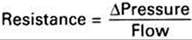
APressure (perfusion pressure difference, or simply perfusion pressure) is the pressure at the lube inlet minus the pressure at its outlet. Figure 22-3 presents these concepts in pictorial and graphic form. The dashed lines in Figure 22-3 indicate that a perfusion pressure of 60 mm Hg causes a flow of 1600 milliliters per minute (mL∕min) through the large tube. Thus the resistance of the large tube is 37.5 mm Hg/liter per minute (L∕min). The same perfusion pressure (60 mm Hg) causes a flow of only lOOmL/min through the small tube. The resistance of the small tube is therefore 600 mm Hg/L/min. The resistance of the small tube is 16 times greater than the resistance of the large tube.
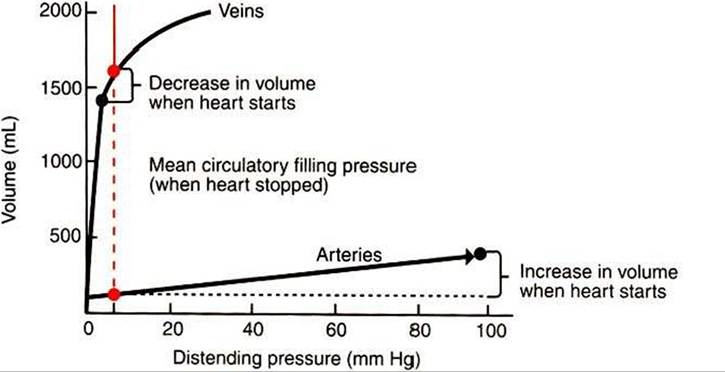
FIGURE 22-2 Typical relationships between volume (of blood) and distending pressure for veins and arteries. Veins are more compliant (easier to distend) than arteries, so they hold a greater volume of blood for a given distending pressure.This concept is illustrated for a distending pressure of 7 mm Hg (vertical dashed red line}, which is a normal value for the mean circulatory filling pressure (the pressure that would exist in the circulation if the heart were stopped, as shown in Figure 22-1). For a distending pressure of 7 mm Hg, the veins contain about 1600 mL of blood and the arteries only 125 mL (red circles).
When the heart is restarted, the venous volume decreases, and the arterial volume increases (black circles). Because the veins are much more compliant than the arteries, the venous pressure changes very little (decreases from 7 to 3 mm Hg), whereas the arterial pressure changes greatly (increases from 7 to 98 mm Hg).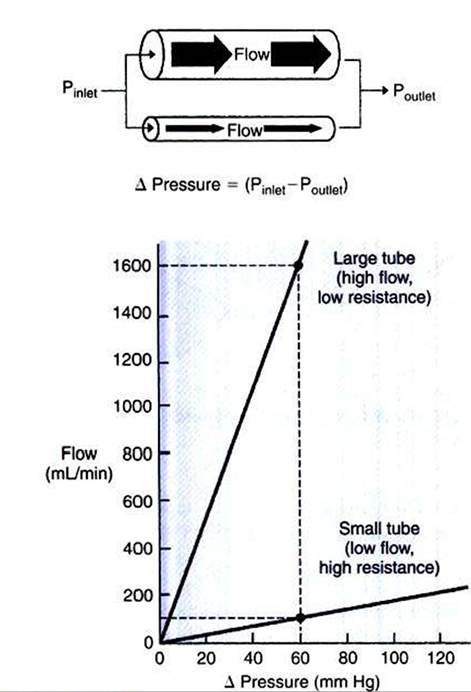
FIGURE 22-3 Relationship between fluid flow and perfusion pressure (^Pressure) for two tubes.The perfusion pressure is the pressure at the inlet (Pinlet) of the tube minus the pressure at the outlet (P0υl∣el). ∣n this example, the larger tube has twice the radius of the smaller tube. For a given perfusion pressure, the flow through the larger tube is 16 times greater than the flow through the smaller tube. That is, the resistance of the larger tube is one-sixteenth the resistance of the smaller tube.
In the late 1800s the French physician J.L.M. Poiseuille demonstrated the dominant effect of radius on the resistance of a tube. He showed the following:

where / is the length of the tube, r is the radius, η is the viscosity of the fluid flowing through the tube, and π has its usual meaning.
This equation (Poiseuille9S law) states that the resistance of a tube varies inversely with the fourth power of the radius, so that doubling the radius (r) of the tube decreases its resistance by a factor of 16 (24). Resistance is also influenced by the length (I) of the tube. This makes intuitive sense; it is harder to force fluid through a long tube than through a short tube of the same radius. The final determinant of resistance is the viscosity (η) of the fluid. The higher the viscosity of the fluid, the higher is the resistance to its flow through a tube.
For example, honey is more viscous than water, so a tube would offer a higher resistance to the flow of honey than to the flow of water.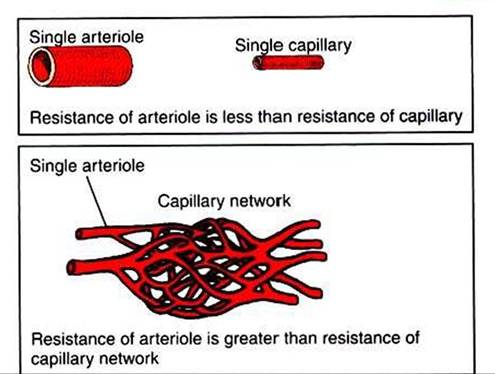
FIGURE 22-4 The resistance of a single arteriole is less than the resistance of a single capillary, because arterioles are larger in diameter. However, each arteriole supplies blood to a whole network of capillaries, and the resistance of an arteriole is greater than the resistance of the capillary network that it supplies with blood (see text).
As already described, the arterioles are the segment of the systemic circulation with the highest resistance to blood flow (see Figure 22-1). It may seem paradoxical that the arterioles are the site of highest resistance when the capillaries are smaller vessels. After al), a smaller tube has a much higher resistance than a larger tube (see Figure 22-3). The resolution of this paradox is presented in Figure 22-4. It is true that each capillary has a smaller radius and therefore a greater resistance than each arteriole. However, each arteriole in the body distributes blood to many capillaries, and the net resistance of all those capillaries is less than the resistance of the single arteriole that delivers blood to them. Il is only because each arteriole delivers blood to so many capillaries that the net resistance of the capillaries is less than the resistance of the arteriole.
Arterioles are the site not only of the highest resistance in the circulation, but also of adjustable resistance. Variation in arteriolar resistance is the main factor that determines how much blood flows through each organ in the body; an increase in arteriolar resistance in an organ decreases the blood flow through that organ, and vice versa. Arterioles change their resistance, moment to moment, by changing their radius. (The length of an arteriole does not change, at least not over the short term.) The walls of arterioles are relatively thick and muscular.
Contraction of the arteriolar smooth muscle decreases the radius of arterioles, and this vasoconstriction substantially increases resistance to blood flow. Relaxation of the smooth muscle allows the radius of the vessels to increase, and this vasodilation substantially reduces the resistance to blood flow.Figure 22-5 illustrates that a small change in the radius of arterioles in an organ brings about a large change in resistance and therefore in blood flow. In this example the arterial pressure is 93 mm Hg and the venous pressure is 3 mm Hg, so the perfusion pressure is 90 mm Hg. The brain blood flow is
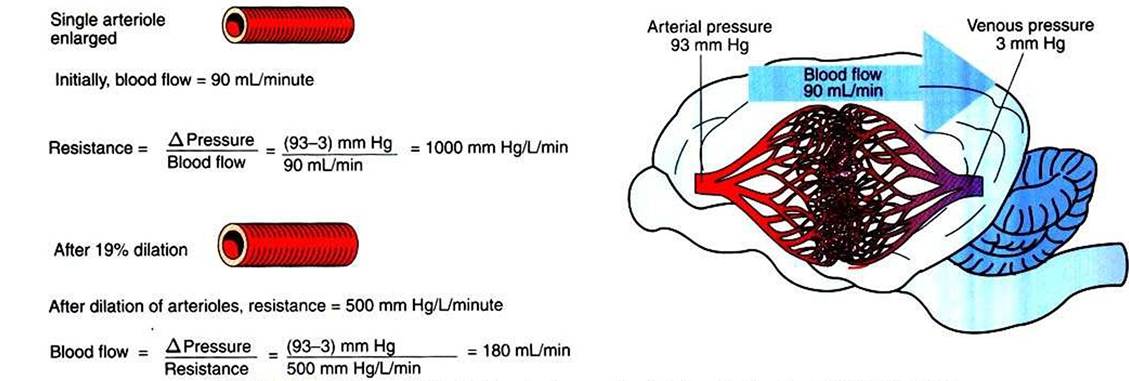
FIGURE 22-5 Example illustrating that a small arteriolar dilation (vasodilation) would substantially increase blood flow to the brain (see text).
initially observed to be 90 mL∕min. Based on the mathematical definition of resistance, the resistance of the brain blood vessels is IOOOmrn Hg/L/min. Most of this resistance is provided by the brain arterioles. Next, consider the consequence of a slight vasodilation, such that the radius of the arterioles increases by 19% (e.g., from a radius of 1.00 to a radius of 1.19). Recall from Poiseuilles law that the resistance varies inversely as the fourth power of the radius. Because 1.19, equals 2.00» a 19% increase in radius cuts the resistance in half! Decreasing the brain’s resistance by half (to 500 mm Hg/L/min) would double the brain blood flow (to 180 mL∕min).