VISCERAL AFFERENT PATHWAYS
There are both “general” and special visceral afferent pathways, and the latter is concerned with taste and smell. The receptors of the general visceral afferent pathway are found within viscera and blood vessels; most are mechanoreceptors responsive to pressure, stretch, and, less commonly, flow, while a minority are chemoreceptors responsive to such stimuli as the carbon dioxide content of the blood.
The fibers that convey impulses from these receptors travel within any conveniently located nerve trunk, utilizing those of mainly somatic composition as well as those whose other com-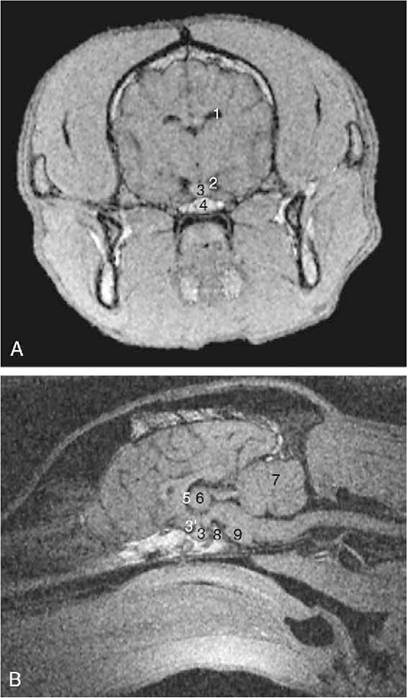
Figure 8-52 Transverse image at the level of the pituitary fossa (A) and median image (B) of 1-mm-thick T1-weighted gradient-echo magnetic resonance slices of the canine head. 1, Lateral ventricle; 2, basal cistern; 3, pituitary gland; 3', infundibulum; 4, fat in sphenoid bone; 5, third ventricle; 6, interthalamic adhesion; 7, cerebellum; 8, dorsum sellae; 9, pons.
ponents are visceral efferent. The bodies of the primary neurons are located within the dorsal root ganglia of all spinal nerves (and the equivalent ganglia of certain cranial nerves); the axons project on interneurons and projection neurons within the visceral afferent column of the spinal cord and brainstem (Figure 8-12/2).
Short chains of interneurons provide for simple visceral reflexes that have their last two relays within the visceral efferent column and the peripheral autonomic ganglia. The projection neurons form ascending pathways that follow somatic systems, both lemniscal and extralemniscal, to end (like these) within nuclei of the ventrocaudal thalamus. A final projection to the cortex may give rise to conscious perception, although most visceral activity goes unnoticed. (The sense of fullness arising from digestive organs or the bladder is among the visceral activities of which awareness is most common.) Pronounced contraction and serious overdistention of visceral organs may be perceived as pain. Pain of visceral origin may be “referred” to the surface of the body, presumably as a consequence of the convergence of the cutaneous somatic and visceral afferent pathways on the same neurons at some point along their course.
The special visceral afferent pathway concerned with taste follows a similar route to that taken by the general visceral sensory modalities. The course from the taste buds within the facial, glossopharyngeal, and vagus nerves terminates in the nucleus of the solitary tract.
The more complicated olfactory pathways are described elsewhere (see Figure 8-40).