Epidemiology
Sporotrichosis is not a registered disease; therefore its real prevalence in a given region is difficult to determine. Also inadequate diagnostics hinder understanding of epidemiology.
Therefore reliable data on disease incidence in endemic regions are not always available and vary between countries (Pappas et al. 2000, 2003).Sporotrichosis is considered a cosmopolitan mycosis, but it occurs more often in regions with humid (sub)tropical and temperate climates. Countries with highly endemic areas include South and Central America, South Africa, China, Japan, and India (Mayorga et al. 1978; Fukushiro 1984; Conti Diaz 1989; Verma et al. 2012; Schubach et al. 2005b; Camacho et al. 2015; Chakrabarti et al. 2015). In Brazil, feline sporotrichosis is more common in the South and Southeast regions, being considered endemic in the state of Rio de Janeiro (Oliveira et al. 2011), especially in areas with high population density and low sanitation rates (Barros et al. 2008). In other regions of Brazil, basal transmission levels have been reported (de Araujo et al. 2015), and human infections are usually associated with direct contact with soil and decaying organic matter (Rodrigues et al. 2014d). Sporothrix globosa causes a large sapronosis in the relatively cold climate in Jilin, China's northeast province (Zhang et al. 2015). Species-specific differences in biogeography of the disease are of clinical interest (Rodrigues et al. 2016b). For example, in the USA and Australia, major outbreaks were described in patients who reported previous contact with Sphagnum moss or hay (Dixon et al. 1991; Coles et al. 1992; Feeney et al. 2007). In these cases, S. schenckii s. str. was the etiological agent. However, in the large outbreaks in China, India, and Japan (Fukushiro 1984;
Verma et al. 2012; Song et al. 2013), humans were probably infected through soil and plant debris.
The classical transmission route occurs via traumatic inoculation of Sporothrix propagules from soil and plant material (Fig. 10.6). In many cases, lesions caused by thorns or splinters, or scratches against tree bark or contaminated wood, can result in the development of the disease (Powell et al. 1978; de Araujo et al. 2015).
The disease can also be acquired through animal bites or scratches, especially from cats (Schubach et al. 2004; Schubach et al. 2005a; Barros et al. 2008). Sporotrichosis has also been reported in other animals such as dogs, rats, horses, mules, armadillos, goats, bats, squirrels, camels, dolphins, and foxes (Fig. 10.7). Among the animals able to develop sporotrichosis, the domestic cat (Felis catus) is the animal host more susceptible to infection by Sporothrix, and due to the proximity to humans, it presents the greatest potential for zoonotic transmission. When the cat transmits the fungus by scratching or biting, the contamination is caused by the yeast inoculum and not by conidia (Fig. 10.6). According to Fernandes et al. (2000), the yeast is more virulent in the murine model than the conidia. This may enhance the alternative, mammal-borne transmission route (Almeida-Paes et al. 2014).
The presence of the fungus in the cat's skin and fur, the habit of foraying away from home, and the involvement in fights with other animals likely favor fungal transmission among cats (Barbee et al. 1977). In cats, mycosis follows a severe course in which the fungus spreads quickly from initial skin lesions. Schubach et al. (2002) isolated Sporothrix from 100% of skin lesion samples, 66.2% of nasal cavity samples, 41.8% of oral cavity samples, and 39.5% of nail samples of cats with sporotrichosis. Transmission of the fungus to humans occurs through scratches or bites as well as through contamination of preexisting skin wounds (Dunstan et al. 1986). The role of cats in the epidemiology of human sporotrichosis has been emphasized since the 1980s; however, little was known about feline sporotrichosis and the role of cats in the epidemiological chain (Larsson et al.
1989).The first reports of human cases due to transmission by cats were described by Read and Sperling (1982). In the state of Rio de Janeiro, the epicenter of areas of catcat and cat-human transmission, several outbreaks have been reported (de Lima Barros et al. 2003; Oliveira et al. 2011). Currently a large epidemic takes place. Between the 1980s and 1990s, a low number of human sporotrichosis cases were registered by the Evandro Chagas Institute of Clinical Research (Fiocruz, Rio de Janeiro, Brazil). In the late 1990s, 759 cases of human sporotrichosis were diagnosed, with a direct correlation between human and cat cases (de Lima Barros et al. 2001). From 1998 to 2004, Fiocruz identified 1503 cats and 64 dogs with sporotrichosis in Rio de Janeiro (Schubach et al. 2005b). The epidemiological data show an unprecedented spread of the epidemic, with more than 4000 human and feline cases (Gremiao et al. 2015, 2017). Such data underline the successful transmission via cats. Currently, the feces of contaminated animals are identified as possible sources of S. brasiliensis in nature (Montenegro et al. 2014; Rodrigues et al. 2015a). In the Brazilian states of Rio Grande do Sul and Sao Paulo, epizootics in cats exist with similar characteristics to those observed in Rio de Janeiro (Sanchotene et al. 2015; Montenegro et al. 2014). Early diagnosis of the disease
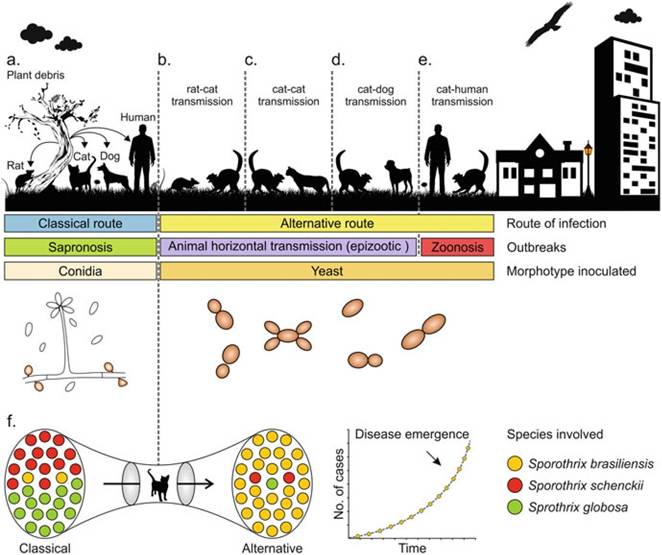
Fig. 10.6 Epidemiological aspects of the transmission chain of human and animal sporotrichosis. (a) Classically, sporotrichosis is a sapronosis, in which the mammalian host (humans, rats, cats, and dogs) can acquire the disease through direct contact with the environment (classical transmission route). (b) Horizontal animal transmission may involve the rat-cat contact (rat-rat, not shown). (c) The cat-cat transmission causes epizootics in populations of susceptible cats, especially in densely populated urban areas such as the metropolitan regions of Rio de Janeiro, Sao Paulo, and Rio Grande do Sul (Brazil).
(d) Cats can transmit Sporothrix spp. to dogs by traumatic inoculation. (e) Due to the proximity to humans, cats have great potential for zoonotic transmission in urban areas. Note that in scenarios (b-e) (alternative transmission route), traumatic inoculation of Sporothrix yeast, a more virulent morphotype, occurs. Furthermore, a greater fungal load is transmitted in the alternative transmission route. Such factors (inoculum size, yeast morphotype, and S. brasiliensis) lead to the onset of more severe forms of the disease in the population. (f) In the classical transmission route, transmission occurs mainly by traumatic inoculation of S. schenckii and S. globosa from soil and plant debris. However, the S. brasiliensis-cat association causes horizontal transmission of S. brasiliensis to other animals (rats, cats, dogs, etc.) and humans. In areas with epizootics of feline sporotrichosis, S. brasiliensis is prevalent in cats and, consequently, in humans because of zoonotic transmission. In areas where the classical infection route is prevalent, the main etiological agent is S. schenckii s. str. or S. globosa (depending on the region). Therefore, reservoirs, vectors, microbes, and hosts may vary in the disease transmission chainand control and prevention measures are extremely important (Madrid et al. 2010, 2012). Dogs do not seem to play an important role in disease transmission (Barros et al. 2010).
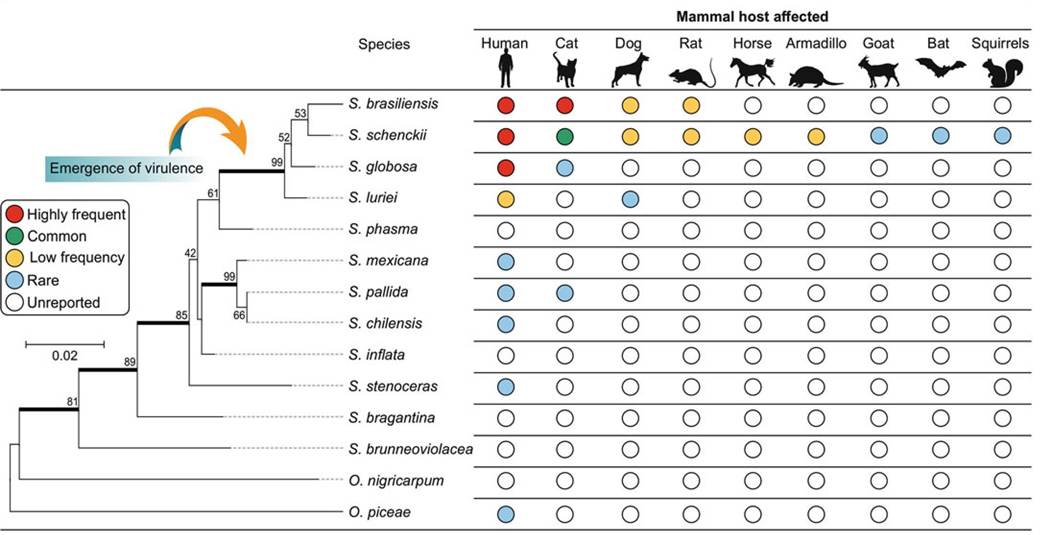
Fig. 10.7 Mammalian hosts of sporotrichosis. Among the species of clinical relevance, Sporothrix brasiliensis, S. Schenekii, and S. globosa are highly frequent in humans. A few cases of infection by S. Iuriei have been described in the literature. In Brazil, large epizootics are caused by S. brasiliensis in cats. In turn, S. Schenckii is an important etiological agent of feline sporotrichosis in other regions of the world (e.g., Peru, the USA, and Malaysia). Although diagnosed in other animals such as dogs, rats, armadillos, goats, bats, and squirrels, Sporothrix spp.
infection in these animals is less frequent than that observed in cats and humans. Rare cases of human infection have been reported for members of the environmental clade such as S. mexicana, S. pallida, S. chilensis, S. Stenoceras, and Ophiostoma piceae. Note that the frequency of infection caused by members of the S. Schenckii complex is higher due to the emergence of pathogenicity in this group210 A. M. Rodrigues et al.
The prevalent agent in epizootics of feline sporotrichosis is S. brasiliensis (96.9%), an agent endemic to Brazil. Phylogenetic and population genetic analyses confirm zoonotic transmission (cat-human) of S. brasiliensis and the low genetic diversity of this species. A positive correlation exists between the number of feline cases and the marked increase in human cases. Over time, S. brasiliensis will expand its biogeographical occurrence.
On rare occasions, sporotrichosis has been associated with scratches and bites during the hunting of wild animals. In the state of Rio Grande do Sul (Brazil), ten cases of sporotrichosis associated with armadillo hunting were recorded from 2005 to 2009 in hunters scratched by the animals (Alves et al. 2010). The etiological agent was S. schenckii (Rodrigues et al. 2014a), the same species found in 18 clinical isolates from cats in Malaysia (Kano et al. 2015) (Fig. 10.7).
10.5