Parturition
The average gestation length of the goat is 150 days. There is a tendency for goats bearing triplets to kid slightly earlier (149 days) than goats with single kids (151 days) (Peaker 1978).
Doe kids tended to be carried one day longer than male kids in one study (Amoah and Bryant 1983). One Mexican study of 1468 pregnancies showed breed effects on gestation length as well as advantages to kid survival of a longer gestation, because of increased birthweight (Mellado et al. 2000). The birthweights of twins and triplets are approximately 0.91 and 0.82 of the weight of a single dairy goat kid. Parturition in the doe is termed kidding. Births are concentrated during the daylight period with a maximum at midday and early afternoon in stabled goats (Lickliter 1984/85; Bosc et al. 1988).Normal Parturition
Signs of impending delivery include relaxation of the pelvic ligaments at the base of the tail, separation from the herd and defense of the area chosen for giving birth, increased restlessness (up and down, pawing), and low-pitched vocalizations with closed mouth. For the actual delivery of the kids, the doe often lies down next to a vertical surface such as a wall, fence, or feed trough (Lickliter 1984/85). The doe should be left undisturbed and in its natural surroundings, to avoid interfering with normal delivery.
Parturition is traditionally divided into three stages. First- stage labor, when the cervix softens and relaxes and uterine contractions force placenta, fetus, and fluids against the cervix to help dilate it, lasts up to 12 hours in primiparous does (Bliss 1988). Multiparous does typically proceed faster. Second-stage labor, which is accompanied by straining (contraction of abdominal muscles), typically lasts two hours or less and is completed by expulsion of the last kid. The third stage involves expulsion of the placenta (normally within four hours) and involution of the uterus.
Lochia, which should not have a foul odor, is normally discharged for as long as three weeks (Wittek and Elze 2001). Owners may choose to clip or wash the tail to prevent unsightly accumulation of lochia (Figure 13.7). Macroscopic involution of the uterus is complete in approximately four weeks (Greyling and Van Niekerk 1991b).Evaluation for Dystocia
Most kiddings occur uneventfully and without any human assistance. In one report of records kept by breeders, 95% of does required no help (Engum and Lyngset 1970). In one study of 60 normal parturitions, the fetal forelegs appeared from 3 to 38 minutes (average 12 minutes) before delivery of the kid was completed (Lickliter 1984/85). Some does experience difficulty delivering their kids because of problems such as fetal malpresentation or oversize or failure of cervical dilation. These animals may or may not be observed to be in active labor (straining) and placenta or fetal parts may or may not be visible. Thus, the question frequently arises of whether or not the goat is in labor or in need of assistance. Certainly, if hard labor produces no kids in one-half to one hour or if placenta has been showing for that long, closer evaluation of the doe is warranted (Yankovich 1990); in most situations, when the exact time of onset is unknown, no progress after 30 minutes of labor should prompt intervention. Yellow staining of the mucus with fetal meconium (Figure 13.8) also indicates that
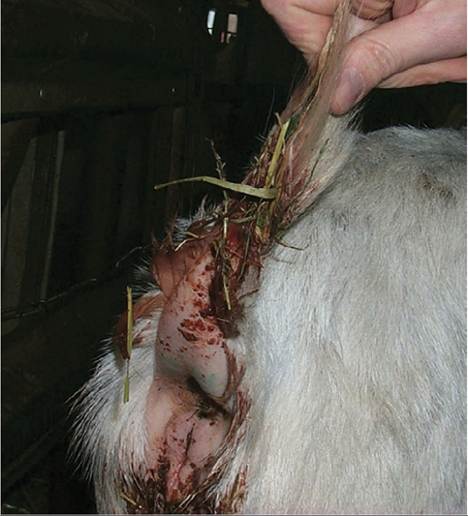
Figure 13.7 Postpartum doe with lochia adhering to the tail.
Source: Courtesy of Dr. M.C. Smith.
assistance should be provided at once. To limit discomfort or bruising of the doe and subsequent infection of her reproductive tract, the vulva should be washed with mild soap. Examination should be made with a gloved, well- lubricated, small hand or (less traumatic) glass artificial insemination speculum.
When the main source of concern is merely that the seemingly happy doe is overdue to kid, the calculations of due date (including the possibility of rebreeding) should be checked.
Normal does undergo a softening of ligaments around the birth canal before the onset of parturition. If the sacrotuberous ligaments (extending from tailhead to tuber ischiadicum, or pinbone, bilaterally) have softened to the point of disappearing completely, then parturition usually occurs within 12 hours (Yankovich 1989). The doe should be examined carefully if nothing happens within the next 12-16 hours. Progesterone in the blood also drops within 24 hours of parturition (Fredriksson et al. 1984). A bovine or canine enzyme immunoassay progesterone kit test value that is low (5 ng/mL) usually means that parturition is more than a day away (Singer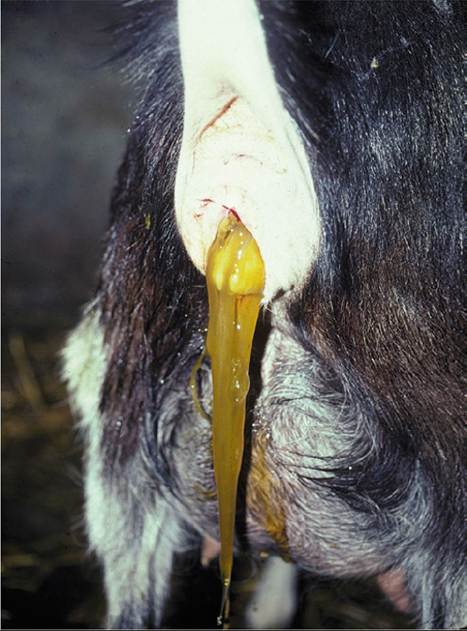
Figure 13.8 Meconium staining of the mucus indicates fetal distress and need for intervention. Source: Courtesy of Dr. M.C. Smith.
et al. 2004). Induction of parturition, discussed above, shortens the period when close observation is required.
Care of the Newborn Kid
In all kids, whether born naturally or assisted, or delivered by cesarean section, attention should be given to important health measures. Unless special care is given to undersized kids, they are especially susceptible to death from hypothermia and starvation (Bajhau and Kennedy 1990). How feral goats care for their kids is described in Chapter 1.
Respiration
The parturient doe normally licks the kid intensely, beginning with its head and neck. Placental membranes (if present) are torn from the head, and fluid is manually removed from the nostrils and mouth if the doe does not attend to these matters. The kid can be stimulated to breathe and fluids cleared from its nose (but not lungs) by swinging it (in a location away from walls and other hard objects). The hindlimbs of the kid are held firmly by one hand while the other hand and forearm support the head, neck, and shoulder area. The kid is swung in a 90° arc once or twice, then returned to the ground and rubbed briskly with a clean, dry towel or straw.
Kids that still are not breathing but have a palpable heartbeat may be given a respiratory stimulant such as doxopram HCl (1-1.5 mg/kg intravenously or sublingually). A resuscitation device for lambs has been described (Weaver and Angell-James 1986) that should be equally valuable in establishing respiration in apneic kids. It consists of a mouth piece (milk inflation), one-way valve, flange, and oral tube approximately 9.5 cm long. An infant bag valve mask could be used if available. A lung inflation rate of 20 times per minute is recommended. Owners and veterinarians alike should resist the urge to supply direct mouth-to-mouth respiration when the kid does not respond to swinging and rubbing. Many dystocias and weak kids are the result of in utero infection with zoonotic pathogens.Kids delivered by cesarean section or with apparent neonatal maladjustment can be treated with resuscitation compression of the chest using half hitches with a soft cotton rope applied for 5 minutes (“Madigan squeeze”) (Flora et al. 2021). This mimics the normal birth process.
Umbilicus
The umbilical stump should be dipped in iodine. Some authors recommend 7% tincture of iodine, while others consider 2% tincture of iodine or povidone iodine to be preferable. The stronger solution has the advantage of drying the tissues, to prevent later penetration of bacteria. However, availability of 7% tincture of iodine is currently restricted in the United States because of potential misuse for methamphetamine production. Excess length that would otherwise drag on the ground should be trimmed off the cord with clean scissors and the fresh end thoroughly immersed in the iodine. Do not dip the prepuce of the male kid. Using a partially filled small pill bottle or small paper cup avoids contamination of the stock solution. In herds experiencing problems with omphalophlebitis or septicemia, repeated dipping on a daily or twice-daily basis might be advocated. A clean, dry environment is a more effective prophylactic measure.
Housing
In cold weather, careful attention should be given to drying the kid, especially the extremities. Otherwise, the tips of the ears may be lost through frostbite. Folded ears can be straightened out and splinted at this time, using portions of a Styrofoam cup or plastic hair rollers. If the doe is to raise her kid, mother and offspring should be penned together on clean bedding, or at least observed closely until a pair bond is established and the kid is nursing and following well. Kids to be raised artificially should be removed to another location, where they should not be in contact with kids more than two weeks older than themselves. Heat lamps, with space for the kids to get away if they become overheated, may be used with caution in cold weather. Commercial coats or homemade body socks made of sweatshirt sleeves or wool socks (toe removed, holes cut for the front feet) in place of heat lamps avoid all danger of barn fires.
If kids are chilled at birth, force feeding or rewarming may be necessary for survival. The chilled kid does not suckle. Determining the rectal temperature is helpful when choosing the method of rewarming (Eales et al. 1984). If the temperature is 36.7-37.8 °C (98-100 °F), it is often adequate to tube-feed warm colostrum and place the kid under a heat lamp. Colder kids can be rewarmed in a water bath or with the aid of a hair dryer or space heater aimed into a box or a dog crate. Some producers heat bath towels in the dryer, turn it off, and install the kid into the nest of towels. Continue to monitor the rectal temperature, because overheating can easily occur. If the chilled kid is to be raised by its dam, the water bath technique may wash away birth fluids and thereby cause rejection by the mother. This can be avoided by placing the kid's body into a plastic bag before it goes into the water bath.
Colostrum
Nursing kids should be assisted to obtain colostrum. Plugs should be stripped out of each teat by hand and the udder secretion inspected for evidence of mastitis. The fullness of the kid's abdomen should be monitored regularly, because this, rather than time spent sucking on a teat, is what counts. Obviously, a kid with atresia of anus or colon remains distended, even after nursing ceases, but otherwise the plump, active kids can be assumed to be drinking well. If kids are to be raised artificially or are too weak to suckle, the section of Chapter 19 devoted to feeding newborn kids should be consulted. Dietary deficiencies discussed in Chapter 19 (iodine, selenium, copper, vitamin E) may contribute to a herd problem with weak kids that do not suckle. Heat treatment of colostrum and milk for disease control is discussed under CAE in Chapter 4. Failure of transfer of passive immunity is discussed in Chapter 7.
More on the topic Parturition:
- Induced Abortion or Parturition
- Prolonged Gestation
- Periparturient Problems
- CHAPTER MENU
- Late-Term Complications of Gestation
- Medical Record
- Perinatal Adaptation
- Neoplasia of the Female Reproductive Tract
- FEMALE MARSUPIALS
- Serum or plasma protein measurements constitute a vital component of laboratory diagnostic evaluations.