REFERENCES
The complete list of references can be found at www.expertconsult.com.
REFERENCES
Ophthalmic History and Examination
1. Townsend WM: Disease and surgery of the equine lens, Vet Clin North Am Equme 33:483, 2017.
2. Gilger BC, Stoppini R: Equine ocular eye examination: routine and advanced diagnostic techniques. In Gilger BC, editor: Equine ophthalmology, ed 2, Maryland Heights, MO, 2011, Saunders, pp 1-51.
3. Betts DM: Ophthalmic examination techniques for food and fiber animals. In Howard JL, editor: Current veterinary therapy food animal practice, ed 3, Philadelphia, PA, 1993, Saunders, p 829.
4. Townsend WM: Food and fiber-producing animal ophthalmology. In Gelatt KN, editor: Veterinary ophthalmology, ed 4, Ames, IA, 2007, Blackwell, pp 1275-1335.
5. Myrna KE: Neuro-ophthalmology in the horse, Vet Clin North Am Equine 33:541, 2017.
6. Whitley RD, Moore CP: Ocular diagnostic and therapeutic techniques in food animals, Vet Clin North Am Large Anim Pract 6:553, 1984.
7. Hakanson NE, Merideth RE: Ocular examination and diagnostic techniques in the horse. II. Assessment of vision and examination of the intraocular structures, Equine Pract 9:6, 1987.
8. Knollinger AM, La Croix NC, Barrett PM, et al: Evaluation of rebound tonometer for measuring intraocular pressure in dogs and horses, J Am Vet Med Assoc 227:244, 2005.
9. Komaromy AM, Garg CD, Ying GS, et al: Effect of head position on intraocular pressure in horses, Am J Vet Res 67:1232, 2006.
Signs of Ocular Disease
1. Leipold HW: Congenital ocular defects in food-producing animals, Vet Clin North Am Large Anim Pract 6:577, 1984.
2. Townsend WM: Food and fiber-producing animal ophthalmology. In Gelatt KN, editor: Veterinary ophthalmology, ed 4, Ames, IA, 2007, Blackwell, pp 1275-1335.
3. Munroe GA, Barnett KC: Congenital ocular disease in the foal, Vet Clin North Am Large Anim Pract 6:519, 1984.
4. Williams DL: Congenital abnormalities in production animals, Vet Clin North Am Food Anim Pract 26:477, 2010.
5. Ramsey DT, Ewart SL, Render JA, et al: Congenital ocular abnormalities of Rocky Mountain horses, Vet Ophthalmol 2:47, 1999.
6. Komaromy AM, Rowlan JS, La Croix NC, et al: Equine multiple congenital ocular anomalies (MCOA) syndrome in PMEL17 (Silver) mutant ponies: five cases, Vet Ophthalmol 14:313, 2011.
7. Mousel MR, Reynolds JO, White SN: Genome-wide association identifies SLC2A9 and NLN gene regions as associated with entropion in domestic sheep, PLoS ONE 10:1, 2015.
8. Anderson DE, Badzioch M: Association between solar radiation and ocular squamous cell carcinoma in cattle, Am J Vet Res 52:784, 1991.
9. Giuliano EA: Equine ocular adnexal and nasolacrimal disease. In Gilger BC, editor: Equine ophthalmology, ed 2, Maryland Heights, MO, 2011, Elsevier Saunders, pp 133-180.
10. McConaghy FF, Davis RE, Hodgson DR: Equine sarcoids: a persistent therapeutic challenge, Compend Contin Educ Pract Vet 16:1022, 1994.
11. Moore CP, Grevan VL, Champagne ES, et al: Equine conjunctival pseudotumors, Vet Ophthalmol 3:51, 2000.
12. Colitz CMH, McMullen RJ: Diseases and surgery of the lens. In Gilger BC, editor: Equine ophthalmology, ed 2, Maryland Heights, MO, 2011, Elsevier Saunders, pp 282-316.
13. Brown MH, Brightman AH, Fenwick BW, et al: Infectious bovine keratoconjunctivitis: a review, J Vet Intern Med 12:259, 1998.
14. Moore CP: Eyelid and nasolacrimal disease, Vet Clin North Am Equine Pract 8:499, 1992.
15. Myrna KE: Neuro-ophthalmology in the horse, Vet Clin North Am Equine 33:541, 2017.
16. Wotman KL, Johnson AL: Ocular manifestations of systemic disease in the horse, Vet Clin North Am Equine 33:563, 2017.
17. Hurn S, Turner A, McCowan C: Ectopic cilium in seven horses, Vet Ophthalmol 8:199, 2005.
18. Dwyer AE: Practical management of blind horses. In Gilger BC, editor: Equine ophthalmology, ed 2, Maryland Heights, MO, 2011, Elsevier Saunders, pp 470-481.
Ocular Trauma
1. Galle LE, Moore CP: Clinical microbiology. In Gelatt KN, editor: Veterinary ophthalmology, ed 4, Philadelphia, PA, 2007, Lippincott Williams & Wilkins, pp 236-270.
2. Caron JP, Barber SM, Bailey JV, et al: Periorbital skull fractures in five horses, J Am Vet Med Assoc 188:280, 1986.
3. Turner LM, Whitley RD, Hager D: Management of ocular trauma in horses. I. Orbit, eyelids, uvea, lens, retina, and optic nerve, Mod Vet Pract 67:341, 1986.
4. Morgan RV, Daniel GB, Donnell RL: Magnetic resonance imaging of the normal eye and orbit of the horse, Prog Vet Comp Ophthalmol 3:127, 1993.
5. Boroffka S, van den Belt A: CT/ultrasound diagnosis: retrobulbar hematoma in a horse, Vet Radiol Ultrasound 37:41, 1996.
6. Santos M, Gutierrez-Nibeyro S, Stewart A, et al: Identification of a periorbital wooden foreign body as a cause of chronic ocular discharge, Aust Vet J 90(3):84-87, 2012.
7. Brooks DE: Orbit. In Auer JA, editor: Equine surgery, Philadelphia, PA, 1992, Saunders, p 654.
8. Rampazzo A, Eule C, Speier S, et al: Scleral rupture in dogs, cats, and horses, Vet Ophthalmol 9:149, 2006.
9. Rebhun WC: Diseases of the bovine orbit, J Am Vet Med Assoc 175:171, 1979.
10. Giuliano EA: Equine ocular adnexal disease. In Gilger BC, editor: Equine ophthalmology, ed 2, Maryland Heights, MO, 2011, Elsevier, pp 146-148.
11. Miller TR: Eyelids. In Auer JA, editor: Equine surgery, Philadelphia, PA, 1992, Saunders, p 599.
12. Welker B: Ocular surgery, Vet Clin North Am Food Anim Pract 11:149, 1995.
13. Sweeney CR, Russell GE: Complications associated with use of a one-hole subpalpebral lavage system in horses: 150 cases (1977-1996), J Am Vet Med Assoc 211:1271, 1997.
14. Giuliano EA, Maggs DJ, Moore CP: Inferomedial placement of a single-entry subpalpebral lavage tube for the treatment of equine eye disease, Vet Ophthalmol 3:153, 2000.
15. Brooks DE, Matthews A, Clode AB: Diseases and surgery of the cornea. In Gilger BC, editor: Equine ophthalmology, ed 3, Ames, IA, 2017, John Wiley & Sons, Inc., p 302.
16. Pearce JW, Giuliano EA, Moore CP: In vitro susceptibility patterns of Aspergillus and fusarium species isolated from equine ulcerative kerato- mycosis cases in the midwestern and southern United States with inclusion of the new antifungal agent voriconazole, Vet Ophthalmol 12:318, 2009.
17. Chmielewski NT, Brooks DE, Smith PJ, et al: Visual outcome and ocular survival following iris prolapse in the horse: a review of 32 cases, Equine Vet J 29:31, 1997.
18. Lavach JD, Severin GA, Roberts SM: Lacerations of the equine eye: a review of 48 cases, J Am Vet Med Assoc 184:1243, 1984.
19. Michau T, Gilger BC: Cosmetic globe surgery in the horse, Vet Clin North Am Equine Pract 20:467, 2004.
20. Gilger BC, Pizzirani S, Johnston LC, et al: Use of a hydroxyapatite orbital implant in a cosmetic corneoscleral prosthesis after enucleation in a horse, J Am Vet Med Assoc 222:343, 2003.
21. Martin C, Kaswan R, Gratzek A, et al: Ocular use of tissue plasminogen activator in companion animals, Prog Vet Comp Ophthalmol 3:29, 1993.
22. Martin CL: Ophthalmic disease in veterinary medicine, London, 2005, Manson.
23. Millichamp NJ, Dziezyc J: Cataract phacofragmentation in horses, Vet Ophthalmol 3:157, 2000.
24. Fife TM, Gemensky-Metzler AJ, Wilkie DA, et al: Clinical features and outcomes of phacoemulsification in 37 horses: a retrospective study (19932003), Vet Ophthalmol 9:361, 2006.
25. Heidbrink V: First experiences with endoscopic surgery on the equine eye, Praktische Tierarzt 79:824, 1998.
26. Wilkie DA: Diseases of the ocular posterior segment. In Gilger BC, editor: Equine ophthalmology, ed 2, Maryland Heights, MO, 2011, Elsevier, pp 380-381.
27. Martin CL, Kaswan R, Chapman W: Four cases of traumatic optic nerve blindness in the horse, Equine Vet J 18:133, 1986.
Infectious Ocular Diseases
1. Baas EJ, Trotter SL, Franklin RM, et al: Epidemic caprine keratoconjunctivitis: recovery of Mycoplasma conjunctivae and its possible role in pathogenesis, Infect Immunol 18:806, 1977.
2. Trotter SL, Franklin RM, Baas EJ, et al: Epidemic caprine keratoconjunctivitis: experimentally induced disease with a pure culture of Mycoplasma conjunctivae, Infect Immunol 18:816, 1977.
3. Rodriguez JL, Poveda JB, Oros J, et al: High mortality in goats associated with the isolation of a strain of Mycoplasma mycoides subsp. mycoides (large colony type), J Vet Med 42:587, 1995.
4. Ayling RD, Bashiruddin RA, Nicholas RAJ: Mycoplasma species and related organisms isolated from ruminants in Britain between 1990 and 2000, Vet Rec 155:2004.
5. Bar-Moshe B, Rapapport E: Observations on Mycoplasma mycoides subsp. mycoides infection in Saanen goats, Isr J Med Sci 17:537, 1981.
6. Al-Aubaidi JM, Dardiri AH, Muscoplatt CC, et al: Identification and characterization of Acholeplasma oculusi spec. nov. from the eyes of goats with keratoconjunctivitis, Cornell Vet 63:117, 1973.
7. Arbuckle JBR, Bonson MD: The isolation of Acholeplasma oculi from an outbreak of ovine keratoconjunctivitis, Vet Rec 106:15, 1980.
8. Jones GE: Mycoplasmas of sheep and goats: a synopsis, Vet Rec 113:619, 1983.
9. Janovsky M, Frey J, Nicolet J, et al: Mycoplasma conjunctivae infection is self-maintained in the Swiss domestic sheep population, Vet Microbiol 83:11, 2001.
10. McCauley EH, Surman PG, Anderson DR: Isolation of Mycoplasma from goats during an epizootic of keratoconjunctivitis, Am J Vet Res 32:861, 1971.
11. Whitley RD, Albert RA: Clinical uveitis and polyarthritis associated with Mycoplasma species in a young goat, Vet Rec 115:217, 1984.
12. Surman PG: Cytology of “pink-eye” of sheep, including a reference to trachoma of man, by employing acridine orange and iodine stains, and isolation of Mycoplasma agents from infected sheep eyes, Aust J Biol Sci 21:447, 1968.
13. Dagnall GJR: Use of exfoliative cytology in the diagnosis of ovine keratoconjunctivitis, Vet Rec 135:127, 1994.
14. Degiorgis MP, El-Mostafa A, Nicolet M, et al: Immune responses to Mycoplasma conjunctivae in alpine ibex, alpine chamois, and domestic sheep in Switzerland, J Wildl Dis 36:265, 2000.
15. Belloy L, Giacometti M, El-Mostafa A, et al: Detection of specific Mycoplasma conjunctivae antibodies in the sera of sheep with infectious keratoconjunctivitis, Vet Res 32:155, 2001.
16. Giacometti J, et al: Detection and identification of Mycoplasma conjunctivae in infectious keratoconjunctivitis by PCR based on the 16S rRNA gene, J Vet Med 46:173, 1999.
17. Baker SE, Bashiruddin JB, Ayling RD, et al: Molecular detection of Mycoplasma conjunctivae in English sheep affected by infectious keratoconjunctivitis, Vet Rec 148:240, 2001.
18. Egwu GO, Faull WB: Humoral immune responses in lambs following ocular experimental infection with a pure cloned culture of Mycoplasma conjunctivae, Bull Anim Health Prod Afr 39:333, 1991.
19. Egwu GO, Faull WB, Bradbury JM, et al: Ovine infectious keratoconjunctivitis: a microbiological study of clinically unaffected and affected sheep’s eyes with special reference to Mycoplasma conjunctivae, Vet Rec 125:253, 1989.
20. Dagnall GJR: An investigation of colonization of the conjunctival sac of sheep by bacteria and mycoplasmas, Epidemiol Infect 112:561, 1994.
21. Giacometti M, Janovsky M, Jenny H, et al: Mycoplasma conjunctivae infection is not maintained in alpine chamois in eastern Switzerland, J Wildl Dis 38:297, 2002.
22. Ter Laak EA, Schreuder BE, Kimman TG, et al: Ovine keratoconjunctivitis experimentally induced by instillation of Mycoplasma conjunctivae, Vet Q 10:217, 1988.
23. Dagnall GJR: Experimental infection of the conjunctival sac of lambs with Mycoplasma conjunctivae, Br Vet J 149:429, 1993.
24. Hosie BD, Greig A: Role of oxytetracycline dihydrate in the treatment of Mycoplasma-associated ovine keratoconjunctivitis in lambs, Br Vet J 151:83, 1995.
25. Egwu GO: In vitro antibiotic sensitivity of Mycoplasma conjunctivae and some bacterial species, Small Rumin Res 7:85, 1992.
26. Regnier A, Laroute V, Gautier-Bouchardon A, et al: Florfenicol concentrations in ovine tear fluid following intramuscular and subcutaneous administration and comparison with the minimum inhibitory concentrations against mycoplasmal strains potentially involved in infectious keratoconjunctivitis, Am J Vet Res 74(2):268-274, 2013.
27. Belloy L, Janovsky M, Vilei EM, et al: Molecular epidemiology of Mycoplasma conjunctivae in Caprinae: transmission across species in natural outbreaks, Appl Environ Microbiol 69:1913, 2003.
28. Giacometti M, Janovsky M, Belloy L, et al: Infectious keratoconjunctivitis of ibex, chamois and other Caprinae, Rev - Off Int Epizoot 21:335, 2002.
29. Hayman F, Hirst R: Development of a semi-nested PCR for the improved detection of Mycoplasma bovis from bovine milk and mucosal samples, Vet Microbiol 91:91, 2003.
30. Pugh GW, Hughes DE, Schulz VD: Infectious bovine keratoconjunctivitis: experimental induction of infection in calves with mycoplasmas and Moraxella bovis, Am J Vet Res 37:493, 1976.
31. Rosenbusch RF: Bovine pinkeye: etiology and pathogenesis, Bovine Pract 20:150, 1985.
32. Naglic T, Sankovic F, Macic J, et al: Mycoplasmas associated with bovine conjunctivitis and keratoconjunctivitis, Acta Vet Hung 44:21, 1996.
33. Levisohn S, Garazi S, Gerchmann I, et al: Diagnosis of a mixed mycoplasma infection associated with a severe outbreak of bovine pinkeye in young calves, J Vet Diagn Invest 16:579, 2004.
34. Neitfeld JC: Chlamydial infections in small ruminants, Vet Clin North Am Food Anim Pract 17:301, 2001.
35. Everett KDE, Bush RM, Anderson AA: Emended description of the order Chlamydiales, proposal of Parachlamydiaceae fam. nov. and Simkaniaceae fam. nov., each containing one monotypic genus, revised taxonomy of the family Chlamydiaceae, including a new genus and five new species, and standards for the identification of organisms, Int J Syst Bacteriol 49:415, 1999.
36. Stephenson EH, Storz J, Hopkins JB: Properties and frequency of isolation of chlamydiae from eyes of lambs with conjunctivitis and polyarthritis, Am J Vet Res 35:177, 1984.
37. Hopkins JB, Stephenson EH, Storz J, et al: Conjunctivitis associated with chlamydial polyarthritis in lambs, J Am Vet Med Assoc 163:1157, 1973.
38. Storz J, Pierson RE, Marriott ME, et al: Isolation of psittacosis agents from follicular conjunctivitis of sheep, Proc Soc Exp Biol Med 125:857,
1967.
39. Wilsmore AJ, Dagnall GJ, Woodland RM, et al: Experimental conjunctival infection of lambs with a strain of Chlamydia psittaci isolated from the eyes of a sheep naturally affected with keratoconjunctivitis, Vet Rec 127:229, 1990.
40. Bulgin MS, Dubose DA: Pinkeye associated with Branhamella ovis infection in dairy goats, Vet Med Small Anim Clin 77:1791, 1982.
41. Naglic T, Hajsig D, Frey J, et al: Epidemiological and microbiological study of an outbreak of infectious keratoconjunctivitis in sheep, Vet Rec 147:72, 2000.
42. Spradbrow PB: The bacterial flora of the ovine conjunctival sac, Aust Vet J 44:117, 1968.
43. Nagy A, Vandersmissen E, Kapp P, et al: Further data to the aetiology, pathogenesis and therapy of infectious bovine keratoconjunctivitis, Comp Immunol Microbiol Infect Dis 12:115, 1989.
44. Bankemper KW, Linkley DM, Nusbaumm KE, et al: Keratoconjunctivitis associated with Neisseria ovis infection in a herd of goats, J Vet Diagn Invest 2:76, 1990.
45. Dagnall GJR: The role of branhamella ovis, Mycoplasma conjunctivae, and Chlamydia psittaci in conjunctivitis of sheep, Br Vet J 150:65, 1994.
46. Hughes DE, Pugh GW: Isolation and description of a moraxella from horses with conjunctivitis, J Am Vet Med Assoc 31:457, 1970.
47. Huntington PJ, Coloe PJ, Bryden JD, et al: Isolation of a moraxella sp. from horses with conjunctivitis, Aust Vet J 64:118, 1987.
48. Andrew SE, Nguyen A, Jones GL, et al: Seasonal effects on the aerobic bacterial and fungal conjunctival flora of normal thoroughbred brood mares in Florida, Vet Ophthalmol 6:45, 2003.
49. Stiles J: Ocular manifestations of systemic disease, p 1481. III. The horse. In Gelatt KN, editor: Veterinary ophthalmology, Philadelphia, PA, 1999, Lippincott Williams & Wilkins.
50. Hamor RE, Whelan NC: Equine infectious keratitis, Vet Clin North Am Equine Pract 15:623, 1999.
51. Sauer P, Andrew SE, Lassaline M, et al: Changes in antibiotic resistance in equine bacterial ulcerative keratitis (1991-2000): 65 horses, Vet Ophthalmol 6:309, 2003.
52. Gerard MP, Wotman KL, Komaromy AM: Infections of the head and ocular structures in the horse, Vet Clin North Am Equine Pract 22:591, 2006.
53. Brooks DE, Andrew SE, Biros DJ, et al: Ulcerative keratitis caused by beta-hemolytic Streptococcus equi in 11 horses, Vet Ophthalmol 3:121,
2000.
54. Ramphal R, McNiece MT, Polack FM: Adherence of pseudomonas aeruginosa to the injured cornea: a step in the pathogenesis of corneal infections, Ann Ophthalmol 13:421, 1981.
55. Brown SI, Bloomfield SE, Tam WI: The cornea-destroying enzyme of pseudomonas aeruginosa, Invest Ophthalmol 13:174, 1974.
56. Nasisse MP, Nelms S: Equine ulcerative keratitis, Vet Clin North Am Large Anim Pract 8:537, 1992.
57. Ledbetter EC, Scarlett JM: Isolation of obligate anaerobic bacteria from ulcerative keratitis in domestic animals, Vet Ophthalmol 11:114, 2008.
58. Rebhun WC: Corneal stromal abscesses in the horse, J Am Vet Med Assoc 181:677, 1982.
59. Hamilton HL, et al: Histological findings in corneal stromal abscesses of 11 horses: correlation with cultures and cytology, Equine Vet J 26:448, 1994.
60. Hendrix DV, Brooks DE, Smith PJ, et al: Corneal stromal abscesses in the horse: a review of 24 cases, Equine Vet J 27:440, 1995.
61. Brooks DE: Inflammatory stromal keratopathies: medical management of stromal keratomalacia, stromal abscesses, eosinophilic keratitis, and the band keratopathy in the horse, Vet Clin North Am Equine Pract 20:345,
2004.
62. Strubbe DT, Brooks DE, Schultz GS, et al: Evaluation of tear film proteinases in horses with ulcerative keratitis, Vet Ophthalmol 3:111, 2000.
63. Ollivier FJ, Brooks DE, Van Setten GB, et al: Profiles of matrix metalloproteinase activity in equine tear fluid during corneal healing in 10 horses with ulcerative keratitis, Vet Ophthalmol 3:111, 2000.
64. Clode AB: Therapy of equine infectious keratitis: a review, Equine Vet J Suppl 37:19, 2010.
65. Wada S, Hobo S, Niwa H: Ulcerative keratitis in thoroughbred racehorses in Japan from 1997 to 2008, Vet Ophthalmol 13:99, 2010.
66. Moore CP, et al: Antimicrobial agents for treatment of infectious keratitis in horses, J Am Vet Med Assoc 207:855, 1995.
67. Keller RL, Hendrix DVH: Bacterial isolates and antimicrobial susceptibilities in equine bacterial ulcerative keratitis (1993-2004), Equine Vet J 37:207,
2005.
68. Baker A, Plummer CE, Szabo NJ, et al: Doxycycline levels in preocular tear film of horses following oral administration, Vet Ophthalmol 11:381,
2008.
69. Haffner JC, Fecteau KA, Eiler H: Inhibition of collagenase breakdown of equine corneas by tetanus antitoxin, equine serum and acetylcysteine, Vet Ophthalmol 6:67, 2003.
70. Chmielewski NT, Brooks DE, Smith PJ, et al: Visual outcome and ocular survival following iris prolapse in the horse: a review of 32 cases, Equine Vet J 29:31, 1997.
71. Brussieres M, Krohne SG, Stiles J, et al: The use of porcine small intestinal submucosa for the repair of full-thickness corneal defects in dogs, cats and horses, Vet Ophthalmol 7:352, 2004.
72. Lassaline ME, Brooks DE, Ollivier FJ, et al: Equine amniotic membrane transplantation for corneal ulceration and keratomalacia in three horses, Vet Ophthalmol 8:311, 2005.
73. Gelatt KN: Posterior lamellar keratoplasty for treatment of deep stromal abscesses in nine horses, Vet Ophthalmol 3:99, 2000.
74. Plummer CE, Kallberg ME, Ollivier FJ, et al: Deep lamellar endothelial keratoplasty in ten horses, Vet Ophthalmol 11:35, 2008.
75. Whittaker CJG, et al: Therapeutic penetrating keratoplasty for deep corneal stromal abscesses in eight horses, Vet Comp Ophthalmol 7:19, 1997.
76. Martins BC, Brooks DE, Plummer CE, et al: Light microscopic evaluation and scanning electron microscopic analysis of horse eyes following deep anterior lamellar keratectomy, Vet Ophthalmol 16(Suppl 1):42, 2013.
77. Wehrman RF, Gemensky-Metzler AJ, Zibura AE, et al: Objective evaluation ofthe systemic effects of topical application of 1% atropine sulfate ophthalmic solution in healthyhorses, J Am Vet Med Assoc 251(11):1324, 2017.
78. Patipa LA, Sherlock CE, Witte SH, et al: Risk factors for colic in equids hospitalized for ocular disease, J Amer Vet MedAssoc 240(12):1488, 2012.
79. Robin JB, Regis-Pacheco LF, Kash RL, et al: The histopathology of corneal neovascularization: inhibitor effects, Arch Ophthalmol 103:284, 1985.
80. Ezra DB: Neovasculogenesis: triggering factors and possible mechanisms, Surv Ophthalmol 24:167, 1979.
81. Whitley RD, Moore CP: Microbiology of the equine eye in health and disease, Vet Clin North Am Large Anim Pract 6:451, 1984.
82. Moore CP, Fales WH, Whittington P, et al: Bacterial and fungal isolates from equidae with ulcerative keratitis, J Am Vet MedAssoc 182:600, 1983.
83. Hendrix DVH, et al: Keratomycosis in four horses caused by Cylindro- carpon destructans, Vet Comp Ophthalmol 6:252, 1996.
84. Grahn B, et al: Equine keratomycosis: clinical and laboratory findings in 23 cases, Prog Vet Comp Ophthalmol 3:2, 1993.
85. Hendrix DVH, Ward DA, Guglick MA: Disseminated candidiasis in a neonatal foal with keratomycosis as the initial sign, Vet Comp Ophthalmol 7:10, 1997.
86. Wada S, Hobo S, Ode H, et al: Equine keratomycosis in Japan, Vet Ophthalmol 16:1, 2013.
87. Sherman AB, Clode AB, Gilger BC: Impact of fungal species cultured on outcome in horses with fungal keratitis, Vet Ophthalmol 20(2):140-146, 2017.
88. Gaarder JE, Rebhun WC, Ball MA, et al: Clinical appearances, healing patterns, risk factors, and outcomes of horses with fungal keratitis: 53 cases (1978-1996), J Am Vet Med Assoc 213:105, 1998.
89. Brooks DE, Andrew SE, Denis H, et al: Rose bengal positive epithelial microerosions as a manifestation of equine keratomycosis, Vet Ophthalmol 3:83, 2000.
90. Brooks DE, Plummer CE, Mangan B, et al: Equine subepithelial kera- tomycosis, Vet Ophthalmol 16(2):93-96, 2013.
91. Andrew SE, et al: Equine ulcerative keratomycosis: visual outcome and ocular survival in 39 cases (1987-1996), Equine Vet J 30:109, 1998.
92. Maxwell KM, Plummer CE, Brooks DE: The fungal plaque form of equine keratomycosis, J Vet Med Animal Sci 3(2):1-10, 2015.
93. Ledbetter EC, Irby NL, Kim SG: In vivo confocal microscopy of equine fungal keratitis, Vet Ophthalmol 14:1, 2011.
94. Gemensky-Metzler AJ, Wilkie DA, Kowalski JJ, et al: Changes in bacterial and fungal ocular flora in clinically normal horses following experimental application of topical antimicrobial or antimicrobial-corticosteroid ophthalmic preparations, Am J Vet Res 66(5):800, 2005.
95. Coad CT, Robinson NM, Wilhelmus KR: Antifungal sensitivity testing for equine keratomycosis, Am J Vet Res 46:676, 1985.
96. Proietto LR, Plummer CE, Maxwell KM, et al: A retrospective analysis of environmental risk factors for the diagnosis of deep stromal abscess in 390 horses in North Central Florida from 1991 to 2013, Vet Ophthalmol 19(4):291-296, 2016.
97. Betbeze CM, et al: In vitro fungistatic and fungicidal activities of silver sulfadiazine and natamycin on pathogenic fungi isolated from horses with keratomycosis, Am J Vet Res 67:1788, 2006.
98. Brooks DE, et al: Antimicrobial susceptibility patterns of fungi isolated from horses with ulcerative keratomycosis, Am J Vet Res 59:138, 1998.
99. Clode AB, Davis JL, Salmon J: Evaluation of concentration of voriconazole in aqueous humor after topical and oral administration in horses, Am J Vet Res 67:296, 2006.
100. Passler NH, Chan HM, Stewart AJ, et al: Distribution of voriconazole in seven body fluids of adult horses after repeated oral dosing, J Vet Pharmacol Ther 33:35, 2010.
101. Colitz CM, Latimer FG, Cheng H, et al: Pharmacokinetics of voriconazole following intravenous and oral administration and body fluid concentrations of voriconazole following repeated oral administration in horses, Am J Vet Res 68:1115, 2007.
102. Yee RW, et al: Ocular penetration and pharmacokinetics of topical fluconazole, Cornea 16:64, 1997.
103. Latimer FG, et al: Pharmacokinetics of fluconazole following intravenous and oral administration and body fluid concentrations of fluconazole following repeated oral dosing in horses, Am J Vet Res 62:1606, 2001.
104. Ball MA, et al: Corneal concentrations and preliminary toxicological evaluation of an itraconazole/dimethyl sulphoxide ophthalmic ointment, J Vet Pharmacol Ther 20:100, 1997.
105. Davis JL, Salmon JH, Papich MG: Pharmacokinetics and tissue distribution of itraconazole after oral and intravenous administration to horses, Am J Vet Res 66:1694, 2005.
106. Weinstein WL, Moore PA, Sanchez S, et al: In vitro efficacy of a buffered chelating solution as an antimicrobial potentiator for antifungal drugs against fungal pathogens obtained from horses with mycotic keratitis, Am J Vet Res 67:562, 2006.
107. Pearce JW, Giuliano EA, Moore CP: In vitro susceptibility patterns of Aspergillus and Fusarium species isolated from equine ulcerative keratomycosis cases in the midwestern and southern United States with inclusion of the new antifungal agent voriconazole, Vet Ophthalmol 12:318,
2009.
108. Ledbetter EC, Patten VH, Scarlett JM, et al: In vitro susceptibility patterns of fungi associated with keratomycosis in horses of the northeastern United States: 68 cases (1987-2006), J Am Vet Med Assoc 231:1086, 2007.
109. Neoh CF, Daniell M, Chen SC, et al: Clinical utility of caspofungin eye drops in fungal keratitis, Int J Antimicrob Agents 44(2):96, 2014.
110. Patil A, Majumdar S: Echinocandins in ocular therapeutics, J OculPharmacol Ther 33(5):340, 2017.
111. Altun A, Kurna SA, Sengor T, et al: Effectiveness of posaconazole in recalcitrant fungal keratitis resistant to conventional antifungal drugs, Case Rep Ophthalmol Med 701653:2014.
112. Thein P: The association of EHV-2 infection with keratitis and research on the occurrence of equine coital exanthema (EHV-3) of horses in Germany. Proceedings of the Fourth International Conference of Equine Infectious Diseases, Lyon, France, 1976.
113. Collinson PN, et al: Isolation of equine herpesvirus type 2 (equine gamma herpesvirus 2) from foals with keratoconjunctivitis, J Am Vet Med Assoc 205:329, 1994.
114. Rushton JO, Kolodziejek J, Nell B, et al: Keratoconjunctivitis in a group of icelandic horses with suspected γ-herpesvirus involvement, Equine Vet J 48(4):427-429, 2016.
115. Hollingsworth SR, Pusterla N, Kass PH, et al: Detection of equine herpesvirus in horses with idiopathic keratoconjunctivitis and comparison of three sampling techniques, Vet Ophthalmol 18(5):416-421, 2015.
116. Rushton JO, Kolodziejek J, Tichy A, et al: Clinical course of ophthalmic findings and potential influence factors of herpesvirus infections: 18 month follow-up of a closed herd of lipizzaners, PLoS ONE 8(11):e79888, 2013.
117. Borchers K, et al: Virological and molecular biological investigations into equine herpes virus type 2 (EHV-2) experimental infections, Virus Res 55:101, 1998.
118. Kershaw O, von Oppen T, Glitz F, et al: Detection of equine herpesvirus type 2 (EHV-2) in horses with keratoconjunctivitis, Virus Res 80:93, 2001.
119. Miller TR, et al: Herpetic keratitis in a horse, Equine Vet J 17(Suppl 10):15, 1990.
120. Latimer CA, Wyman M: Neonatal ophthalmology, Vet Clin North Am Equine Pract 1:235, 1985.
121. Rubin LF: Atlas of veterinary ophthalmoscopy, Philadelphia, PA, 1974, Lea & Febiger.
122. Williams LW, Gelatt KN: Ocular manifestations of systemic disease: food animals. In Gelatt KN, editor: Veterinary ophthalmology, Philadelphia, PA, 1981, Lea & Febiger, p 746.
123. Abinanti FR, Plumer GJ: The isolation of infectious bovine rhinotracheitis virus from cattle affected with conjunctivitis: observations on the experimental infection, Am J Vet Res 86:13, 1961.
124. Hughes JP, Olander HJ, Wada EM: Keratoconjunctivitis associated with infectious bovine rhinotracheitis, J Am Vet Med Assoc 145:32, 1964.
125. Mohanty SB, et al: Effects of an experimentally induced herpesvirus infection in calves, J Am Vet Med Assoc 161:1008, 1972.
126. Rebhun WC, et al: An outbreak of the conjunctival form of infectious bovine rhinotracheitis, Cornell Vet 68:297, 1978.
127. Crandell RA: Infectious bovine rhinotracheitis. In Howard JL, editor: Current veterinary therapy: food animal practice, ed 2, Philadelphia, PA, 1986, Saunders, p 470.
128. Mohanty SB, et al: Natural infection with infectious bovine rhinotracheitis in goats, J Am Vet Med Assoc 160:879, 1972.
129. Abdollahpour G, Raoofi A, Najafi J, et al: Clinical and para-clinical findings of a recent outbreaks of peste des petits ruminants in Iran, J Vet Med B Infect Dis Vet Public Health 53(Suppl 1):14, 2006.
130. Ozmen O, Kale M, Haligur M, et al: Pathological, serological, and virological findings in sheep infected simultaneously with bluetongue, peste-des-petits-ruminants, and sheeppox viruses, Trop Anim Health Prod 41:951, 2009.
131. Barnett KC, Palmer AC: Retinopathy in sheep affected with natural scrapie, Res Vet Sci 12:383, 1971.
132. Valdez RA, Rock MJ, Anderson AK, et al: Immunohistochemical detection and distribution of prion protein in a goat with natural scrapie, J Vet Diagn Invest 15:157, 2003.
133. Hardt M, Baron T, Groschup MH: A comparative study of immunohistochemical methods for detecting abnormal prion protein with monoclonal and polyclonal antibodies, J Comp Pathol 122:43, 2000.
134. Foster JD, Parnham DW, Hunter N, et al: Distribution of the prion protein in sheep terminally affected with BSE following experimental oral transmission, J Gen Virol 82:2319, 2001.
135. O’Rourke KI, Baszler TV Besser TE, et al: Preclinical diagnosis of scrapie by immunohistochemistry of third eyelid lymphoid tissue, J Clin Microbiol 38:3254, 2000.
136. Young S, Cordy DR: An ovine fetal encephalopathy caused by bluetongue vaccine virus, J Neuropathol Exp Neurol 23:635, 1964.
137. Silverstein AM, et al: An experimental, virus-induced retinal dysplasia in the fetal lamb, Am J Ophthalmol 72:22, 1971.
138. Bowne JG, et al: Bluetongue disease in cattle, J Am Vet Med Assoc 153:662,
1968.
139. Holzhauer M, Vos J: ‘Blue eyes’ in newborn calves associated with bluetongue infection, Vet Rec 164:403, 2009.
140. Baker JC: Bovine viral diarrhea virus: a review, JAm Vet MedAssoc 190:1449,
1987.
141. Bistner SI, Rubin LF, Saunders LZ: The ocular lesions of bovine viral diarrhea-mucosal disease, Pathol Vet 7:275, 1970.
142. Scott FW, et al: Virus-induced congenital anomalies of the bovine fetus, Cornell Vet 63:536, 1973.
143. Olafson P, MacCallum AD, Fox FH: An apparently new transmissible disease of cattle, Cornell Vet 36:205, 1946.
144. Fernandez A, et al: Viral antigen distribution in the central nervous system of cattle persistently infected with bovine viral diarrhea, Vet Pathol 26:26, 1989.
145. Perdrizet JA, et al: Bovine viral diarrhea: clinical syndromes in dairy herds, Cornell Vet 77:46, 1987.
146. Rebhun WC: Diseases of the bovine orbit and globe, J Am Vet MedAssoc 175:171, 1979.
147. Rebhun WC: Orbital lymphosarcoma in cattle, J Am Vet: Med Assoc 180:149,
1982.
148. Saunders LZ, Rubin LF: Ophthalmic pathology of animals, Basel, 1975, S Karger.
149. Abu Elzein EME, Housawi FMT, Gameel AA, et al: Sheep-associated malignant catarrhal fever involving 3-5-week-old calves in Saudi Arabia, J Vet Med B Infect Dis Vet Public Health 50:53, 2003.
150. Baxter SIF, Pow I, Bridgen A, et al: PCR detection of the sheep-associated agent of malignant catarrhal fever, Arch Virol 132:145, 1993.
151. Zemljic T, Pot SA, Haessig M, et al: Clinical ocular findings in cows with malignant catarrhal fever: ocular disease progression and outcome in 25 cases (2007-2010), Vet Ophthalmol 15(1):46-52, 2012.
152. Rebhun WC: Viral diseases of the bovine eye, Bovine Pract 14:139, 1979.
153. Desmecht D, Cassart D, Rollin F, et al: Molecular and clinicopathological diagnosis of non-wildebeest associated malignant catarrhal fever in Belgium, Vet Rec 144:388, 1999.
154. Brenner J, Perl S, Lahav D, et al: An unusual outbreak of malignant catarrhal fever in a beef herd in Israel, J Vet Med B Infect Dis Vet Public Health 49:304, 2002.
155. Pierson RE, et al: Clinical and clinicopathologic observations in induced malignant catarrhal fever of cattle, J Am Vet Med Assoc 173:833, 1978.
156. Jubb KVF, Kennedy PC: Pathology of domestic animals, ed 2, New York, NY, 1970, Academic.
157. Jubb KV, Saunders LZ, Stenius PI: Die histologische augenveranderungen bein bosartigen katarrhalfieber des rindes, Schweiz Arch Tierheilkd 102:393, 1960.
158. Brenner J, Perl S, Lahav D, et al: An unusual outbreak of malignant catarrhal fever in a beef herd in Israel, J Vet Med B Infect Dis Vet Public Health 49:304, 2002.
159. Abu Elzein EM, Housawi FM, Gameel AA, et al: Sheep-associated malignant catarrhal fever involving 3-5-week-old calves in Saudi Arabia, J Vet Med B Infect Dis Vet Public Health 50:53, 2003.
160. Dukes TW: The ocular lesions in thromboembolic meningoencephalitis (TEME) of cattle, Can Vet J 12:180, 1971.
161. Little PB, Sorensen DK: Bovine polioencephalomalacia, infectious embolic meningoencephalitis, and acute lead poisoning in feedlot cattle, J Am Vet Med Assoc 155:1892, 1969.
162. Bernard WV: Leptospirosis, Vet Clin North Am Equine Pract 9:435, 1993.
163. Wong ML, et al: Leptospirosis: a childhood disease, J Pediatr 90:532, 1977.
164. Roberts SJ, York CJ, Robinson JW: An outbreak of leptospirosis in horses on a small farm, J Am Vet Med Assoc 121:237, 1952.
165. Hoag WG, Bell WB: Isolation of Leptospira pomona from a bovine eye, J Am Vet Med Assoc 125:381, 1954.
166. Roberts SJ: Sequelae of leptospirosis in horses on a small farm, J Am Vet Med Assoc 133:189, 1958.
167. Williams RD, et al: Experimental chronic uveitis, Invest Ophthalmol 10:948, 1971.
168. Faber NA, et al: Detection of Leptospira spp. in the aqueous humor of horses with naturally acquired recurrent uveitis, J Clin Microbiol 38:2731, 2000.
169. Hartskeerl RA, Goris MGA, Brem S, et al: Classification of Leptospira from the eyes of horses suffering from recurrent uveitis, J Vet Med B Infect Dis Vet Public Health 51:110, 2004.
170. Wollanke B, Rohrback BW, Gerhards H: Serum and vitreous humor antibody titers in and isolation of leptospira interrogans from horses with recurrent uveitis, J Am Vet Med Assoc 219:795, 2001.
171. Davidson MG, Nasisse MP, Roberts SM: Immunodiagnosis of leptospiral uveitis in two horses, Equine Vet J 19:155, 1987.
172. Halliwell RE, et al: Studies on equine recurrent uveitis. II. The role of infection with Leptospira interrogans serovar pomona, Curr Eye Res 4:1033, 1985.
173. Gilger BC, Salmon JH, Wilkie DA, et al: A novel bioerodible deep scleral lamellar cyclosporine implant for uveitis, Invest Ophthalmol Vis Sci 47:2596,
2006.
174. Cooper J, Walker RD: Listeriosis, Vet Clin North Am Food Anim Pract 14:113, 1998.
175. Rebhun WC, De Lahunta A: Diagnosis and treatment of bovine listeriosis, J Am Vet Med Assoc 180:395, 1982.
176. Kummeneje K, Mikkelsen T: Isolation of Listeria monocytogenes type 04 from cases of keratoconjunctivitis in cattle and sheep, Nord Vet Med 27:144, 1975.
177. Walker JK, Morgan JH: Ovine ophthalmitis associated with Listeria monocytogenes, Vet Rec 132:636, 1993.
178. Evans K, Smith M, McDonough P, et al: Eye infections due to Listeria monocytogenes in three cows and one horse, J Vet Diagn Invest 16:464, 2004.
179. Sanchez S, Studer M, Currin P, et al: Listeria keratitis in a horse, Vet Ophthalmol 4:217, 2001.
180. Revold T, Abayneh T, Brun-Hansen H, et al: Listeria monocytogenes associated kerato-conjunctivitis in four horses in Norway, Acta Vet Scand 57:76, 2015.
181. Blanton JD, Palmer D, Rupprecht CE: Rabies surveillance in the United States during 2009, J Am Vet Med Assoc 237:646, 2010.
182. Langley R, Morris T: That horse bit me: zoonotic infections of equines to consider after exposure through the bite or the oral/nasal secretions, J Agromedicine 14:370, 2009.
183. Lee DN, Pape§ M, Van Den Bussche RA: Present and potential future distribution of common vampire bats in the Americas and the associated risk to cattle, PLoS ONE 7:e42466, 2012. Epub 2012 Aug 10.
184. Den K, Sato T, Schneebeli M, et al: Acoustic characteristics of voiceless bellowing typical of bovine rabies, Am J Trop Med Hyg 86:528, 2012.
185. Faizee N, Hailat NQ, Ababneh MM, et al: Pathological, immunological and molecular diagnosis of rabies in clinically suspected animals of different species using four detection techniques in Jordan, Transbound Emerg Dis 59:154, 2012. Epub 2011 Aug 21.
186. Wilson PJ, Oertli EH, Hunt PR, et al: Evaluation of a postexposure rabies prophylaxis protocol for domestic animals in Texas: 2000-2009, J Am Vet Med Assoc 237:1395, 2010.
187. Whitley RD, Gelatt KN: Ocular manifestations of systemic disease. II. Horse. In Gelatt KN, editor: Textbook of veterinary ophthalmology, Philadelphia, PA, 1981, Lea & Febiger, p 724.
188. Blogg JR, et al: Blindness caused by Rhodococcus equi infection in a foal, Equine Vet J 2(Suppl):25, 1983.
189. Reuss SM, Chaffin MK, Cohen ND: Extrapulmonary disorders associated with Rhodococcus equi infection in foals: 150 cases (1987-2007), J Am Vet Med Assoc 235(7):855-863, 2009.
190. Yelle MT: Clinical aspects of Streptococcus equi infection, Equine Vet J 19:158, 1987.
191. Roberts SR: Chorioretinitis in a band of horses, J Am Vet Med Assoc 158:2043, 1971.
192. Barratt-Boyes SM, et al: Streptococcus equi infection as a cause of panophthalmitis in a horse, J Equine Vet Sci 11:229, 1991.
193. Jones TC: The relation of brucellosis to periodic ophthalmia in Equidae, Am J Vet Res 1:54, 1940.
194. Leifsson PS, Olsen SN, Larsen S: Ocular tuberculosis in a horse, Vet Rec 141:651, 1997.
195. McChesney AE, England JJ, Rich LJ: Adenoviral infection in foals, J Am Vet Med Assoc 162:545, 1973.
196. Traub-Dargatz JL, et al: Equine viral arteritis, Compend Contin Educ Pract Vet 7:5490, 1985.
197. Glaser AL, Chirnside ED, Horzinek MC, et al: Equine arteritis virus, Theriogenology 47:1275, 1997.
198. Jones TC: Clinical and pathologic features of equine viral arteritis, J Am Vet Med Assoc 155:315, 1969.
199. Burgess EC, Gillette D, Pickett JP: Arthritis and panuveitis as manifestations of Borrelia burgdorferi infection in a Wisconsin pony, J Am Vet Med Assoc 189:1340, 1986.
200. Riis RC: Equine ophthalmology. In Gelatt KN, editor: Textbook of veterinary ophthalmology, Philadelphia, PA, 1981, Lea & Febiger, p 574.
201. Slater JD, et al: Chorioretinopathy associated with neuropathology following infection with equine herpesvirus-1, Vet Rec 131:237, 1992.
202. McCartan CG, et al: Clinical, serological and virological characteristics of an outbreak of paresis and neonatal foal disease due to equine herpesvirus-1 on a stud farm, Vet Rec 136:7, 1995.
203. Weyer CT, Quan M, Joone C, et al: African horse sickness in naturally infected, immunised horses, Equine Vet J 45:117, 2013.
204. Maclachlan NJ, Guthrie AJ: Re-emergence of bluetongue, African horse sickness, and other orbivirus diseases, Vet Res 41:35, 2010.
205. Major DA, Jones B: Behaviour of equine influenza virus in a naive population: a practitioner’s perspective, Aust Vet J 89(Suppl 1):13, 2011.
206. El-Hage CM, Savage CJ, Minke JM, et al: Accelerated vaccination schedule provides protective levels of antibody and complete herd immunity to equine influenza, Equine Vet J 45:235, 2013.
207. Miller LD, Pearson JE, Muhm RL: A comparison of clinical manifestations and pathology of the equine encephalidites: VEE, WEE, EEE, Proc Annu Meet US Anim Health Assoc 77:629, 1973.
208. Stevenson J: West Nile virus: a progression from unknown to endemic, Vet Herit 34:7, 2011.
209. Lim SM, Koraka P, Osterhaus AD, et al: West Nile virus: immunity and pathogenesis, Viruses 3:811, 2011.
210. Murray KO, Mertens E, Despres P: West Nile virus and its emergence in the United States of America, Vet Res 41:67, 2010.
211. Scott EA, Duncan JR, McCormack JE: Cryptococcosis involving the postorbital area and frontal sinus in a horse, J Am Vet Med Assoc 165:626,
1974.
212. Hart KA, Flaminio MJ, LeRoy BE, et al: Successful resolution of cryptococ- cal meningitis and optic neuritis in an adult horse with oral fluconazole, J Vet Intern Med 22:1436, 2008.
213. Desbrosse AM: Cryptococcus mycotic keratitis in a horse [French], Pratique Vet Equine 28:147, 1996.
214. Ameni G: Epidemiology of equine histoplasmosis (epizootic lymphangitis) in carthorses in Ethiopia, The Vet J 172(1):160, 2006.
215. Richter M, Hauser B, Kaps S, et al: Keratitis due to Histoplasmosis spp. in a horse, Vet Ophthalmol 6:99, 2003.
216. Hatziolos BC, Sass B, Albert TF, et al: Ocular changes in a horse with gutturomycosis, J Am Vet Med Assoc 167:51, 1975.
217. Schmallenbach KH, Rahman I, Sasse HH, et al: Studies on pulmonary and systemic Aspergillus fumigatus-specific IgE and IgG antibodies in horses affected with chronic obstructive pulmonary disease (COPD), Vet Immunol Immunopathol 66:245, 1998.
Infectious Bovine Keratoconjunctivitis
1. Slatter DH, Edwards ME, Hawkins CD, et al: A national survey of the clinical features, treatment and importance of infectious bovine keratoconjunctivitis, Aust Vet J 59:69-72, 1982.
2. Pugh GW, Hughes DE: Bovine infectious keratoconjunctivitis: carrier state of Moraxella bovis and development of preventive measures against the disease, J Am Vet Med Assoc 167:310-313, 1968.
3. Pugh GW, Hughes DW: Bovine infectious keratoconjunctivitis: Moraxella bovis as the sole etiologic agent in a winter epizootic, J Am Vet Med Assoc 161:481-486, 1972.
4. Snowder GD, Van Vleck LD, Cundiff LV et al: Genetic and environmental factors associated with incidence of infectious bovine keratoconjunctivitis in preweaned beef calves, J Anim Sci 83:507-518, 2005.
5. Frisch JE: The relative incidence and effect of bovine infectious keratoconjunctivitis in Bos indicus and Bos taurus cattle, Anim Prod 21:265-274,
1975.
6. Ward JK, Neilson MK: Pinkeye (bovine infectious keratoconjunctivitis) in beef cattle, J Anim Sci 49:361-366, 1979.
7. Kizilkaya K, Tait RG, Garrick DJ, et al: Whole genome analysis of infectious bovine keratoconjunctivitis in Angus cattle using Bayesian threshold models, BMC Proc 5(Suppl 4):S22, 2011.
8. Kizilkaya K, Tait RG, Garrick DJ, et al: Genome-wide association study of infectious bovine keratoconjunctivitis in Angus cattle, BMC Genet 14:23,
2013.
9. Caspari EL, Wood PD, Newton JM: Eyelid pigmentation and the incidence of infectious bovine kerato-conjunctivitis in Hereford-Friesian cross-bred calves, Br Vet J 136:210-213, 1980.
10. Garcia MD, Matukumalli L, Wheeler TL, et al: Markers on bovine chromosome 20 associated with carcass quality and composition traits and incidence of contracting infectious bovine keratoconjunctivitis, Anim Biotechnol 21:188-202, 2010.
11. Kataria RS, Tait RG, Jr, Kumar D, et al: Association of toll-like receptor four single nucleotide polymorphisms with incidence of infectious bovine keratoconjunctivitis (IBK) in cattle, Immunogenetics 63:115-119, 2011.
12
. Thrift fA, Overfield JR: Impact of pinkeye (infectious bovine keratoconjunctivitis) on weaning and postweaning performance of Hereford calves, J Anim Sci 38:1179-1184, 1974.
13. Killinger AH, Valentine D, Mansfield ME, et al: Economic impact of infectious bovine keratoconjunctivitis in beef calves, Vet Med Small Anim Clin 72:618-620, 1977.
14. Funk LD, Reecy JM, Wang C, et al: Associations between infectious bovine keratoconjunctivitis at weaning and ultrasongraphically measured body composition traits in yearling cattle, J Am Vet Med Assoc 244:100-106,
2014.
15. Anon. Control of cattle diseases. National Research Publication 20420, USDA Agricultural Research Service, National Research Program, 1976.
16. Henson JB, Grumbles LC: Infectious bovine keratoconjunctivitis. I. etiology, Am J Vet Res 21:761-766, 1960.
17. Mohanty SB, Lillie MG: Relationship of infectious bovine keratoconjunctivitis virus to the virus of infectious bovine rhinotracheitis, Cornell Vet 60:3-9, 1970.
18. Sykes JA, Kmochowski L, Grey CE, et al: Isolation of a virus from infectious bovine kerato-conjunctivitis, Proc Soc Exp Biol Med 111:51-57, 1962.
19. Langford EV, Dorward WJ: A mycoplasma isolated from cattle with infectious bovine keratoconjunctivitis, Can J Comp Med 33:275-279, 1969.
20. Rosenbusch RF: Influence of mycoplasma preinfection on the expression of Moraxella bovis pathogenicity, Am J Vet Res 44:1621-1624, 1983.
21. George LW, Ardans A, Mihalyi J, et al: Enhancement of infectious bovine keratoconjunctivitis by modified-live infectious bovine rhinotracheitis virus vaccine, Am J Vet Res 49:1800-1806, 1988.
22. Pugh GW, Jr, Hughes DE, Packer RA: Bovine infectious keratoconjunctivitis: interactions of Moraxella bovis and infectious bovine rhinotracheitis virus, Am J Vet Res 31:653-662, 1970.
23. Pugh GW, Hughes DE, Schulz VD: Infectious bovine keratoconjunctivitis: experimental induction of infection in calves with mycoplasmas and Moraxella bovis, Am J Vet Res 37:493-495, 1976.
24. Levisohn S, Garazi S, Gerchman I, et al: Diagnosis of a mixed mycoplasma infection associated with a severe outbreak of bovine pinkeye in young calves, J Vet Diagn Invest 16:579-581, 2004.
25. Zbrun MV, Zielinski GC, Piscitelli HC, et al: Dynamics of Moraxella bovis infection and humoral immune response to bovine herpes virus type 1 during a natural outbreak of infectious bovine keratoconjunctivitis in beef calves, J Vet Sci 12:347-352, 2011.
26. Fairlie G: The isolation of a haemolytic Neisseria from cattle and sheep in the North of Scotland, Vet Rec 78:649-650, 1966.
27. Spradbrow PB: A microbiological study of bovine conjunctivitis and keratoconjunctivitis, Aust Vet J 43:55-58, 1967.
28. Wilcox GE: Bacterial flora of the bovine eye with special reference to the Moraxella and Neisseria, Aust Vet J 46:253-256, 1970.
29. Barber DM: Bacterial population of the eyes of slaughter cattle, Vet Rec 115:169, 1984.
30. Barber DM, Jones GE, Wood A: Microbial flora of the eyes of cattle, Vet Rec 118:204-206, 1986.
31. Elad D, Yeruham I, Bernstein M: Moraxella ovis in cases of infectious bovine keratoconjunctivitis (IBK) in Israel, Zentralbl Veterinarmed B 35:431-434, 1988.
32. Yeruham I, Perl S, Elad D: Infectious bovine keratoconjunctivitis and lymphofollicular hyperplasia of the third eyelid in heifers, J Vet Med B Infect Dis Vet Public Health 48:137-141, 2001.
33. Pedersen KB: Isolation and description of a haemolytic species of Neisseria (N. ovis) from cattle with infectious keratoconjunctivitis, Acta Pathol Microbiol Scand [B] Microbiol Immunol 80:135-139, 1972.
34. Dubay SA, Williams ES, Mills K, et al: Association of Moraxella ovis with keratoconjunctivitis in mule deer and moose in Wyoming, J Wildl Dis 36:241-247, 2000.
35. Cerny HE, Rogers DG, Gray JT, et al: Effects of Moraxella (Branhamella) ovis culture filtrates on bovine erythrocytes, peripheral mononuclear cells, and corneal epithelial cells, J Clin Microbiol 44:772-776, 2006.
36. Dueger EL, George LW, Angelos JA, et al: Efficacy of a long-acting formulation of ceftiofur crystalline-free acid for the treatment of naturally occurring infectious bovine keratoconjunctivitis, Am J Vet Res 65:1185-1188, 2004.
37. Angelos JA, Spinks PQ, Ball LM, et al: Moraxella bovoculi sp. nov., isolated from calves with infectious bovine keratoconjunctivitis, Int J Syst Evol Microbiol 57:789-795, 2007.
38. O’Connor AM, Shen HG, Wang C, et al: Descriptive epidemiology of Moraxella bovis, Moraxella bovoculi and Moraxella ovis in beef calves with naturally occurring infectious bovine keratoconjunctivitis (Pinkeye), Vet Microbiol 155:374-380, 2012.
39. Gould S, Dewell R, Tofflemire K, et al: Randomized blinded challenge study to assess association between Moraxella bovoculi and infectious bovine keratoconjunctivitis in dairy calves, Vet Microbiol 164:108-115, 2013.
40. Schnee C, Heller M, Schubert E, et al: Point prevalence of infection with Mycoplasma bovoculi and moraxella spp. in cattle at different stages of infectious bovine keratoconjunctivitis, Vet J 203:92-96, 2015.
41. Loy JD, Brodersen BW: Moraxella spp. isolated from field outbreaks of infectious bovine keratoconjunctivitis: a retrospective study of case submissions from 2010 to 2013, J Vet Diagn Invest 26:761-768, 2014.
42. Cullen JN, Lithio A, Seetharam AS, et al: Microbial community sequencing analysis of the calf eye microbiota and relationship to infectious bovine keratoconjunctivitis, Vet Microbiol 207:267-279, 2017.
43. Dickey AM, Loy JD, Bono JL, et al: Large genomic differences between Moraxella bovoculi isolates acquired from the eyes of cattle with infectious bovine keratoconjunctivitis versus the deep nasopharynx of asymptomatic cattle, Vet Res 47:31, 2016.
44. Meekins JM, Apley MD, Lubbers B, et al: Evaluation of conjunctival bacterial flora in a herd of goats in the Midwestern United States, Vet Ophthalmol 2016.
45. Steve PC, Lilly JH: Investigations on transmissability of Moraxella bovis by the face fly, J Econ Entomol 58:444-446, 1965.
46. Glass HW, Jr, Gerhardt RR, Greene WH: Survival of Moraxella bovis in the alimentary tract of the face fly, J Econ Entomol 75:545-546, 1982.
47. Arends JJ, Wright RE, Barto PB, et al: Transmission of Moraxella bovis from blood agar cultures to Hereford cattle by face flies (Diptera: Muscidae), J Econ Entomol 77:394-398, 1984.
48. Gerhardt RR, Allen JW, Greene WH, et al: The role of face flies in an episode of infectious bovine keratoconjunctivitis, J Am Vet Med Assoc 180:156-159, 1982.
49. Hughes DE, Pugh GW, Jr, McDonald TJ: Ultraviolet radiation and Moraxella bovis in the etiology of bovine infectious keratoconjunctivitis, Am J Vet Res 26:1331-1338, 1965.
50. Hughes DE, Pugh GW, McDonald TJ: Experimental bovine infectious keratoconjunctivitis caused by sunlamp irradiation and Moraxella bovis infection: resistance to re-exposure with homologous and heterologous Moraxella bovis, Am J Vet Res 29:829-833, 1968.
51. Lepper AW, Barton IJ: Infectious bovine keratoconjunctivitis: seasonal variation in cultural, biochemical and immunoreactive properties of Moraxella bovis isolated from the eyes of cattle, Aust Vet J 64:33-39, 1987.
52. Vogelweid CM, Miller RB, Berg JN, et al: Scanning electron microscopy of bovine corneas irradiated with sun lamps and challenge exposed with Moraxella bovis, Am J Vet Res 47:378-384, 1986.
53. Hughes DE, Pugh DW, Jr, McDonald TJ: Experimental bovine infectious keratoconjunctivitis caused by sunlamp irradiation and Moraxella bovis infection: determination of optimal irradiation, Am J Vet Res 29:821-827, 1968.
54. Kopecky KE, Pugh GW, Jr, Hughes DE: Wavelength of ultraviolet radiation that enhances onset of clinical infectious bovine keratoconjunctivitis, Am J Vet Res 41:1412-1415, 1980.
55. Weech GM, Renshaw HW: Infectious bovine keratoconjunctivitis: bacteriologic, immunologic, and clinical responses of cattle to experimental exposure with Moraxella bovis, Comp Immunol Microbiol Infect Dis 6:81-94,
1983.
56. Cox PJ, Liddell JS, Mattinson AD: Infectious bovine keratoconjunctivitis: isolation of Moraxella bovis from two groups of young beef cattle in fly control field trials during, Vet Rec 115:29-32, 1981.
57. Powe TA, Nusbaum KE, Hoover TR, et al: Prevalence of nonclinical Moraxella bovis infections in bulls as determined by ocular culture and serum antibody titer, J Vet Diagn Invest 4:78-79, 1992.
58. Pugh GW, Jr, Hughes DE: Bovine infectious keratoconjunctivitis: carrier state of Moraxella bovis and the development of preventive measures against disease, J Am Vet Med Assoc 167:310-313, 1975.
59. Kodjo A, Exbrayat P, Richard Y: Identification of Moraxella bovis and related species from calves with IBK and goats by qualitative genetic transformation assay, Zentralbl Veterinarmed B 41:336-343, 1994.
60. Pugh GW, McDonald TJ: Identification of bovine carriers of Moraxella bovis by comparative cultural-examinations of ocular and nasal secretions, Am J Vet Res 47:2343-2345, 1986.
61. Frank SK, Gerber JD: Hydrolytic enzymes of Moraxella bovis, J Clin Microbiol 13:269-271, 1981.
62. Dalrymple B, Mattick JS: An analysis of the organization and evolution of type 4 fimbrial (MePhe) subunit proteins, J Mol Evol 25:261-269, 1987.
63. Heinrich DW, Glasgow AC: Transcriptional regulation of type 4 pilin genes and the site-specific recombinase gene, piv, in Moraxella lacunata and Moraxella bovis, J Bacteriol 179:7298-7305, 1997.
64. Patel P, Marrs CF, Mattick JS, et al: Shared antigenicity and immunogenicity of type 4 pilins expressed by Pseudomonas aeruginosa, Moraxella bovis, Neisseria gonorrhoaea, Dichelobacter nodosus, and Vibrio cholerae, Infect Immun 59:4674-4676, 1991.
65. Annuar BO, Wilcox GE: Adherence of Moraxella bovis to cell cultures of bovine origin, Res Vet Sci 39:241-246, 1985.
66. Ruehl WW, Marrs C, Beard MK, et al: Q pili enhance the attachment of Moraxella bovis to bovine corneas in vitro, Mol Microbiol 7:285-288,
1993.
67. Ruehl WW, Marrs CF, George L, et al: Infection rates, disease frequency, pilin gene rearrangement, and pilin expression in calves inoculated with Moraxella bovis pilin-specific isogenic variants, Am J Vet Res 54:248-253, 1993.
68. Prieto C, Serra DO, Martina P, et al: Evaluation of biofilm-forming capacity of Moraxella bovis, the primary causative agent of infectious bovine keratoconjunctivitis, Vet Microbiol 166:504-515, 2013.
69. Kagonyera GM, George L, Miller M: Effects of Moraxella bovis and culture filtrates on 51Cr-labeled bovine neutrophils, Am J Vet Res 50:18-21, 1989.
70. Kagonyera GM, George LW, Munn R: Light and electron microscopic changes in corneas of healthy and immunomodulated calves infected with Moraxella bovis, Am J Vet Res 49:386-395, 1988.
71. O’Connell KA The development and testing of a vaccine for the prevention of infectious bovine keratoconjunctivitis. Thesis, University of California, Davis 1995.
72. Kagonyera GM, George LW, Munn R: Cytopathic effects of Moraxella bovis on cultured bovine neutrophils and corneal epithelial cells, Am J Vet Res 50:10-17, 1989.
73. Clinkenbeard KD, Thiessen AE: Mechanism of action of Moraxella bovis hemolysin, Infect Immun 59:1148-1152, 1991.
74. Beard MK, Moore LJ: Reproduction of bovine keratoconjunctivitis with a purified haemolytic and cytotoxic fraction of Moraxella bovis, Vet Microbiol 42:15-33, 1994.
75. Gray JT, Fedorka-Cray PJ, Rogers DG: Partial characterization of a Moraxella bovis cytolysin, Vet Microbiol 43:183-196, 1995.
76. Lo RY, Strathdee CA, Shewen PE: Nucleotide sequence of the leukotoxin genes of Pasteurella haemolytica A1, Infect Immun 55:1987-1996, 1987.
77. Chang YF, Young R, Struck DK: Cloning and characterization of a hemolysin gene from Actinobacillus (Haemophilus) pleuropneumoniae, DNA 8:635-647, 1989.
78. Kuhnert P, Heyberger-Meyer B, Nicolet J, et al: Characterization of PaxA and its operon: a cohemolytic RTX toxin determinant from pathogenic Pasteurella aerogenes, Infect Immun 68:6-12, 2000.
79. Berthoud H, Frey J, Kuhnert P: Characterization of Aqx and its operon: the hemolytic RTX determinant of Actinobacillus equuli, Vet Microbiol 87:159-174, 2002.
80. Bauer ME, Welch RA: Characterization of an RTX toxin from enterohemorrhagic Escherichia coli O157:H7, Infect Immun 64:167-175,
1996.
81. Hardie KR, Issartel JP, Koronakis E, et al: In vitro activation of Escherichia coli prohaemolysin to the mature membrane-targeted toxin requires HlyC and a low molecular-weight cytosolic polypeptide, Mol Microbiol 5:1669-1679, 1991.
82. Hughes C, Issartel JP, Hardie K, et al: Activation of Escherichia coli prohemolysin to the membrane-targetted toxin by HlyC-directed ACP- dependent fatty acylation, FEMS Microbiol Immunol 5:37-43, 1992.
83. Issartel JP, Koronakis V, Hughes C: Activation of Escherichia coli prohaemolysin to the mature toxin by acyl carrier protein-dependent fatty acylation, Nature 351:759-761, 1991.
84. Stanley P, Koronakis V, Hardie K, et al: Independent interaction of the acyltransferase HlyC with two maturation domains of the Escherichia coli toxin HlyA, Mol Microbiol 20:813-822, 1996.
85. Stanley P, Koronakis V, Hughes C: Acylation of Escherichia coli hemolysin: a unique protein lipidation mechanism underlying toxin function, Microbiol Mol Biol Rev 62:309-333, 1998.
86. Koronakis V, Stanley P, Koronakis E, et al: The HlyB/HlyD-dependent secretion of toxins by gram-negative bacteria, FEMS Microbiol Immunol 5:45-53, 1992.
87. Wandersman C, Delepelaire P: TolC, an Escherichia coli outer membrane protein required for hemolysin secretion, Proc Natl Acad Sci USA 87:4776-4780, 1990.
88. Leeds JA, Welch RA: Enhancing transcription through the Escherichia coli hemolysin operon, hlyCABD: RfaH and upstream JUMPStart DNA sequences function together via a postinitiation mechanism, J Bacteriol 179:3519-3527, 1997.
89. Angelos JA, Hess JF, George LW: An RTX operon in hemolytic Moraxella bovis is absent from nonhemolytic strains, Vet Microbiol 92:363-377, 2003.
90. Hess JF, Angelos JA: The Moraxella bovis RTX toxin locus mbx defines a pathogenicity island, J Med Microbiol 55:443-449, 2006.
91. Angelos JA, Ball LM, Hess JF: Identification and characterization of complete RTX operons in Moraxella bovoculi and Moraxella ovis, Vet Microbiol 125:73-79, 2007.
92. Angelos JA, Ball LM: Relatedness of cytotoxins from geographically diverse isolates of Moraxella bovis, Vet Microbiol 124:382-386, 2007.
93. Mach JP, Pahud JJ: Secretory IgA, a major immunoglobulin in most bovine external secretions, J Immunol 106:552-563, 1971.
94. Pedersen KB: The origin of immunoglobulin-G in bovine tears, Acta Pathol Microbiol Scand [B] Microbiol Immunol 81:245-252, 1973.
95. Nayar PS, Saunders JR: Infectious bovine keratoconjunctivitis II. Antibodies in lacrimal secretions of cattle naturally or experimentally infected with Moraxella bovis, Can J Comp Med 39:32-40, 1975.
96. Killinger AH, Weisiger RM, Helper LC, et al: Detection of Moraxella bovis antibodies in the SIgA, IgG, and IgM classes of immunoglobulin in bovine lacrimal secretions by an indirect fluorescent antibody test, Am J Vet Res 39:931-934, 1978.
97. Bishop B, Schurig GG, Troutt HF: Enzyme-linked immunosorbent assay for measurement of anti-Moraxella bovis antibodies, Am J Vet Res 43:1443-1445, 1982.
98. Smith PC, Greene WH, Allen JW: Antibodies related to resistance in bovine pinkeye, California Veterinarian July/August:7-10, 18, 1989.
99. Hughes DE, Pugh GW, Jr: Experimentally induced bovine infectious keratoconjunctivitis: effectiveness of intramuscular vaccination with viable Moraxella bovis culture, Am J Vet Res 32:879-886, 1971.
100. Hughes DE, Pugh GW: Experimentally induced infectious bovine keratoconjunctivitis: vaccination with nonviable Moraxella bovis culture, Am J Vet Res 33:2475-2479, 1972.
101. Hughes DE, Pugh GW, Jr, Kohlmeier RH, et al: Effects of vaccination with a Moraxella bovis bacterin on the subsequent development of signs of corneal disease and infection with M bovis in calves under natural environmental conditions, Am J Vet Res 37:1291-1295, 1976.
102. Pugh GW, Jr, Hughes DE, Booth GD: Experimentally induced infections bovine keratoconjunctivitis: effectiveness of a pilus vaccine against exposure to homologous strains of Moraxella bovis, Am J Vet Res 38:1519-1522, 1977.
103. Pugh GW, Phillips M, McDonald TJ, et al: Isolation of Moraxella bovis ribosomes and their subsequent use in a vaccine against infectious bovine keratoconjunctivitis, Am J Vet Res 42:516-520, 1981.
104. Gerber JD, Selzer NL, Sharpee RL, et al: Immunogenicity of a Moraxella bovis bacterin containing attachment and cornea-degrading enzyme antigens, Vet Immunol Immunopathol 18:41-52, 1988.
105. Smith PC, Blankenship T, Hoover TR, et al: Effectiveness of two commercial infectious bovine keratoconjunctivitis vaccines, Am J Vet Res 51:1147-1150, 1990.
106. Marrs CF, Ruehl WW, Schoolnik GK, et al: Pilin-gene phase variation of Moraxella bovis is caused by an inversion of the pilin genes, J Bacteriol 170:3032-3039, 1988.
107. Marrs CF, Schoolnik G, Koomey JM, et al: Cloning and sequencing of a Moraxella bovis pilin gene, J Bacteriol 163:132-139, 1985.
108. Lepper AW, Atwell JL, Lehrbach PR, et al: The protective efficacy of cloned Moraxella bovis pili in monovalent and multivalent vaccine formulations against experimentally induced infectious bovine keratoconjunctivitis (IBK), Vet Microbiol 45:129-138, 1995.
109. Ruehl WW, Marrs CF, Fernandez R, et al: Purification, characterization, and pathogenicity of Moraxella bovis pili, J Exp Med 168:983-1002,
1988.
110. Vandergaast N, Rosenbusch RF: Infectious bovine keratoconjunctivitis epizootic associated with area-wide emergence of a new Moraxella bovis pilus type, Am J Vet Res 50:1437-1441, 1989.
111. Greene WH, Grubbs ST, Potgieter LN: Immunoblot analysis of cyanogen bromide-cleaved Moraxella bovis pilin reveals presence of shared antigenic determinants on pili from heterologous strains, Vet Microbiol 80:365-372,
2001.
112. Greene WH, Grubbs ST, Potgieter LN: Detection of shared antigenic determinants on whole Moraxella bovis pili by use of antisera to cyanogen bromide-cleaved M. bovis pilus protein, Am J Vet Res 62:1279-1284, 2001.
113. McConnel CS, Shum L, Gleeson BL, et al: Serologic cross-reactivity of Australian Moraxella bovis to vaccinal bacterin strains as determined by competitive ELISA, Aust Vet J 86:124-129, 2008.
114. Billson FM, Hodgson JL, Egerton JR, et al: A haemolytic cell-free preparation of Moraxella bovis confers protection against infectious bovine keratoconjunctivitis, FEMS Microbiol Lett 124:69-74, 1994.
115. Hoien-Dalen PS, Rosenbusch RF, Roth JA: Comparative characterization of the leukocidic and hemolytic activity of Moraxella bovis, Am J Vet Res 51:191-196, 1990.
116. Nakazawa M, Nemoto H: Hemolytic activity of Moraxella bovis, Nippon Juigaku Zasshi 41:363-367, 1979.
117. Ostle AG, Rosenbusch RF: Immunogenicity of Moraxella bovis hemolysin, Am J Vet Res 46:1011-1014, 1985.
118. George LW Angelos JA, Ruehl WW: Stability, antigenicity, and aggregation of Moraxella bovis cytolysin after purification and storage, Am J Vet Res 65:977-983, 2004.
119. George LW, Borrowman AJ, Angelos JA: Effectiveness of a cytolysin- enriched vaccine for protection of cattle against infectious bovine keratoconjunctivitis, Am J Vet Res 66:136-142, 2005.
120. Angelos JA, Hess JF, George LW: Prevention of naturally occurring infectious bovine keratoconjunctivitis with a recombinant Moraxella bovis cytotoxin-ISCOM matrix adjuvanted vaccine, Vaccine 23:537-545, 2004.
121. Angelos JA, Bonifacio RG, Ball LM, et al: Prevention of naturally occurring infectious bovine keratoconjunctivitis with a recombinant Moraxella bovis pilin-Moraxella bovis cytotoxin-ISCOM matrix adjuvanted vaccine, Vet Microbiol 125:274-283, 2007.
122. Angelos JA, Lane VM, Ball LM, et al: Recombinant Moraxella bovoculi cytotoxin-ISCOM matrix adjuvanted vaccine to prevent naturally occurring infectious bovine keratoconjunctivitis, Vet Res Commun 34:229-239, 2010.
123. Angelos JA, Gohary KG, Ball LM, et al: Randomized controlled field trial to assess efficacy of a Moraxella bovis pilin-cytotoxin-Moraxel bovoculi cytotoxin subunit vaccine to prevent naturally occurring infectious bovine keratoconjunctivitis, Am J Vet Res 73:1670-1675, 2012.
124. Misiura M: Keratoconjunctivitis infectiosa in calves-attempt at elimination by active immunization, Arch Vet Pol 34:187-194, 1994.
125. Zbrun MV, Zielinski GC, Piscitelli HC, et al: Evaluation of anti-Moraxella bovis pili immunoglobulin-A in tears following intranasal vaccination of cattle, Res Vet Sci 93:183-189, 2012.
126. Angelos JA, Chigerwe M, Edman JM, et al: Systemic and ocular immune responses in cattle following intranasal vaccination with precipitated or partially solubilized recombinant Moraxella bovis cytotoxin adjuvanted with polyacrylic acid, Am J Vet Res 77:1411-1418, 2016.
127. Angelos JA, Edman JM, Chigerwe M: Ocular immune responses in steers following intranasal vaccination with recombinant Moraxella bovis cytotoxin adjuvanted with polyacrylic acid, Clin Vaccine Immunol 21:181-187, 2014.
128. Angelos JA, Agulto RL, Mandzyuk B, et al Intranasal recombinant moraxella bovis cytotoxin subunit vaccine to prevent naturally occurring infectious bovine keratoconjunctivitis (pinkeye) (abstract). 98th Conference of Research Workers in Animal Diseases (CRWAD), 2017; Available at: https://crwad.org/wp-content/uploads/2017/11/CRWAD-2017-Author- Index-and-Abstracts.pdf.
129. Cullen JN, Yuan C, Totton S, et al: A systematic review and meta-analysis of the antibiotic treatment for infectious bovine keratoconjunctivitis: an update, Anim Health Res Rev 17:60-75, 2016.
130. Abeynayake P, Cooper BS: The concentration of penicillin in bovine conjunctival sac fluid as it pertains to the treatment of Moraxella bovis infection. (I) Subconjunctival injection, J Vet Pharmacol Ther 12:25-30,
1989.
131. Edmondson AJ, George LW, Farver TB: Survival analysis for evaluation of corneal ulcer healing times in calves with naturally acquired infectious bovine keratoconjunctivitis, Am J Vet Res 50:838-844, 1989.
132. George L, Mihalyi J, Edmondson A, et al: Topically applied furazolidone or parenterally administered oxytetracycline for the treatment of infectious bovine keratoconjunctivitis, J Am Vet Med Assoc 192:1415-1422, 1988.
133. Angelos JA, Dueger EL, George LW, et al: Efficacy of florfenicol for treatment of naturally occurring infectious bovine keratoconjunctivitis, J Am Vet Med Assoc 216:62-64, 2000.
134. Dueger EL, Angelos JA, Cosgrove S, et al: Efficacy of florfenicol in the treatment of experimentally induced infectious bovine keratoconjunctivitis, Am J Vet Res 60:960-964, 1999.
135. Lane VM, George LW, Cleaver DM: Efficacy of tulathromycin for treatment of cattle with acute ocular Moraxella bovis infections, J Am Vet Med Assoc 229:557-561, 2006.
136. Angelos JA, Ball LM, Byrne BA: Minimum inhibitory concentrations of selected antimicrobial agents for Moraxella bovoculi associated with infectious bovine keratoconjunctivitis, J Vet Diagn Invest 23:552-555, 2011.
137. Maboni G, Gressler LT, Espindola JP, et al: Differences in the antimicrobial susceptibility profiles of Moraxella bovis, M. bovoculi and M. ovis, Braz J Microbiol 46:545-549, 2015.
138. Gard J, Taylor D, Maloney R, et al: Preliminary evaluation of hypochlorous acid spray for treatment of experimentally induced infectious bovine keratoconjunctivitis, Bovine Practitioner 50:180-189, 2016.
139. Jhala SK, Dabas VS, Chaudhari CF: Third eyelid flap technique for the management of corneal ulcer in a calf, Intas Polivet 12:50-51, 2011.
140. Cintia PG, Leonardo M, Israel OR, et al: Superoxide dismutase activity, hydrogen peroxide steady-state concentration, and bactericidal and phagocytic activities against Moraxella bovis, in neutrophils isolated from Copper-Deficient bovines, Biol Trace Elem Res 171:94-100, 2016.
141. Moraxella bovoculi bacterin; Addison Biological Laboratory, Inc. Available at: https://addisonlabs.com/product/moraxella-bovoculi-bacterin/. (Accessed 18 March 2018).
142. O’Connor AM, Brace S, Gould S, et al: A randomized clinical trial evaluating a farm-of-origin autogenous Moraxella bovis vaccine to control infectious bovine keratoconjunctivis (pinkeye) in beef cattle, J Vet Intern Med 25:1447-1453, 2011.
143. Funk L, O’Connor AM, Maroney M, et al: A randomized and blinded field trial to assess the efficacy of an autogenous vaccine to prevent naturally occurring infectious bovine keratoconjunctivis (IBK) in beef calves, Vaccine 27:4585-4590, 2009.
144. Cullen JN, Engelken TJ, Cooper V, et al: Randomized blinded controlled trial to assess the association between a commercial vaccine against Moraxella bovis and the cumulative incidence of infectious bovine keratoconjunctivitis in beef calves, J Am Vet Med Assoc 251:345-351, 2017.
145. Kowalski AP, Maboni G, Gressler LT, et al: Antigenic characterization of Moraxella bovis, Moraxella bovoculi and Moraxella ovis strains with potential use in vaccines, Vet Microbiol 210:56-63, 2017.
Immune-Mediated Ocular Diseases
1. English RV: Immune responses and the eye. In Gelatt K, editor: Veterinary ophthalmology, ed 3, Philadelphia, PA, 1999, Lippincott Williams & Wilkins.
2. Eichenbaum JD, Lavach JD, Severin GA, et al: Immunology of the ocular surface, Compend Contin Educ Pract Vet 9:1101, 1987.
3. English RV: Regulation of intraocular immune responses, Prog Vet Comp Ophthalmol 2:41, 1992.
4. Rahi AHS, Garner A: Immunopathology of the eye, Oxford, England, 1976, Blackwell Scientific.
5. Nussenblatt RB, Whitcup SM, Palestine AG: Uveitisifundamentals and clinical practice, ed 2, St. Louis, MO, 1996, Mosby.
6. Hines MT: Immunologically mediated ocular disease in the horse, Vet Clin North Am Large Anim Pract 6:501, 1984.
7. Swiderski CE: Hypersensitivity disorders in horses, Vet Clin North Am Equme Pract 16:131, 2000.
8. Frank MM, Lawley TJ: Immune complexes and allergic disease. In Middleton E, Reed CE, Ellis EF, editors: Allergy: principles and practice, ed 5, St. Louis, MO, 1998, Mosby.
9. McClure JJ: Equine autoimmunity, Vet Clin North Am Equine Pract 16:153,
2000.
10. Matthews AG, Handscombe MC: Uveitis in the horse: a review of the aetiological and immunopathological aspects of the disease, Equine Vet J Suppl 2:61, 1983.
11. Romeike A, Brugmann M, Drommer W: Immunohistochemical studies in equine recurrent uveitis (ERU), Vet Pathol 35:515, 1998.
12. Gilger BC, Malok E, Cutter KV, et al: Characterization of T lymphocytes in the anterior chamber of eyes with chronic equine recurrent uveitis, Vet Immunol Immunopathol 71:17, 1999.
13. Askenase PW: Delayed-type hypersensitivity and cellular immunity: effector/regulator molecules and mechanisms. In Adkinson NF, Yunginger JW, Busse WW, editors: Middleton's allergy: principles and practice, ed 6, St. Louis, MO, 2003, Mosby-Elsevier.
14. Abelson MB, Udell IJ: H2-receptors in the human ocular surface, Arch Ophthalmol 99:302, 1981.
15. Severin GA, Hazel SJ, Kainer RA: The eye. In Amstutz HE, editor: Bovine medicine and surgery, ed 2, Santa Barbara, CA, 1980, American Veterinary Publications.
16. Krahwinkel DJ, Schmeitzel LP, Fadok VA, et al: Familial allergic rhinitis in cattle, J Am Vet Med Assoc 192:1593, 1988.
17. Rebhun WC: Ocular manifestations of systemic disease in the bovine. In Howard JL, editor: Current veterinary therapy: food animal practice, ed 2, Philadelphia, PA, 1986, Saunders.
18. Swiderski C: Hypersensitivity reactions. In Reed S, Bayly W, editors: Equine internal medicine, Philadelphia, PA, 1997, Saunders.
19. Evans AG: Recurrent urticaria due to inhaled allergens. In Robinson NE, editor: Current therapy in equine medicine, ed 2, Philadelphia, PA, 1987, Saunders.
20. Kimyai-Asadi A, Jih MH: Paraneoplastic pemphigus, Int J Dermatol 6:367,
2001.
21. Scott DW, Walton DK, Slater MR, et al: Immune-mediated dermatoses in domestic animals: ten years after. Part I, Compend Contin Educ Pract Vet 9:423, 1987.
22. George LW, White SL: Autoimmune skin disease of large animals, Vet Clin North Am Large Anim Pract 6:79, 1984.
23. Fadok VA: An overview of equine dermatoses characterized by scaling and crusting, Vet Clin North Am Equine Pract 11:43, 1995.
24. Scott DW, Manning TO, Smith CA, et al: Pemphigus and pemphigoid in dogs, cats and horses, Ann N Y Acad Sci 420:353, 1983.
25. Winfield LD, White SD, Affolter VK, et al: Pemphigus vulgaris in a welsh pony stallion: case report and demonstration of antidesmoglein autoantibodies, Vet Dermatol 24:269, 2013.
26. Zabel S, Mueller RS, Fieseler KV, et al: Review of 15 cases of pemphigus foliaceus in horses and a survey of the literature, Vet Rec 157:505, 2005.
27. Miragliotta V, Donadio E, Felicioli A, et al: Immunolocalisation of desmoglein-1 in equine muzzle skin, Eq Vet J 38:485, 2006.
28. Merchant S, Weinstein M: Pemphigus vulgaris: the eyes have it, Pediatrics 112:183, 2003.
29. Scott DW: Large animal dermatology, Philadelphia, PA, 1988, Saunders.
30. Rosenkrantz W: Immune-mediated dermatoses, Vet Clin of North Am Equine Pract 29:3, 2013.
31. Edwards S, Clode AB, Gilger BC: Equine eosinophilic keratitis in horses: 28 cases (2003-2013), Clin Case Rep 3:12, 2015.
32. Ramsey DT, Whiteley HE, Gerding PA, Jr, et al: Eosinophilic keratoconjunctivitis in a horse, J Am Vet Med Assoc 205:1308, 1994.
33. Yamagata M, Wilkie DA, Gilger BC: Eosinophilic keratoconjunctivitis in seven horses, J Am Vet Med Assoc 209:1283, 1996.
34. Utter ML, Keenan D, Makkreel L, et al: Eosinophilic keratoconjunctivitis in 19 mares on a standardbred farm, 41st Annual Meeting of the American College of veterinary ophthalmologists, oct 6-9, San Diego, CA, Vet Ophthalmol 13:407, 2010.
35. Lassaline-Utter ML, Miller C, Wotman KL: Eosinophilic keratitis in 46 eyes of 27 horses in the Mid-Atlantic United States (2008-2012), Vet Ophthalmol 17:5, 2014.
36. Matthews A: Eosinophilic keratitis/keratoconjunctivitis. In Gilger BC, editor: Equine ophthalmology, St. Louis, MO, 2005, Saunders-Elsevier.
37. Brooks DE: Inflammatory stromal keratopathies: medical management of stromal keratomalacia, stromal abscesses, eosinophilic keratitis, and band keratopathy in the horse, Vet Clin North Am Equine Pract 20:345, 2004.
38. Moore CP, Sarazan RD, Whitley RD, et al: Equine ocular parasites: a review, Equine Vet J Suppl 2:76, 1983.
39. Berryhill EH, Thomasy SM, Kass PH, et al: Comparison of corneal degeneration and calcific band keratopathy from 2000 to 2013 in 69 horses, Vet Ophthalmol 20:1-33, 2017.
40. Trocme SD, Kephart GM, Bourne WM, et al: Eosinophil major basic protein deposition in corneal ulcers associated with vernal keratoconjunctivitis, Am J Ophthalmol 115:640, 1993.
41. Olsen L, Bondesson U, Brostrom H, et al: Cetirizine in horses: pharmacokinetics and pharmacodynamics following repeated oral administration, Vet J 177:242, 2008.
42. Gilger BC, Michau TM, Salmon JH: Immune-mediated keratitis in horses: 19 cases (1998-2004), Vet Ophthalmol 8:233, 2005.
43. Brooks DE, Plummer CE, Mangan BG, et al: Equine subepithelial kera- tomycosis, Vet Ophthalmol 16:93, 2013.
44. Matthews A, Gilger BC: Equine immune-mediated keratopathies, Vet Ophthalmol 12(Suppl 1):10, 2009.
45. Brooks DE, Matthews A, Clode AB: Immune-mediated keratitis. In Gilger BC, editor: Equine ophthalmology, Ames, IA, 2017, Wiley Blackwell.
46. Parma AE, Sanz ME, Lucchesi PM, et al: Detection of an antigenic protein of leptospira interrogans which shares epitpes with the equine cornea and lens, Vet J 153:75, 1997.
47. Lucchesi PM, Parma AE: A DNA fragment of Leptospira interrogans encodes a protein which shares epitopes with equine cornea, Vet Immunol Immunopathol 71:173, 1999.
48. Pate DO, Clode AB, Olivery T, et al: Immunohistochemical and immu- nopathologic characterization of superficial stromal immune-me diate keratitis in horses, Am J Vet Res 73:7, 2012.
49. Gilger BC, Stoppini R, Wilkie DA: Treatment of immune-mediated keratitis in horses with episcleral silicone matrix cyclosporine delivery devices, Vet Ophthalmol 17(Suppl 1):2014.
50. Schwink KL: Equine uveitis, Vet Clin North Am Equine Pract 8:557, 1992.
51. Dwyer AE, Crockett RS, Kalsow CM: Association of leptospiral seroreactiv- ity and breed with uveitis and blindness in horses: 372 cases (1986-1993), J Am Vet Med Assoc 207:1327, 1995.
52. Dwyer A, Gilger BC: Equine recurrent uveitis. In Gilger BC, editor: Equine ophthalmology, St. Louis, MO, 2005, Saunders-Elsevier.
53. Dick AD: Understanding uveitis through the eyes of a horse: relevance of models of ocular inflammation to human disease, Ocul Immunol Inflamm 6:211, 1998.
54. Rebhun WC: Diagnosis and treatment of equine uveitis, J Am Vet Med Assoc 175:803, 1979.
55. Abrams KL, Brooks DE: Equine recurrent uveitis: current concepts in diagnosis and treatment, Equine Pract 12:27, 1990.
56. Miller TR, Brooks DE, Smith PJ, et al: Equine glaucoma: clinical findings and response to treatment in 14 horses, Vet Comp Ophthalmol 5:170, 1995.
57. Kalsow CM, Dwyer AE, Smith AW, et al: Pinealitis coincident with recurrent uveitis: immunohistochemical studies, Curr Eye Res 11(Suppl):147, 1992.
58. Kalsow CM, Dwyer AE, Smith AW, et al: Pinealitis accompanying equine recurrent uveitis, Br J Ophthalmol 77:46, 1993.
59. Kalsow CM, Dwyer AE: Pineal gland immunopathology in spontaneous equine uveitis, Invest Ophthalmol Vis Sci 37:S897, 1996.
60. Kalsow CM, Dubielzig RR, Dwyer AE: Immunopathology of pineal glands from horses with uveitis, Invest Ophthalmol Vis Sci 40:1611, 1999.
61. Faber NA, Crawford M, LeFebvre RB, et al: Detection of Leptospira spp. in the aqueous humor of horses with naturally acquired recurrent uveitis, J Clin Microbiol 38:2731, 2000.
62. Wollanke B, Rohrbach BW, Gerhards H: Serum and vitreous humor antibody titers in and isolation of Leptospira interrogans from horses with recurrent uveitis, J Am Vet Med Assoc 219:795, 2001.
63. Morter RL: Experimental equine leptospirosis (Leptospira pomona), Proc U S Anim Health Assoc 68:147, 1964.
64. Davidson MG, Nasisse MP, Roberts SM: Immunodiagnosis of leptospiral uveitis in 2 horses, Equine Vet J 19:155, 1987.
65. Schmidt GM, Krehbiel JD, Coley SC, et al: Equine ocular onchocerciasis: histopathologic study, Am J Vet Res 43:1371, 1982.
66. Attenburrow DP, Donnelly JJ, Soulsby EJL: Periodic ophthalmia (recurrent uveitis) of horses: an evaluation of the aetiological role of microfiliariae of Onchocerca cervicalis and the clinical management of the condition, Equine Vet J Suppl 2:48, 1983.
67. Deeg CA, Marti E, Gaillard C, et al: Equine recurrent uveitis is strongly associated with the MHC class I haplotype ELA-A9, Equine Vet J 36:73, 2004.
68. Cooley PL, Wyman M, Kindig O: Pars plicata in equine recurrent uveitis, Vet Pathol 27:138, 1990.
69. Dubielzig RR, Render JA, Morreale RJ: Distinctive morphologic features of the ciliary body in equine recurrent uveitis, Vet Comp Ophthalmol 7:163,
1997.
70. Deeg CA, Ehrenhofer M, Thurau SR, et al: Immunopathology of recurrent uveitis in spontaneously diseased horses, Exp Eye Res 75:127, 2002.
71. Niedermaier G, Wollanke B, Hoffmann R, et al: [Depiction of the structure of the vitreous body in horses without ocular diseases and in horses with equine recurrent uveitis (ERU) using transmission electron microscopy], Dtsch Tierarztl Wochenschr 113:211, 2006.
72. Angelos J, Oppenheim Y, Rebhun W, et al: Evaluation of breed as a risk factor for sarcoid and uveitis in horses, Anim Genet 19:417, 1988.
73. Alexander DS, Keller H: [Etiology and occurrence of periodic eye inflammation of horses in the area of Berlin], Tierarztl Prax 18:623, 1990.
74. Pilgrim S, Threlfall WR: A serologic study of leptospirosis in mares, Equine Pract 21:20, 1999.
75. Nussenblatt RB, Palestine AG, Chan C: Proposed immune mechanisms in uveitis and their modulation, Int Ophthalmol Clin 25:81, 1985.
76. Wildner G, Thurau SR: Cross-reactivity between an HLA-B27-derived peptide and a retinal autoantigen peptide: a clue to major histocompatibility complex association with autoimmune disease, Eur J Immunol 24:2579,
1994.
77. Thurau SR, Wildner G: An HLA-peptide mimics organ-specific antigen in autoimmune uveitis: its role in pathogenesis and therapeutic induction of oral tolerance, Autoimmun Rev 2:171, 2003.
78. Deeg CA, Thurau SR, Gerhards H, et al: Uveitis in horses induced by interphotoreceptor retinoid-binding protein is similar to the spontaneous disease, Eur J Immunol 32:2598, 2002.
79. Deeg CA, Kaspers B, Gerhards H, et al: Immune responses to retinal autoantigens and peptides in equine recurrent uveitis, Invest Ophthalmol Vis Sci 42:393, 2001.
80. Hines MT, Halliwell REW: Autoimmunity to retinal S-antigen in horses with equine recurrent uveitis, Prog Vet Comp Ophthalmol 1:283,
1991.
81. Hines MT, Jarpe A, Halliwell REW: Equine recurrent uveitis: immunization of ponies with equine retinal S-antigen, Prog Vet Comp Ophthalmol 2:3,
1992.
82. Kalsow CM, Dwyer AE: Retinal immunopathology in horses with uveitis, Ocul Immunol Inflamm 6:239, 1998.
83. Gilger BC, Yang P, Salmon JH, et al: Expression of a cytokine by ciliary body epithelium in horses with naturally occurring recurrent uveitis and in cultured ciliary body epithelial cells, Am J Vet Res 63:942, 2002.
84. Ishida K, Panjwani N, Cao Z, et al: Participation of pigment epithelium in ocular immune privilege. 3. Epithelia cultured from iris, ciliary body, and retina suppress T-cell activation by partially non-overlapping mechanisms, Ocul Immunol Inflamm 11:91, 2003.
85. Horohov DW: Equine T-cell cytokines, Vet Clin North Am Equine Pract 16:1, 2000.
86. Caspi R, Silver P, Chan C: Genetic susceptibility to experimental autoimmune uveoretinitis in the rat is associated with an elevated Th1 response, J Immunol 157:2668, 1996.
87. Caspi R, Sun B, Agarwal R, et al: T cell mechanisms in experimental autoimmune uveoretinitis: susceptibility is a function of the cytokine response profile, Eye 11:209, 1997.
88. Halliwell RE, Hines MT: Studies on equine recurrent uveitis. I. Levels of immunoglobulin and albumin in the aqueous humor of horses with and without intraocular disease, Curr Eye Res 4:1023, 1985.
89. Wagner B, Brandt K, Sheoran A, et al: [Demonstration of immunoglobulin isotypes in the vitreous body as a contribution to the etiology of recurrent equine uveitis], Dtsch Tierarztl Wochenschr 104:467, 1997.
90. Eule JC, Wagner B, Leibold W, et al: Occurrence of various immunoglobulin isotypes in horses with equine recurrent uveitis, Berl Munch Tierarztl Wochenschr 113:253, 2000.
91. Shimada K, Silverstein AM: Local antibody formation within the eye: a study of immunoglobulin class and antibody specificity, Invest Ophthalmol Vis Sci 14:573, 1975.
92. Brandes K, Wollanke B, Niedermaier G, et al: Recurrent uveitis in horses: vitreal examinations with ultrastructural detection of leptospires, J Vet Med Series A 54:270, 2007.
93. Halliwell RE, Brim TA, Hines MT, et al: Studies on equine recurrent uveitis. II. The role of infection with Leptospira interrogans serovar pomona, Curr Eye Res 4:1033, 1985.
94. Sillerud CL, Bey RF, Ball M, et al: Serologic correlation of suspected Leptospira interrogans serovar pomona-induced uveitis in a group of horses, J Am Vet Med Assoc 191:1576, 1987.
95. Parma AE, Fernandez AS, Santisteban CG, et al: Tears and aqueous humor from horses inoculated with Leptospira contain antibodies which bind to cornea, Vet Immunol Immunopathol 14:181, 1987.
96. Brem S, Gerhards H, Wollanke B, et al: Demonstration of intraocular leptospira in 4 horses suffering from equine recurrent uveitis (ERU), Berl Munch Tierarztl Wochenschr 111:415, 1998.
97. Parma AE, Santisteban CG, Villalba JS, et al: Experimental demonstration of an antigenic relationship between Leptospira and equine cornea, Vet Immunol Immunopathol 10:215, 1985.
98. Matthews AG, Waitkins SA, Palmer MF: Serological study of leptospiral infections and endogenous uveitis among horses and ponies in the United Kingdom, Equine Vet J 19:125, 1987.
99. Wollanke B, Gerhards H, Brem S, et al: Intraocular and serum antibody titers to Leptospira in 150 horses with equine recurrent uveitis (ERU) subjected to vitrectomy, Berl Munch Tierarztl Wochenschr 111:134, 1998.
100. Brem S, Gerhards H, Wollanke B, et al: Thirty-five leptospira isolated from the vitreous body of 32 horses with recurrent uveitis (ERU), Berl Munch Tierarztl Wochenschr 112:390, 1999.
101. Hartskeerl RA, Goris MG, Brem S, et al: Classification of Leptospira from the eyes of horses suffering from recurrent uveitis, J Vet Med B Infect Dis Vet Public Health 51:110, 2004.
102. Pearce JW, Galle LE, Kleiboeker SB: Detection of leptospira interrogans DNA and antigen in fixed equine eyes affected with end-stage equine recurrent uveitis, J Vet Diag Invest 19:686, 2007.
103. Gilger BC, Salmon JH, Yi NY: Role of bacteria in the pathogenesis of recurrent uveitis in horses from the southeastern United States, Am J Vet Res 69:1329, 2008.
104. Roberts SJ, York C, Robinson J: An outbreak of leptospirosis in horses on a small farm, J Am Vet Med Assoc 121:237, 1952.
105. Roberts SJ: Sequelae of leptospirosis in horses on a small farm, JAm Vet Med Assoc 133:189, 1958.
106. Williams RD, Morter RL, Freeman MJ, et al: Experimental chronic uveitis: ophthalmic signs following equine leptospirosis, Invest Ophthalmol 10:948, 1971.
107. Dwyer A: Equine recurrent uveitis and leptospirosis. In Gilger BC, editor: Equine ophthalmology, St. Louis, MO, 2005, Saunders-Elsevier.
108. Barwick RS, Mohammed HO, McDonough PL, et al: Risk factors associated with the likelihood of leptospiral seropositivity in horses in the state of New York, Am J Vet Res 58:1097, 1997.
109. Barwick RS, Mohammed HO, McDonough PL, et al: Epidemiologic features of equine Leptospira interrogans of human significance, Prev Vet Med 36:153, 1998.
110. Parma AE, Cerone SI, Sansinanea SA, et al: C3 fixed in vivo to cornea from horses inoculated with Leptospira interrogans, Vet Immunol Immu- nopathol 34:181, 1992.
111. Parma AE, Cerone SI, Sansinanea SA: Biochemical analysis by SDS-PAGE and Western blotting of the antigenic relationship between Leptospira and equine ocular tissues, Vet Immunol Immunopathol 33:179, 1992.
112. Lucchesi PMA, Parma AE, Arroyo GH: Serovar distribution of a DNA sequence involved in the antigenic relationship between Leptospira and equine cornea, BMC Microbiol 2:3, 2002.
113. Verma A, Artiushin S, Matsunaga J, et al: LruA and LruB, novel lipoproteins of pathogenic Leptospira interrogans associated with equine recurrent uveitis, Infect Immun 73:7259, 2005.
114. Kalsow CM, Riethmeier SJ, Hainsworth SA, et al: Leptospira antigens in equine eyes, Invest Ophthalmol Vis Sci 40:S399, 1999.
115. Burgess EC, Gillette D, Pickett JP: Arthritis and panuveitis as manifestations of Borrelia burgdorferi infection in a Wisconsin pony, J Am Vet Med Assoc 189:1340, 1986.
116. Hahn CN, Mayhew IG, Whitwell KE, et al: A possible case of lyme borreliosis in a horse in the UK, Equine Vet J 28:84, 1996.
117. McCartan CG, Russell MM, Wood JL, et al: Clinical, serological and virological characteristics of an outbreak of paresis and neonatal foal disease due to equine herpesvirus-1 on a stud farm, Vet Rec 136:7, 1995.
118. Gerhards H, Wollanke B: [Antibody titers against Borrelia in horses in serum and in eyes and occurrence of equine recurrent uveitis], Berl Munch Tierarztl Wochenschr 109:273, 1996.
119. Wollanke B, Gerhards H, Brem S, et al: Studies on vitreous and serum samples from horses with equine recurrent uveitis (ERU): the role of Leptospira, Borrelia burgdorferi, Borna disease virus and toxoplasma in the etiology of ERU, Proc Am Coll Vet Ophthalmol 29:31, 1998.
120. Glaze MB, McGuire TC, Schmidt GM, et al: Immunoglobulin levels in tears and aqueous humor of horses before and after diethylcarbamazine (DEC) therapy, Vet Immunol Immunopathol 7:185, 1984.
121. Chan CC, Ottesen EA, Awadzi K, et al: Immunopathology of ocular onchocerciasis. I. Inflammatory cells infiltrating the anterior segment, Clin Exp Immunol 77:367, 1989.
122. Greene BM, Taylor HR, Aikawa M: Cellular killing of microfilariae of Onchocerca volvulus: eosinophil and neutrophil-mediated immune serum-dependent destruction, J Immunol 127:1611, 1981.
123. Eisen HN: Immunology, Philadelphia, PA, 1980, Harper & Row.
124. Deeg CA: Ocular immunology in equine recurrent uveitis, Vet Ophthalmol 11:61, 2008.
125. Wacker WB, Donoso LA, Kalsow CM, et al: Experimental allergic uveitis. Isolation, characterization and localization of a soluble uveitopathogenic antigen from bovine retina, J Immunol 119:1949, 1977.
126. Gery I, Wiggert B, Redmond TM, et al: Uveoretinitis and pinealitis induced by immunization with interphotoreceptor retinoid-binding protein, Invest Ophthalmol Vis Sci 27:1296, 1986.
127. Broekhuyse RM, Kuhlmann ED, Winkens HJ, et al: Experimental autoimmune anterior uveitis (EAAU), a new form of experimental uveitis.
I. Induction by a detergent-insoluble, intrinsic protein fraction of the retinal pigment epithelium, Exp Eye Res 52:465, 1991.
128. Chan CC, Qian L: Immunopathology of uveitis, Br J Ophthalmol 82:91,
1998.
129. Nussenblatt RB: Experimental autoimmune uveitis: mechanisms of disease and clinical therapeutic indications, Invest Ophthalmol Vis Sci 32:3131, 1991.
130. LaHey E, Broersma L, van der Gaag R, et al: Does autoimmunity to S-antigen play a role in Fuchs’ heterochromic cyclitis?, Br J Ophthalmol 77:436, 1993.
131. Forrester JV: Uveitis: pathogenesis, Lancet 338:1498, 1991.
132. Morter RL, Williams RD, Bolte H, et al: Equine leptospirosis, J Am Vet Med Assoc 155:436, 1969.
133. Maxwell SA, Hurt D, Brightman AH, et al: Humoral responses to retinal proteins in horses with recurrent uveitis, Prog Vet Comp Ophthalmol 1:155, 1991.
134. Deeg CA, Reese S, Gerhards H, et al: The uveitogenic potential of retinal S-antigen in horses, Invest Ophthalmol Vis Sci 45:2286, 2004.
135. O’Connor GR: Overview of ocular autoimmune diseases. In Helmsen RJ, Suran A, Geri I, editors: Immunology of the eye. Workshop II. Autoimmune phenomena and ocular disorders, Washington, DC, 1981, Immunol Abstracts (Spec Suppl) Information Retrieval.
136. Banga JP, Kasp E, Ellis BA, et al: Antigenicity and uveogenicity of partially purified peptides of a retinal autoantigen, S-antigen, Immunology 61:357, 1987.
137. Deeg CA, Amann B, Raith AJ, et al: Inter- and intramolecular epitope spreading in equine recurrent uveitis, Invest Ophthalmol Vis Sci 47:652, 2006.
138. Vanderlugt CJ, Miller SD: Epitope spreading, Curr Opin Immunol 8:831,
1996.
139. Tuohy VK, Kinkel RP: Epitope spreading: a mechanism for progression of autoimmune disease, Arch Immunol Ther Exp (Warsz) 48:347, 2000.
140. Shimada K, Silverstein AM: Induction of booster antibody formation without specific antigen drive, Cell Immunol 18:484, 1975.
141. Gilger BC, Malok E, Stewart T, et al: Effect of an intravitreal cyclosporine implant on experimental uveitis in horses, Vet Immunol Immunopathol 76:239, 2000.
142. Fruhauf B, Ohnesorge B, Deegen E, et al: Surgical management of equine recurrent uveitis with single port pars plana vitrectomy, Vet Ophthalmol 1:137, 1998.
143. Yi NY, Davis JL, Salmon JH, et al: Ocular distribution and toxicity of intravitreal injection of triamcinolone acetonide in normal equine eyes, Vet Ophthalmol 11:15, 2008.
144. Williams MM, Spiess BM, Pascoe PJ, et al: Systemic effects of topical and subconjunctival ophthalmic atropine in the horse, Vet Ophthalmol 3:193, 2000.
145. Lavach JD: The handbook of equine ophthalmology, Ft Collins, CO, 1987, Giddings Studio.
146. Hacker DV, Buyukmihci NC, Franti CE, et al: Effect of topical phenylephrine on the equine pupil, Am J Vet Res 48:320, 1987.
147. Gilger BC, Michau TM: Equine recurrent uveitis: new methods of management, Vet Clin North Am Equine Pract 20:417, 2004.
148. Divers TJ, Irby NL, Mohammed HO, et al: Ocular penetration of intravenously administered enrofloxacin in the horse, Eq Vet J 40:167, 2008.
149. Fischer BM, Brehm W, McMullen RJ Treatment of recurrent uveitis in horses with intravitreal low-dose gentamicin injection, International Equine Ophthalmology Consortium/Acrivet, Inc. Symposium, June 2-4, 2016, Malahide Ireland.
150. Gilger BC, Wilkie DW, Ashton P, et al: Intravitreal cyclosporine (CsA) implants in horses with naturally-occurring recurrent uveitis, Am J Vet Res 62:1892, 2001.
151. Rohrbach BW, Ward DA, Hendrix DVH, et al: Effect of vaccination against leptospirosis on the frequency, days to recurrence and progression of the disease in horses with equine recurrent uveitis, Vet Ophthalmol 8:171, 2005.
152. Nussenblatt RB, Nodrigues MM, Salinas-Carmona MC, et al: Modulation of experimental autoimmune uveitis with cyclosporine A, Arch Ophthalmol 100:1146, 1982.
153. Granelli-Piperno A: Cellular mode of action of cyclosporine A. In Bached JF, editor: T-cell directed immunointervention, Oxford, England, 1993, Blackwell Scientific.
154. Gilger BC, Allen JB: Cyclosporine A in veterinary ophthalmology, Vet Ophthalmol 1:181, 1998.
155. Enyedi LB, Pearson PA, Ashton P, et al: An intravitreal device providing sustained release of cyclosporine and dexamethasone, Curr Eye Res 15:549, 1996.
156. Pearson PA, Jaffe GJ, Martin DF, et al: Evaluation of a delivery system providing long-term release of cyclosporine, Arch Ophthalmol 114:311, 1996.
157. Jaffe GJ, Yang CS, Wang XC, et al: Intravitreal sustained-release cyclosporine in the treatment of experimental uveitis, Ophthalmology 105:46, 1998.
158. Sakurai E, Nozaki M, Okabe K, et al: Scleral plug of biodegradable polymers containing tacrolimus (FK506) for experimental uveitis, Invest Ophthalmol Vis Sci 44:4845, 2003.
159. Gilger BC, Salmon JH, Wilkie DA, et al: A novel bioerodible deep scleral lamellar cyclosporine implant for uveitis, Invest Ophthalmol Vis Sci 47:2596, 2006.
160. Gilger BC, Wilkie DA, Clode AB, et al: Long-term outcome after implantation of a suprachoroidal cyclosporine drug delivery device in horses with recurrent uveitis, Vet Ophthalmol 13:294, 2010.
161. Werry H, Gerhards H: [The surgical therapy of equine recurrent uveitis], Tierarztl Prax 20:178, 1992.
162. Gerhards H, Wollanke B, Winterberg A, et al: Technique for and results with surgical treatment of equine recurrent uveitis, Proc Am Coll Vet Ophthalmol 29:30, 1998.
163. Brooks D: Core vitrectomy for treatment of equine recurrent uveitis: 23 cases, Proc Am Coll Vet Ophthalmol 32:52, 2001.
164. Gerhards H, Wollanke B: Surgical treatment of equine recurrent uveitis: trans-pars-plana-vitrectomy in horses. In Gilger BC, editor: Equine ophthalmology, St. Louis, MO, 2005, Saunders-Elsevier.
165. Marolt J, Burdnjak Z, Vekelic E, et al: Specific ophthalmia of cattle, Zentralbl Vet 10:286, 1963.
166. Davidson HJ, Blanchard GL, Coe PH: Idiopathic uveitis in a herd of Holstein cows, Prog Vet Comp Ophthalmol 2:113, 1992.
Ocular Parasites
1. Cello RM: Ocular onchocerciasis in the horse, Equine Vet J 3:148, 1971.
2. Moore CP, et al: Equine ocular parasites: a review, Equine Vet J 2(Suppl):76,
1985.
3. Moran CT, James ER: Equine ocular pathology ascribed to Onchocerca cervicalis infection: a re-examination, Trop Med Parasitol 38:287, 1987.
4. Pearlman E, Gillette-Ferguson I: Onchocerca volvulus, wolbachia and river blindness, Chem Immunol Allergy 92:254, 2007.
5. Tamarozzi F, et al: Onchocerciasis: the role of Wolbachia bacterial endosymbionts in parasite biology, disease pathogenesis, and treatment, Clin Microbiol Rev 24:459, 2011.
6. Hise AG, Gillette-Ferguson I, Pearlman E: Immunopathogenesis of Onchocerca volvulus keratitis (river blindness): a novel role for TLR4 and endosymbiotic Wolbachia bacteria, J Endotoxin Res 9:390,
2003.
7. Schmidt GM, et al: Equine onchocerciasis: lesions in the nuchal ligament of midwestern U.S. horses, Vet Pathol 19:16, 1982.
8. Schmidt GM, et al: Equine ocular onchocerciasis: histopathologic study, Am J Vet Res 43:1371, 1982.
9. Munger RJ: Equine onchoceral keratoconjunctivitis, Equine Vet J 2(Suppl):65, 1983.
10. Hoerauf A, et al: Depletion of wolbachia endobacteria in Onchocerca volvulus by doxycycline and microfilaridermia after ivermectin treatment, Lancet 357:1415, 2001.
11. Kluxen G, Horauf A: [Ocular onchocerciasis: a key role for wolbachia], Ophthalmologe 104:860, 2007.
12. Herd RP, Donham JC: Efficacy of ivermectin against Onchocerca cervicalis microfilarial dermatitis in horses, Am J Vet Res 44:1102, 1983.
13. Mancebo OA, Verdi JH, Bulman GM: Comparative efficacy of moxidectin 2% equine oral gel and ivermectin 2% equine oral paste against Onchocerca cervicalis microfilariae in horses with naturally acquired infections in formosa (Argentina), Vet Parasitol 73:243, 1997.
14. Monahan CM, et al: Efficacy of moxidectin oral gel against Onchocerca cervicalis microfilariae, J Parasitol 81:117, 1995.
15. Lyons ET, Drudge JH, Tolliver SC: Verification of ineffectual activity of ivermectin against adult Onchocerca spp in the ligamentum nuchae of horses, Am J Vet Res 49:983, 1988.
16. Rebhun WC: Observations on habronemiasis in horses, Equine Vet Educ 8:188, 1996.
17. Traversa D, et al: Semi-nested PCR for the specific detection of Habronema microstoma or Habronema muscae DNA in horse faeces, Parasitology 129(Pt 6):733, 2004.
18. Herd RP, Donham JC: Efficacy of ivermectin against cutaneous Draschia and Habronema infection (summer sores) in horses, Am J Vet Res 42:1953,
1981.
19. Pusterla N, et al: Cutaneous and ocular habronemiasis in horses: 63 cases (1988-2002), J Am Vet Med Assoc 222:978, 2003.
20. Miller PE, Campbell BG: Subconjunctival cyst associated with thelazia gulosa in a calf, J Am Vet Med Assoc 201:1058, 1992.
21. Lyons ET, Drudge JH, Tolliver SC: Age distribution of horses in Kentucky infected with the eye worm Thelazia lacrymalis, JAm Vet MedAssoc 176:221, 1980.
22. Lyons ET, Drudge JH: Occurrence of the eyeworm, Thelazia lacrymalis, in horses in Kentucky, J Parasitol 61:1122, 1975.
23. Lyons ET, Drudge JH: Two eyeworms, Thelazia gulosa and Thelazia skrjabini, in cattle in Kentucky, J Parasitol 61:1119, 1975.
24. Patton S, Marbury K: Thelaziasis in cattle and horses in the United States, J Parasitol 64:1147, 1978.
25. Lyons ET, Drudge JH, Tolliver SC: Experimental infections of Thelazia lacrymalis: maturation of third-stage larvae from face flies (Musca autumnalis) in eyes of ponies, J Parasitol 66:181, 1980.
26. Giangaspero A, et al: Occurrence of Thelazia lacrymalis (Nematoda, Spirurida, Thelaziidae) in native horses in Italy, Parassitologia 41:545, 1999.
27. Giangaspero A, et al: Occurrence of Thelazia lacrymalis (Nematoda, Spirurida, Thelaziidae) in native horses in Abruzzo region (central eastern Italy), Parasite 7:51, 2000.
28. Lyons ET, Drudge JH, Tolliver SC: Apparent inactivity of several antiparasitic compounds against the eyeworm Thelazia lacrymalis in equids, Am J Vet Res 42:1046, 1981.
29. Kennedy MJ, Phillips FE: Efficacy of doramectin against eyeworms (Thelazia spp.) in naturally and experimentally infected cattle, Vet Parasitol 49:61, 1993.
30. Soll MD, et al: The efficacy of ivermectin against Thelazia rhodesii (Desmarest, 1828) in the eyes of cattle, Vet Parasitol 42:67, 1992.
31. Abdelbaki YZ, Davis RW: Ophthalmoscopic findings in elaeophorosis of domestic sheep, Vet Med Small Anim Clin 67:69, 1972.
32. Boyce W, et al: Elaeophorosis in bighorn sheep in New Mexico, J Wildl Dis 35:786, 1999.
33. Rugg D, et al: Efficacy of ivermectin controlled-release capsules for the control and prevention of nasal bot infestations in sheep, Aust Vet J 75:36,
1997.
34. Rugg D, et al: Persistent efficacy of a long acting injectable formulation of moxidectin against natural infestations of the sheep nasal bot (oestrus ovis) in Spain, Vet Parasitol 188:330, 2012.
35. Hoste H, et al: Efficacy of eprinomectin pour-on against gastrointestinal nematodes and the nasal bot fly (Oestrus ovis) in sheep, Vet Rec 154:782,
2004.
36. Laha R, Sasmal NK: Endemic status of Trypanosoma evansi infection in a horse stable of eastern region of India-a field investigation, Trop Anim Health Prod 40:357, 2008.
37. Ikede BO: Ocular lesions in sheep infected with Trypanosoma brucei, J Comp Path 84:203, 1974.
38. Morales I, et al: Ocular lesions associated with Trypanosoma evansi in experimentally infected goats, Vet Parasitology 141:325, 2006.
39. Witola WH, et al: Acquired resistance to berenil in a cloned isolate of Trypanosoma evansi is associated with upregulation of a novel gene, TeDR40, Parasitology 131(Pt 5):635, 2005.
40. Dubey JP, Lindsay DS: Neosporosis, toxoplasmosis, and sarcocystosis in ruminants, Vet Clin North Am Food Anim Pract 22:645, 2006.
41. Piper RC, Cole CR, Shadduck JA: Natural and experimental ocular toxoplasmosis in animals, Am J Ophthalmol 69:662, 1970.
42. Shin J, et al: First blindness cases of horses infected with Setaria digitate (Nematoda: Filarioidea) in the Republic of Korea, Korean J Parasitol 55(6):667, 2017.
43. Klei TR, Torbert BJ, Ochoa R: Efficacy of ivermectin (22,23-dihydroaver- mectin B1) against adult setaria equina and microfilariae of Onchocerca cervicalis in ponies, J Parasitol 66:859, 1980.
44. Muhammad G, Saqib M: Successful treatment of ocular equine microfilariasis (setaria species) with ivermectin, Vet Rec 160:25, 2007.
45. Jemelka ED: Removal of Setaria digitata from the anterior chamber of the equine eye, Vet Med Small Anim Clin 71:673, 1976.
46. Rames DS, et al: Ocular halicephalobus (syn. Micronema) deletrix in a horse, Vet Pathol 32:540, 1995.
47. Barnett KC, Cottrell BD, Rest JR: Retrobulbar hydatid cyst in the horse, Equine Vet J 20:136, 1988.
48. Giadinis ND, et al: Acute coenurosis of dairy sheep from 11 flocks in Greece, NZ Vet J 60:247, 2012.
Ocular Neoplasia
1. Heeney JL, Valli VEO: Bovine ocular squamous cell carcinoma: an epidemiological perspective, Can J Comp Med 49:21, 1985.
2. Roberts SM, Kainer RA: Food animal ocular neoplasia. In Howard JL, editor: Current veterinary therapy: food animal practice, ed 3, Philadelphia, PA, 1993, Saunders, p 846.
3. Schwink K: Factors influencing morbidity and outcome of equine ocular squamous cell carcinoma, Equine Vet J 19:198, 1987.
4. Anderson DE, Badzioch M: Association between solar radiation and ocular squamous cell carcinoma in cattle, Am J Vet Res 52:784, 1991.
5. Bailey CM, Hanks DR, Hanks MA: Circumocular pigmentation and incidence of ocular squamous cell tumors in Bos taurus and Bos indicus s 3, Philadelphia, PA, 1990, Saunders.
6. Wilcock BP: The eye and ear. In Jubb KVF, Kennedy PC, Palmer N, editors: Pathology of domestic animals, New York, NY, 1985, Academic, p 396.
7. Theon AP, Pascoe JR, Meagher DM: Perioperative intratumoral administration of cisplatin for treatment of cutaneous tumors in Equidae, J Am Vet Med Assoc 205:1170, 1994.
8. Theon AP, Pascoe JR, Carlson GP, et al: Intratumoral chemotherapy with cisplatin in oily emulsion in horses, J Am Vet Med Assoc 202:261, 1993.
9. Yodaiken MD, Bennett D: OSHA work-practice guidelines for personnel dealing with cytotoxic (antineoplastic) drugs, Am J Hosp Pharm 43:1193,
1986.
10. Dugan SJ, Roberts SM, Curtis CR, et al: Prognostic factors and survival of horses with ocular/adnexal squamous cell carcinoma: 147 cases (19781988), J Am Vet Med Assoc 198:298, 1991.
11. Dugan SJ, et al: Epidemiologic study of ocular/adnexal squamous cell carcinoma in horses, J Am Vet Med Assoc 198:251, 1991.
12. Brooks DE, Matthews A, Clode AB: Diseases of the cornea. p.323-27 in gilger, BC equine ophthalmology, ed 3, 2017, Elsevier.
BKi 1 1 H 7'∕"^' '-τ"' Γ I 1 11 ∙ 1
. Rebhun WC: Treatment of advanced squamous cell carcinomas involving the equine cornea, Vet Surg 4:407, 1990.
14. Andrew SE, Willis M: Corneal neoplasm. In Gilger BC, editor: Equine ophthalmology, Philadelphia, PA, 2005, Saunders, p 235.
15. Mosunic CB, Moore PA, Carmichael KP, et al: Effects of treatment with and without adjuvant radiation therapy on recurrence of ocular adnexal squamous cell carcinoma in horses: 157 cases (1985-2002), J Am Vet Med Assoc 225:1733, 2004.
16. Hendrix DVH: Equine ocular squamous cell carcinoma, Clin Tech Equine Pract 4:87, 2005.
17. Mair TS, Sherlock CE, Pearson GR: Delayed metastasis of ocular squamous cell carcinoma following treatment in five horses, Equine Vet Educ 27:9, 2015.
18. Elce YA, Wilkie DA, Santschi EM, et al: Metastasis or delayed local extension of ocular squamous cell carcinoma in four horses, Equine Vet Educ 23:496, 2011.
19. English RV, Nasisse MP, Davidson MG: Carbon dioxide laser ablation for treatment of limbal squamous cell carcinoma in horses, J Am Vet Med Assoc 196:439, 1990.
20. Giuliano EA, Johnson PJ, Pearce JW et al: Local photodynamic therapy delays recurrence of equine periocular squamous cell carcinoma compared to cryotherapy, Vet Ophthalmol 17:37, 2014.
21. Giuliano EA: Personal communication, 2018.
22. Paterson S: Treatment of superficial ulceration squamous cell carcinoma in three horses with topical 5-fluorouracil, Vet Rec 141:626, 1997.
23. Pucket JD, Gilmour MA: Intralesional 5-fluorouracil (5-FU), Equine Vet Ed 26:331, 2014.
24. Rayner SG, Van Zyl N: The use of mitomycin-c as an adjunctive treatment for equine ocular squamous cell carcinoma, Aust Vet J 84:43, 2006.
25. Gionfriddo JR, Severin GA, Woodard S: Tattooing of the equine eyelid: a retrospective study, J Eq Vet Sci 29:82, 2009.
26. Mara M, Di Guardo G, Venuti A, et al: Spontaneous ocular squamous cell carcinoma in twin goats: pathological and bimolecular studies, J Comp Pathol 132:96, 2005.
27. Ahmed AF, Hassanein KMA: Ovine and caprine cutaneous and ocular neoplasms, Small Ruminant Research 106:189, 2012.
28. Rebhun WC: Orbital lymphosarcoma in cattle, J Am Vet Med Assoc 180:149,
1982.
29. Rebhun WC, Bertone A: Equine lymphosarcoma, J Am Vet Med Assoc 184:720, 1984.
30. Meek LA, Cooley AJ, Whitley RD: Intraocular lymphosarcoma as the presenting sign of generalized lymphosarcoma in a Holstein cow, Compend Contin Educ Pract Vet 9:239, 1987.
31. Rebhun WC, Del Piero F: Ocular lesions in horses with lymphosarcoma: 21 cases (1977-1997), J Am Vet Med Assoc 212:852, 1998.
32. Germann SE, Spiess BM, Richter M, et al: Ocular and multicentric lymphoma in a young racehorse, Vet Ophthalmol 11:51, 2008.
33. D’Agostino JJ, Brightman AH: Bilateral lymphosarcoma of the nictitating membranein a Quarterhorse, J Equing Vet Sci 24:489, 2004.
34. Vallone LV Neaderland MH, Dubielzig RR: Suspected transformation of B-lymphocytes in the equine cornea from immune-mediated keratitis, Vet Ophthalmol 19:172, 2016.
35. Trope GD, McCowain CF, Maggs DJ, et al: Solitary (primary) uveal T-cell lymphoma in a horse, Vet Ophthalmol 17:139, 2014.
36. Moore CP, Grevan VL, Champagne ES, et al: Equine conjunctival pseudotumors, Vet Ophthalmol 3:57, 2000.
37. Stoppini R, Gilger B, Marlarkey D, et al: Bilateral nodular lymphocytic conjunctivitis in a horse, Vet Ophthalmol 8:129, 2005.
38. Kelley LC, Mahaffey EA: Equine malignant lymphoma: morphologic and immunohistochemical classification, Vet Pathol 35:241, 1998.
39. Taintor J, Schleis S: Equine lymphoma, Equine Vet Educ 23:205, 2011.
40. Schnoke AT, Brooks DE, Wilkie DA, et al: Extraocular lymphoma in the horse, Vet Ophthalmol 16:35, 2013.
41. Lavach JD, Sullins KE, Roberts SM, et al: BCG treatment of periocular sarcoid, Equine Vet J 17:445, 1985.
42. Reid SW, Gettinby G, Fowler JN, et al: Epidemiological observations on sarcoids in a population of donkeys (Equus asinus), Vet Rec 134:207, 1994.
43. Carr EA, Theon AP, Madewell BR, et al: Expression of a transforming gene (E5) of bovine papillomavirus in sarcoids obtained from horses, Am J Vet Res 62:1212, 2001.
44. Mohammed HO, Rebhun WC, Antczak DG: Factors associated with the risk of developing sarcoid tumours in horses, Equine Vet J 24:165, 1992.
45. Angelos J, Oppenheim Y, Rebhun W, et al: Evaluation of a bred as a risk factor for sarcoid and uveitis in horses, Anim Genet 19:417, 1988.
46. Knottenbelt DC, Kelly DF: The diagnosis and treatment of periorbital sarcoid in the horse: 445 cases from 1974 to 1999, Vet Ophthalmol 3:169, 2000.
47. Crawley GR, Bryan GM, Gogolewski RP: Ocular hemangioma in a horse, Equine Pract 9:11, 1987.
48. Hacker DV, Moore PF, Buyckmihci NC: Ocular angiosarcoma in four horses, J Am Vet Med Assoc 189:200, 1986.
49. Albanese V, Waguespack RW, Newton JC: Malignant melanoma of the third eyelid in a horse, Equine Vet Educ 27:15, 2015.
50. Snaiderman-Torban A, Tatz A, Oreff G, et al: Mast cell tumour in the third eyelid of a mare, Equine Vet Educ 29:659, 2017.
51. Scherrer NM, Lassaline M, Engiles J: Ocular and periocular hemangiosarcoma in 6 horses, Vet Ophthalmol 2017, doi:10.1111/vop.12529.
52. Goetz TE, Ogilvie GK, Keegan KG, et al: Cimetidine for treatment of melanomas in three horses, J Am Vet Med Assoc 196:449, 1990.
53. Goetz TE, Long MT: Treatment of melanomas in horses, Compend Contin Educ Pract Vet 15:608, 1993.
54. Laus F, Cerquetella M, Paggi E, et al: Evaluation of cimetidine as a therapy for dermal melanomatosis in grey horses, Israel J Vet Med 65:48, 2010.
55. MacGillivray KC, Seeney RW, Del Piero F: Metastatic melanoma in horses, J Vet Intern Med 16:452, 2002.
56. Hirst LW, Jabs DA, Stoskopf M, et al: Benign epibulbar melanocytoma in a horse, J Am Vet Med Assoc 183:333, 1983.
57. Murphy J, Young S: Intraocular melanoma in a horse, Vet Pathol 16:539, 1979.
58. Labelle AL, Hamor RE, Labelle P, et al Equine intraocular melanocytic neoplasia: 52 cases. In: Proceedings of the International equine Ophthalmology Consortium/Acrivet Equine Ophthalmology Symposium; Stirling, Scotland; 2012.
59. Szymanski CM: Malignant teratoid medulloepithelioma in a horse, J Am Vet Med Assoc 190:301, 1987.
60. Gornik KR, Pirie CG, Barber LG, et al: Ocular lymphangiosarcoma in a horse, J Equine Vet Sci 35:327, 2015.
61. Gerding JC, Gilger BC, Clode AB, et al: Presumed primary ocular lymphangiosarcoma with metastasis in a miniature horse, Vet Ophthalmol 18:502, 2015.
62. Matthews AG, Barry DR: Bilateral melanoma of the iris in a horse, Equine Vet J 19:358, 1987.
63. Davidson HJ, Blanchard GL, Wheeler CA, et al: Anterior uveal melanoma, with secondary keratitis, cataract, and glaucoma, in a horse, J Am Vet Med Assoc 199:1049, 1991.
64. Miesner T, Wilkie D, Gemensky-Metzler A, et al: Extra-adrenal paraganglioma of the equine orbit: six cases, Vet Ophthalmol 12:263, 2009.
65. Pucket JD: Equine orbital disease: a review, Equine Vet Educ 29:452, 2017.
66. Bistner S, Campbell RJ, Shaw D, et al: Neuroepithelial tumor of the optic nerve in a horse, Cornell Vet 73:30, 1983.
67. Naylor RJ, Dunkel B, Dyson S, et al: A retrobulbar meningioma as a cause of unilateral exophthalmos and blindness in a horse, Equine Vet Educ 22:503, 2010.
68. Richardson DW, Acland HM: Multilobular osteoma (chondroma rodens) in a horse, J Am Vet Med Assoc 182:289, 1983.
69. Colitz CMH, Gilger BC, Davidson MG: Orbital fibroma in a horse, Vet Ophthalmol 3:213, 2000.
70. Bischofberger AS, Konar M, Posthaus H, et al: Ocular angiosarcoma in a pony-PRI and histopathological appearance, Equine Vet Educ 20:340, 2008.
71. Eagle R, Font K, Swerczek T: Malignant medulloepithelioma of the optic nerve in a horse, Vet Pathol 15:488, 1978.
72. Hong CB, Van Metzer PW, Latimer CL: Malignant rhabdoid tumour in the orbit of a horse, J Comp Pathol 121:197, 1999.
73. Rings MD, Rojko J: Naturally occurring nasal obstructions in 11 sheep, Cornell Vet 75:269, 1985.
74. Mendes de Cordova F, Vaz Burns L, Ramos AT, et al: Cerebral malacia ina mule with ependymoma, Equine Vet Educ 27:34, 2015.
75. Mitcham SA, Kasari TR, Parent JM, et al: Intracranial schwannoma in a cow, Can Vet J 25:138, 1984.
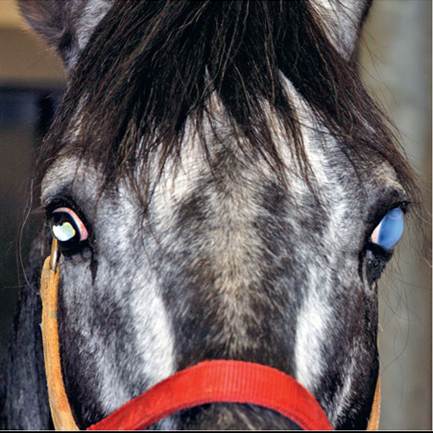
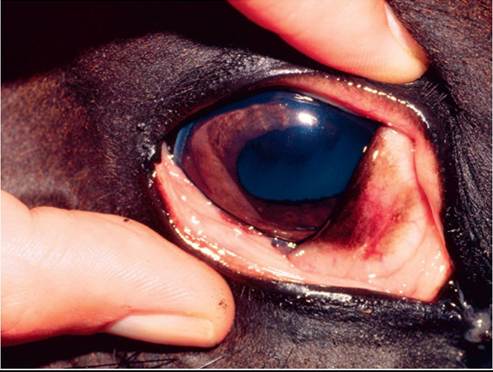
Color Plate 39.4 Third eyelid elevation is noted on retropulsion of the globe. The nictitating membrane can now be thoroughly examined.
Color Plate 39.1 Marked asymmetry present when standing in front of this equine patient. Left eye is buphthalmic, with elevated lashes and diffuse corneal edema secondary to glaucoma. Right eye is developing phthisis bulbi, evident by increased scleral show and decreased lash height secondary to reduced orbital tissue volume.
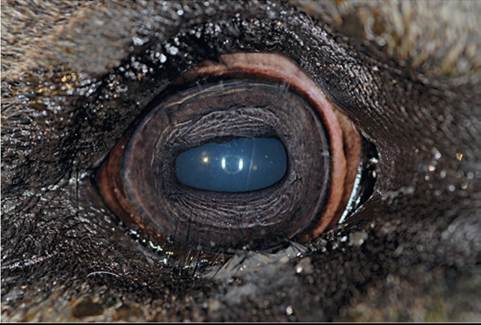
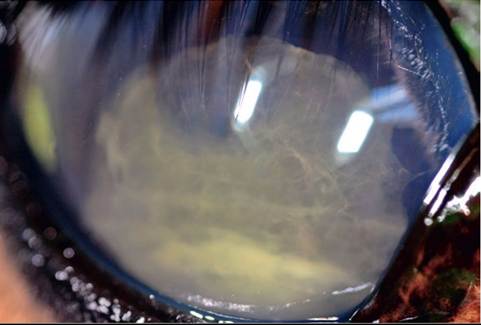
Color Plate 39.5 Fibrin in the anterior chamber of a patient with anterior uveitis. Opacity is blocking the fundic reflex. Opacities in the cornea or anterior chamber will also obscure visualization of the iris.
Color Plate 39.2 Dyscoric pupil secondary to posterior synechia and corneal scarring with a hypermature cataract in an equine patient with equine recurrent uveitis.
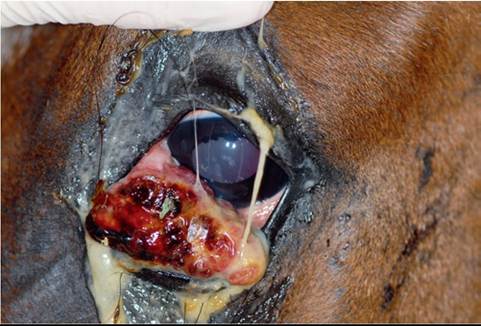
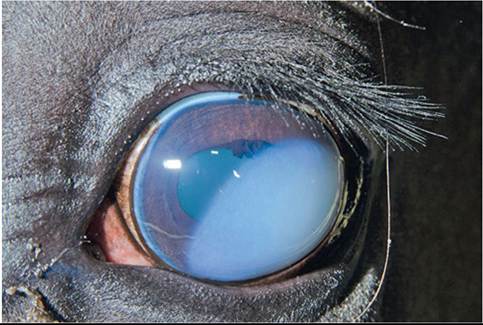
Color Plate 39.3 Entropion in a bovine patient; note the trichiasis present. Patient presented with blepharospasm and epiphora.
Color Plate 39.6 Diffuse corneal edema in an equine patient. Diffuse patterns of edema, which are fluorescein negative, indicate endothelial dysfunction.
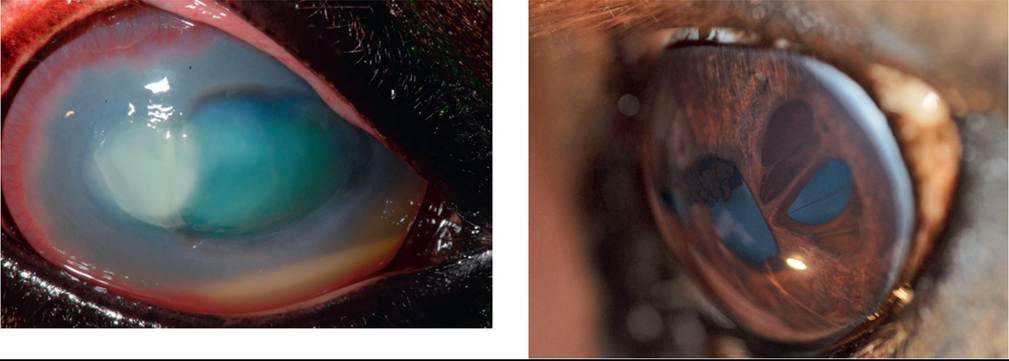
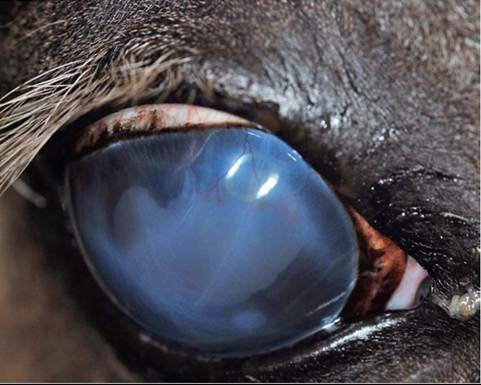
Color Plate 39.8 Haab’s striae in an equine patient with glaucoma.
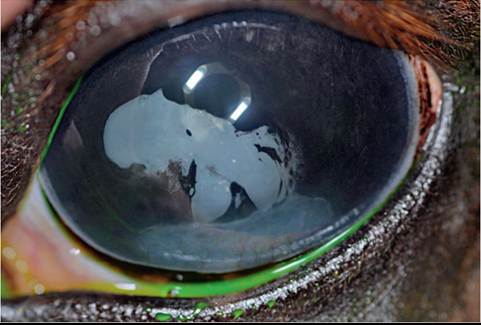
Color Plate 39.11 Phthisis bulbi secondary to chronic equine recurrent uveitis.
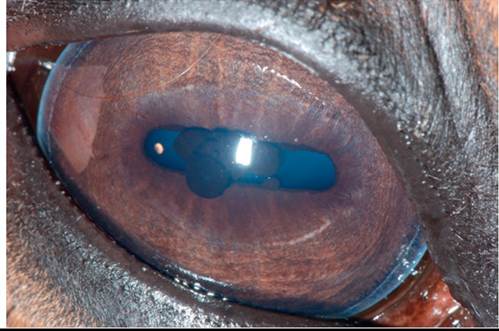
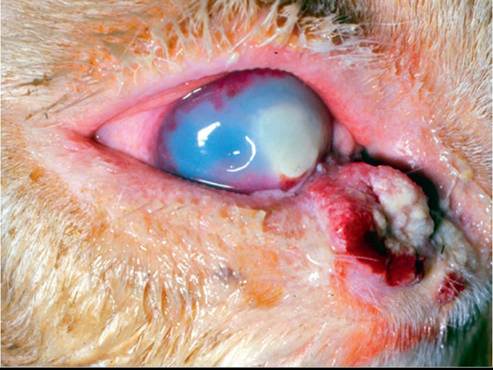
Color Plate 39.9 Corpora nigra cyst in an equine patient. Cysts can become large enough to obstruct vision in horses.
Color Plate 39.12 Bovine squamous cell carcinoma of lower eyelid and medial canthus with secondary corneal ulceration.
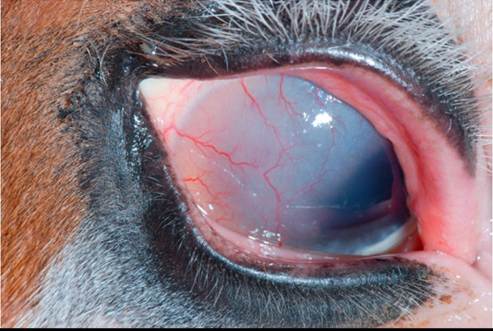
Color Plate 39.13 Corneal stromal invasive squamous cell carcinoma in the horse. Note the vascularized infiltrative mass with smooth epithelial surface.
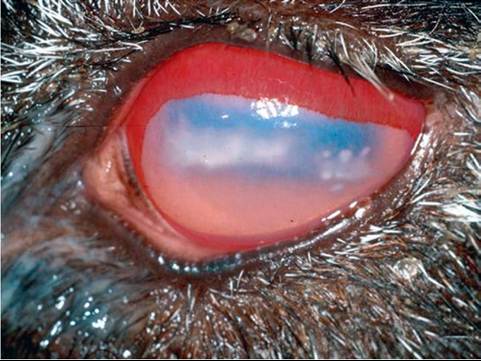
Color Plate 39.16 Mycoplasma keratoconjunctivitis in a goat. Note the 360-degree superficial corneal vessels, diffuse corneal edema, a linear accumulation of white cellular infiltrates of the axial cornea, and miosis.
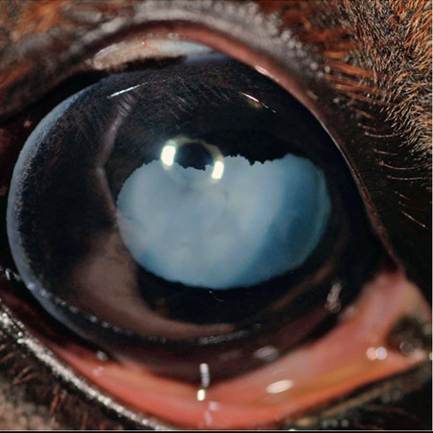
Color Plate 39.14 Congenital cataract in a Thoroughbred colt.
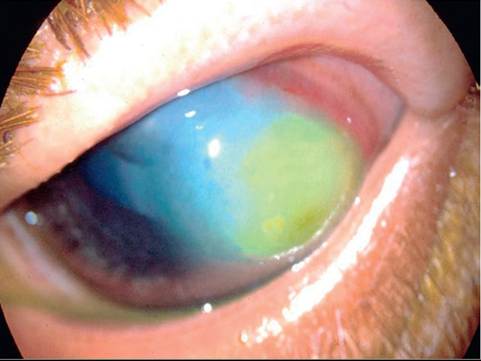
Color Plate 39.17 Mycoplasma keratoconjuntivitis in a sheep. Note the miosis, focal corneal edema, and superonasal corneal vessels extending to the margins of a superficial corneal ulcer that has been stained with fluorescein dye.
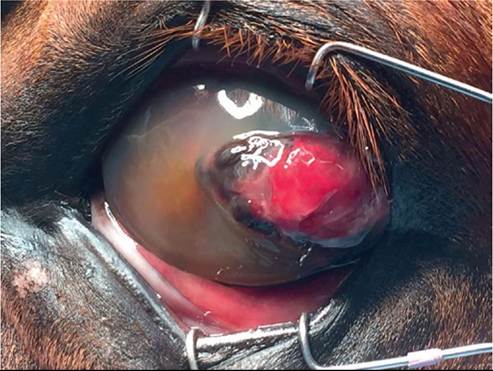
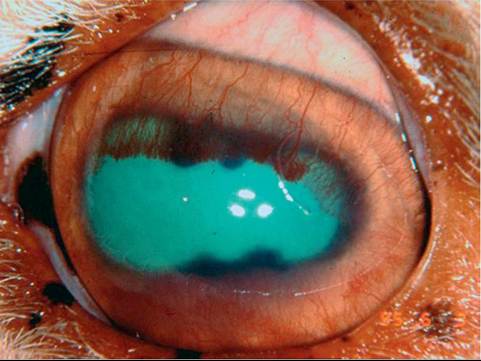
Color Plate 39.15 Severe corneal laceration in a horse. This laceration was large and fibrin, iris, and intraocular contents were expelled. Lacerations such as these require enucleation.
Color Plate 39.18 Chlamydia keratoconjunctivitis in a sheep. Note the mild diffuse corneal edema, miosis, and 360-degree superficial branching corneal vessels.
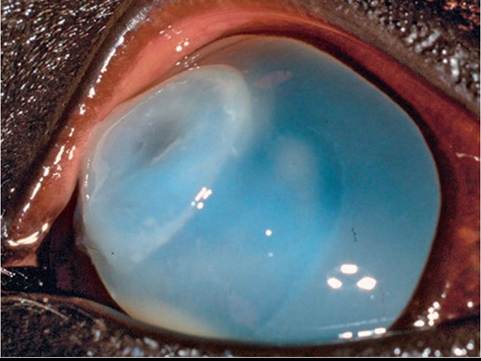
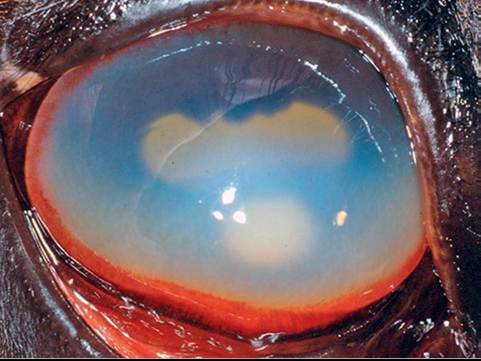
Color Plate 39.19 Melting corneal ulcer, Pseudomonas infection. Note the diffuse corneal edema, hypoyon, and a large superonasal ulcer with cellular infiltrate around the margins and malacic corneal tissue protruding from the surface.
Color Plate 39.22 Fungal corneal stromal abscess. Note the 360-degree deep stromal corneal vessels, diffuse corneal edema, yellow cellular infiltrate of the inferior cornea, a paracentral foci of white deep stromal cellular infiltrate, and miosis.
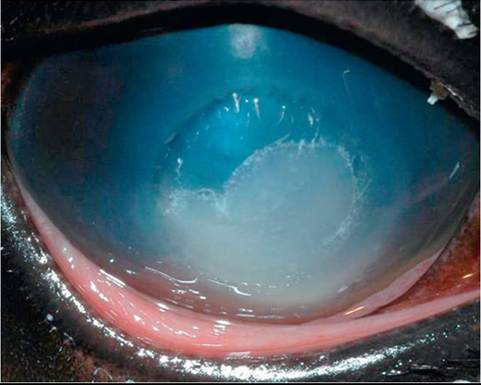
Color Plate 39.20 Fungal keratitis with a granular white cellular infiltrate and a surrounding groove or gutter. Note the corneal vascularization inferiorly.
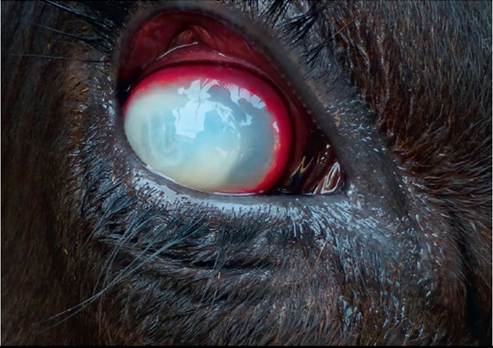
Color Plate 39.23 Infectious bovine keratoconjunctivitis. Deep corneal vascularization, cellular infiltration, ulceration, and diffuse corneal edema are noted.
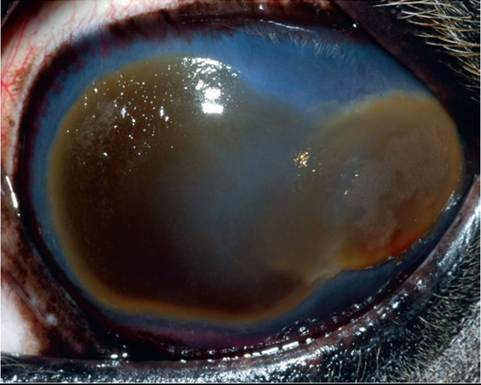
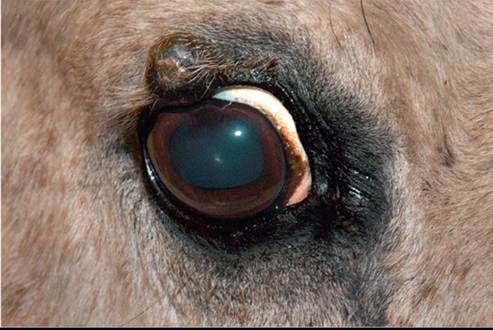
Color Plate 39.21 Fungal keratitis with a pigmented necrotic axial plaque surrounded by active dense corneal vascularization.
Color Plate 39.24 Pigmented mass of the superior eyelid in a horse that was diagnosed as having eyelid melanoma after excisional biopsy.