Coordinated Motility Enables the Lips, Tongue, Mouth, and Pharynx to Grasp Food and Propel It down the Gastrointestinal Tract
Before digestion can begin, food must be directed into the GI tract. To ingest food, quadruped animals must first grasp it with the lips, teeth, or tongue. This involves highly coordinated activity of small, voluntary skeletal muscles.
The muscles of the face, lips, and longue appear to be among the most delicately controlled voluntary muscles of most domestic animals. The exact method of food prehension varies greatly among different species. For example, horses use their lips extensively, whereas cattle often use their tongues for grasping food. In all domestic animals, however, prehension is a highly coordinated process involving direct control by the central nervous system (CNS). Problems of prehension may develop because of abnormalities in the teeth, jaws, muscles of the tongue and face, cranial nerves, or CNS. The facial nerve, the glossopharyngeal nerve, and the motor branch of the trigeminal nerve control the muscles of prehension.Masticationi or chewing, involves the actions of the jaws, tongue, and cheeks and is the first act of digestion. It serves not only to break food particles down to a size that will pass into the esophagus but also to moisten and lubricate food by thoroughly mixing it with saliva. Abnormalities of the teeth are a common cause of digestive disturbances in animals.
Deglutition, or swallowing, involves voluntary and involuntary stages and occurs after food has been well masticated. In the voluntary phase of swallowing, food is molded into a bolus by the tongue and then pushed back into the pharynx. WTien food enters the pharynx, sensory nerve endings detect its presence and initiate the involuntary portion of the swallow reflex.
The involuntary actions of the swallow reflex occur primarily within the pharynx and esophagus. The pharynx is the common opening of both the respiratory and the digestive tract.
The major physiological function of the pharynx is to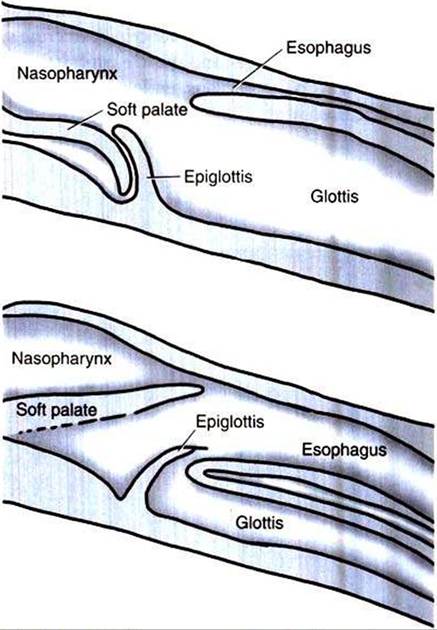
FIGURE 28-4 Midline cross-sectional schematics showing the position of the structures of the larynx and pharynx during breathing (top} and swallowing (bottom).
ensure that air, and only air, enters the respiratory tract and that food and water, and only food and water, enter the digestive tract. The involuntary portion of the swallow reflex is the action that directs food into the digestive system and away from the upper airway. This reflex involves the following series of highly coordinated actions (Figure 28-4). Breathing stops momentarily. The soft palate is elevated, closing the pharyngeal opening of the nasopharynx and preventing food from entering the internal openings of the nostrils. The tongue is pressed against the hard palate, closing off the oral opening of the pharynx. The hyoid bone and larynx arc pulled forward; this action pulls the glottis under the epiglottis, blocking the laryngeal opening. Concurrently, the arytenoid cartilages constrict, further closing the opening of the larynx and preventing the movement of food into the respiratory system. When all openings to the pharynx are closed, a wave of muscular constriction passes over the walls of the pharynx, pushing the bolus of food toward the opening of the esophagus. As the food reaches the esophagus, the upper esophageal sphincter relaxes to accept the material.
The complex reactions of deglutition are controlled by lower motor neurons located in various centers of the brainstem. Efferent nerve fibers from these centers travel in the facial, vagus, hypoglossal, and glossopharyngeal nerves, as well as the motor branch of the trigeminal nerve. Clinically, problems with prehension, mastication, and deglutition frequently are related to neurological lesions, either peripherally in the cranial nerves or centrally in the brainstem.